
(Originally published in C& América Latina on 7 May 2025)
.
While sugar was once called ‘white gold’ in the colonial Caribbean, its sweetness masked the violence that produced it; slavery and forced labour. Centuries later, artist Andrea Chung repurposes the valued raw material, moulding sugar into ephemeral sculptures that grieve, honour, and confront history.
Andrea Chung was born in Newark, New Jersey, to Caribbean parents – her mother is from Trinidad and her father from Jamaica. Chung’s family heritage traces back to Mao Zedong’s China. The artist’s grandfather, on her father’s side, left the communist regime towards the U.S but ended up in Jamaica.
Through the relating of family stories and foregrounding the endurance of Black bodies, Chung forms what Audre Lorde coined biomythography, a resource known to shape theories of intersectionality using multimedia and interdisciplinary formats, to discuss and challenge the many guises of colonialism, slavery, and the historic movement of peoples and goods masqueraded nowadays as capitalism.
In ‘Im Hole ‘Im Cahner, 2008, the artist cuts out with clinical precision an archival image of post-slavery plantation workers in the British West Indies, to symbolically give them a day off. Following a similar strategy, in Caribbean Travel + Tourism, 2014–2017, Chung uses contemporary advertisements of Caribbean resorts and removes the figures of, presumably, Black people servicing whites. She releases them from providing rest and entertainment. Chung pulls apart the move from one service economy to another, where foreigners are the ones holding the upper hand while the Caribbeans are drawn into the dynamics of capital. By forcefully subtracting the Black bodies in the images, she also confronts the absence of Black stories in historic narratives and accentuates the changing exploitation of their bodies across history. The artist explains in a call interview that her work is ‘as if I am collapsing time; the storytelling may be of something from the past, but it very much relates to whatever is happening right now.’
Sugar is a recurring material in Chung’s installations. Not only does it represent the main product obtained through the hard work of slaves in plantations, but it also connects with a health disorder running through her family, diabetes. Her grandmother died, having her second leg amputated due to gangrene triggered by diabetes. The artist cast her leg in sugar to give it as an offering to her.
This project ignited the artist’s love for the ephemeral nature of the material. Sugar morphs depending on the exhibition or storing climate conditions, changing the work itself and adding layers of meaning to the work. This prevents the works from being commodified, and therefore, it prevents stories of Black trauma from being commodified.
In this vein, Chung developed Sink & Swim, 2013, during her Fulbright Scholarship to Mauritius, where she lived for a year. This island, located in the Indian Ocean, shares a similar history of slavery, indentured servitude, and plantation economies. The artist cast liquor bottles out of sugar to reflect on the fishing traditions using bottles, developed by former slaves who became fishermen upon the abolition of slavery in Mauritius. The eventual melting of the bottles in the gallery space bridges the dematerialisation of the artwork and the disappearing trade due to over-fishing.
Over time and unintentionally, the deep blue colour of cyanotypes started permeating Chung’s practice. The artist became interested in exploring their expressive possibilities at a time when she was interested in stories bound to the ocean. She is particularly interested in stories about the movement of predator species that invade and destroy ecosystems. She explored the case Lionfish in her work Anthropocene, 2014. Native to the Indian Ocean and western and central Pacific Ocean, the Lionfish was first detected in Florida waters in the mid-80s and since then, its population has grown drastically to the point where the authorities of Caribbean islands are encouraging people to add Lionfish to their diet to manage the invasion and restore the autochthonous ecosystems.
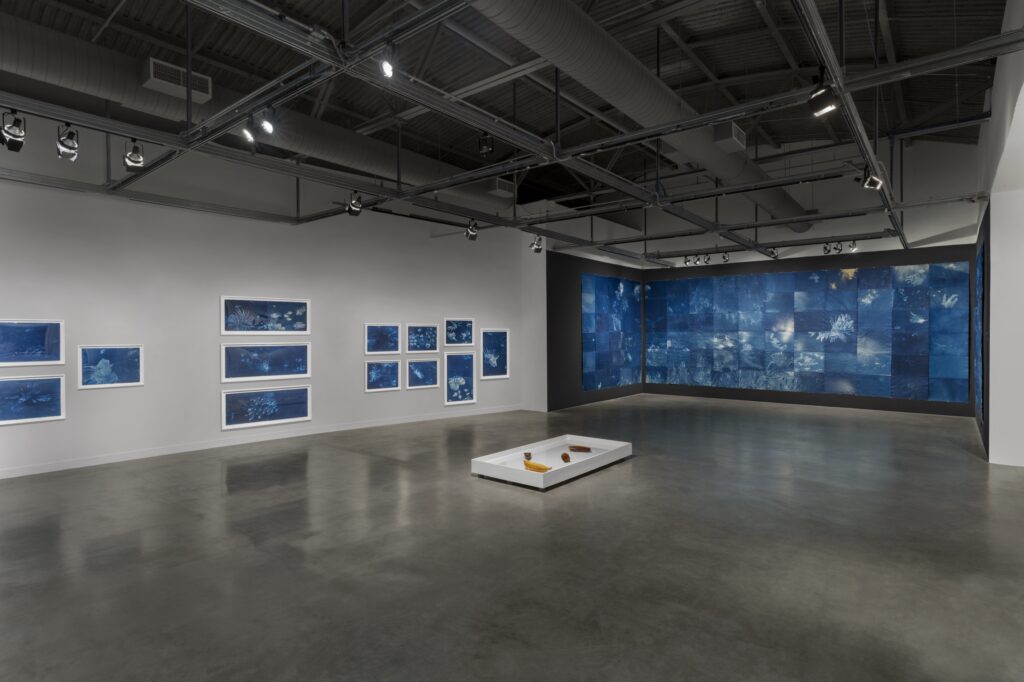
Golden hues also repeat throughout Chung’s works. In her series Crowning, the artist uses gold ink to elevate the women in the archival images of her collages. Equally, the cast sugar of her installations resembles pieces made of gold, paying homage to what is represented while, paradoxically, letting it go.
Chung’s process is slow and somewhat tedious. An unchosen process that allows her to meditate on labour. She is not interested in smooth, sexy pieces; instead, she prefers to leave her imprint visible, allowing for the weight of labour to be evident in the works. “I do want to honour the labour of those who laboured before me,” she reflects, “I do want to do things taking care and time.”
Her latest project, Petty Library, 2024, was born in response to the unempathetic behaviour of the school principal at her child’s school regarding how they handle racism. Completely changing the format and veering towards a socially engaged and participatory art practice, the artist asked people online to donate books by authors of colour on any subject. Some of the titles included were A History of Me by Adrea Theodore and A Kid’s Book About Neurodiversity by Dr Laura Petix. Chung then stamped each of them with the phrase ‘Donated on behalf of ‘son’s name’ and, subsequently, were donated to the school’s library, for all children of colour or children with diverse abilities to have access to reference materials.
In the U.S. current political climate, Chung considers it more important than ever to continue this line of work. One where the artwork and its hyperbolised significance, as we knew it, disappear. To the artist, the Petty Library felt like social justice work because it led on something that engaged people and had an actual impact. ‘I would just like to be able to help people in a very real way,” she says. “And I think that the library gave me the opportunity to do that.”