
(Originally published in C& América Latina on 17 June 2019)
Raquel Villar-Pérez: You have a long career as a practising artist, when did you decide to formalise your career as an artist?
Paola Torres Núñez del Prado: I think for me the struggle wasn’t knowing what I wanted to be, but rather acknowledging what I was and coming to terms with it. I was six when I first sketched myself as a painter. As a child, drawing was the way of manifesting my thoughts; as a teen, art competitions were a way to prove myself. I think the break came when I moved to New York in 2003 to study my undergraduate degree. What this new school and this new city offered me contrasted a lot with my experience growing up in Lima; the art one had access to there was highly ambitious.
I think formalising my career happened after I graduated. The extreme consumerist market ‘tainting’ everything in New York was overwhelming, so I returned to Perú and got a job editing video. Eventually, I left it and relocated to the south of the country. I spent some years going through a personal conflict that involved a deep depression. It finally ended in the acceptance that, if I was going to invest myself in whatever it was I wanted to say, then I’d better find what was worth talking about beyond my individual experience. In that sense, I see art as inherently political.
RVP: What made you decide to become a visual artist?
PT: As I said before, in my case it wasn’t a question of becoming, but of accepting what I was: being an ‘artist’ felt both spoiled and grandiose, like some sort of (ego) trip that could end going up to reach illuminated clairvoyance, or down to the blurriest and incomprehensible pits of the self.
Since an early age, I experienced being-an-artist more as an imposition than as a choice; this made it claustrophobic at times. Even so, making art has mainly been a healer for me. I also knew that, if I was going to seriously embark on this type of creative path, the privilege of making art that sprouts from the needs of the self itself, would come with a big responsibility. I think the awareness of this responsibility has shaped my art practice and allowed me to mentally place myself more in the role of a ‘medium.’
Courtesy Paola Torres Núñez Del Prado.
RVP: Your artwork blends art and technology, can you tell us more about from where stems your interest in matching them both?
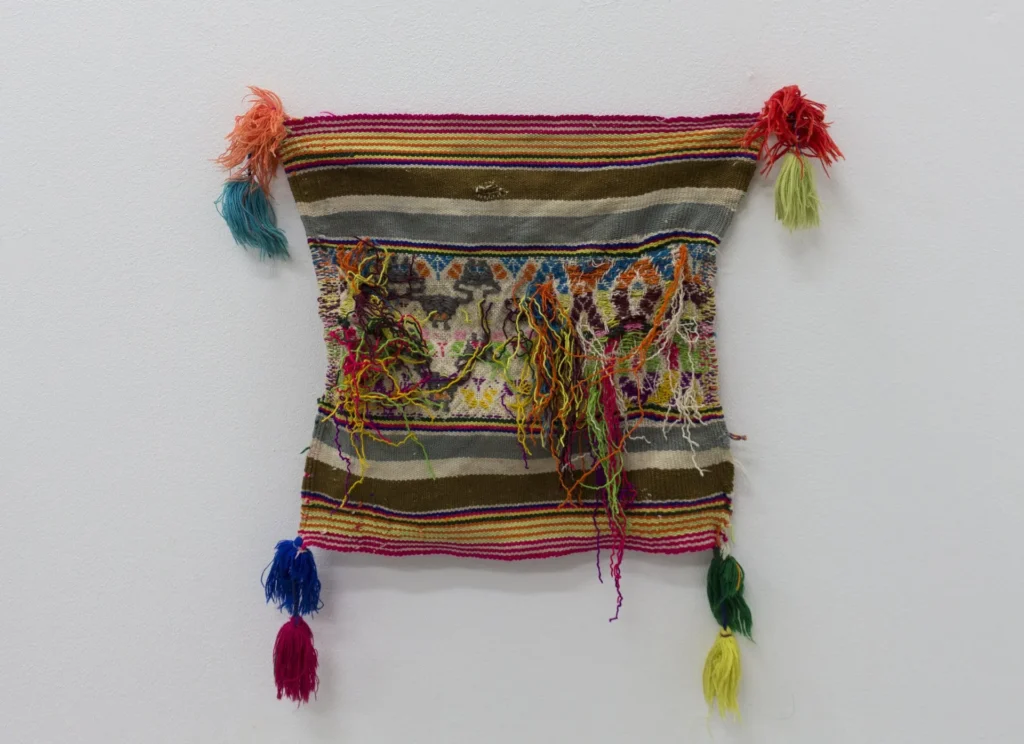
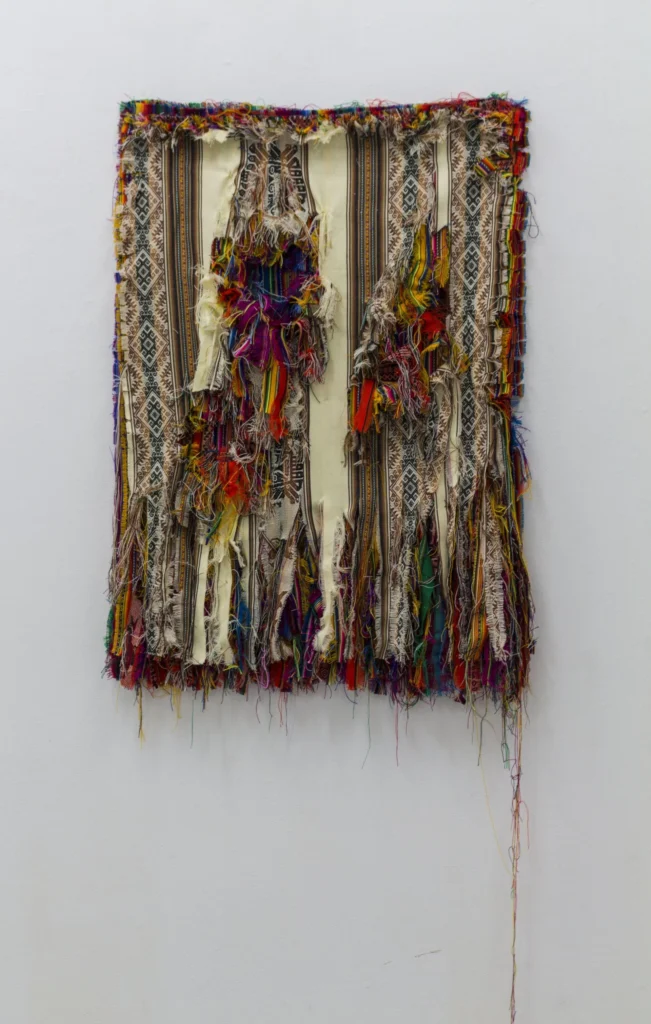
PT: Most of my pieces tend to have analog and digital components, and by analog, I also refer to the traditional idea of ‘craft.’ I think this inclination to use both was born, in one hand, out of the realisation that, at an elemental level, technology allowed me making artworks that reacted to people and changed for them, given that people also interact with them; in the other hand, the knowing that I could use this dual quality, the material/craft/analog vs the virtual/automatised/digital, as a way to criticise the implicit hermeneutic presence when experiencing art nowadays, that is artworks meant to be interpreted/decoded; the ineludible heritage of Conceptual Art.
RVP: You have lived and studied for many years away from your natal Peru, first in New York and currently in Stockholm. You could be considered one of the so-called ‘diasporic artists.’ Can you expand on what your views and positionality are in regards to debates of migration and diaspora particularly as addressed within the art world?
PT: To be honest, I never saw myself as ‘diasporic’, it has been my choice to live a nomadic life. The fact that, I might be tagged as ‘migrant artist’ in Sweden, where I live now, makes me feel as if I should be acting and thinking in a certain way in accordance to my condition (of being a migrant) and that all my wonderings and concerns will be understood only within that framework.
This was never an issue in New York, since the city is more ethnically varied. But I must admit that I have felt some pressure regarding the interpretation of my work in Sweden: as soon as it includes references to traditional styles and crafts from Peru, it awakens some interest in the Swedish art scene, hopefully not because of exotisation or the imperative of covering ‘a certain diversity quota,’ but due to be offering something different, although being honest, I feel it is seen as a manifestation of a longing that obviously had to refer to my current status living somewhere else than ‘where I belong.’
RVP: How is this reflected in your work if reflected at all?
PT: Dealing with the subject of migration in this new context can be felt as an imposition; so, I guess that when it started being reflected in my work, it had a touch of cynicism. When I moved to Sweden, my subjective perspective made me see as if foreign artists felt the need to fit into the role of ‘Migrant Artist That Discusses Migrant Issues’ that the Swedish art scene/market seemed to be craving from non-Swedish artists.
The thing is that, on one hand, these forces that push you under the umbrella term of ‘diasporic’ or ‘migrant’ can be rejected just as intensely as any other imposed classification, but on the other hand, it is hard to deny the relevance and urgent need for discussing the matter. So, even if recently, issues regarding migration have started permeating some of my pieces, I’m aware that this can lead to one’s identity being reduced to that (and only that) of a migrant and, as such, it can actually silence other important elements and reshape the meaning of my work.
RVP: What are you working on at the moment and where can we see your work in the near future?
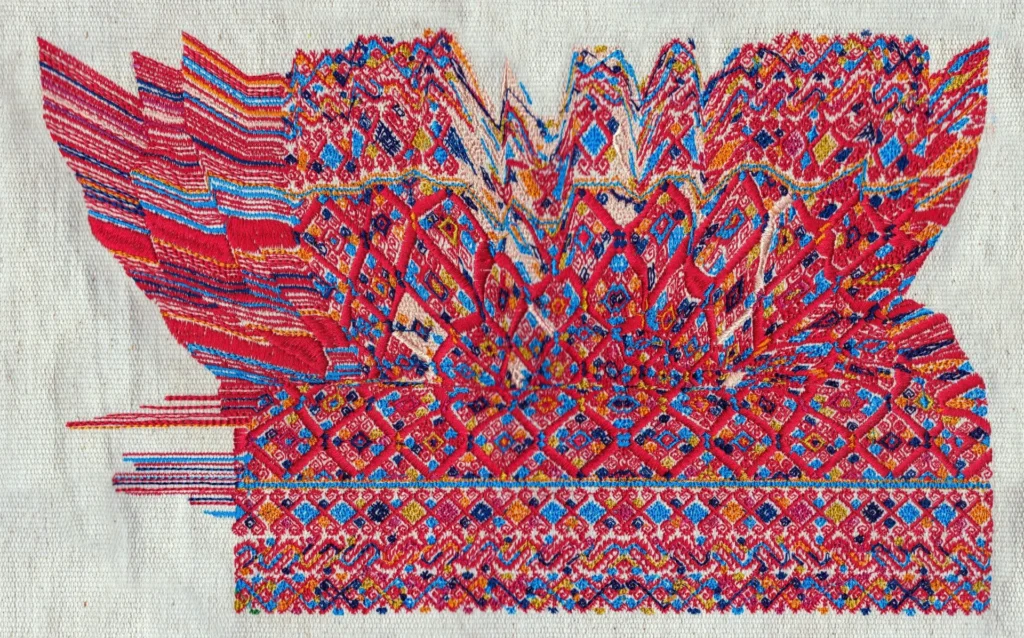
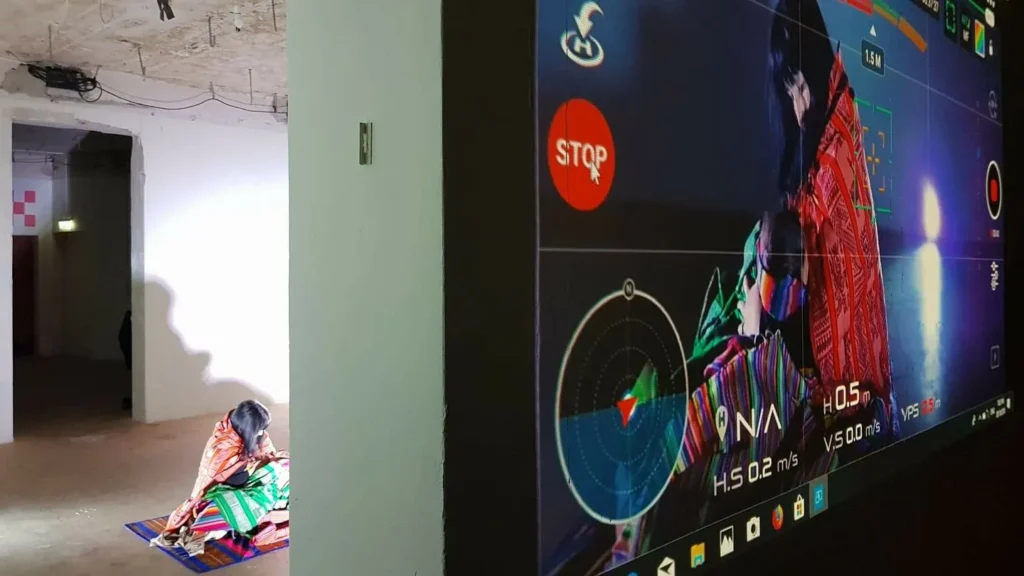
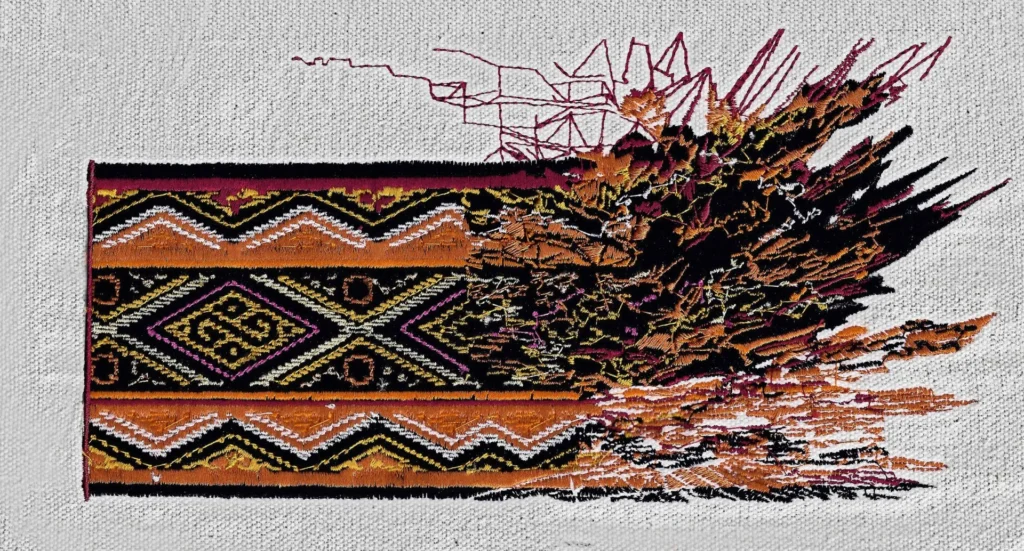
PT: At the moment, I am in Lima with my family. I am exhibiting my work in a place called Socorro Polivalente, a non-profit artists space that allows me to, literally, do as I wish. I have matured three of my main series: Corrupted Structures apparently ‘glitched’ electronic embroideries that embed visualisations of sounds, Textile Controllers, smart textiles that serve as interfases to control sound files, and the Wipes series. I have also started a new series that deals with 3D renderings of Huacas, earth temples scattered all over the coast of Peru. At the end of April, I will perform at the Lima Museum of Contemporary Art Tender Room, a performance presented in Stockholm in 2018. It addresses issues of surveillance, telepresence, migration, and motherhood; I find very interesting how the reception of artworks changes depending on in which countries and contexts are presented.
For more information on Paola’s work, please visit www.autodios.com