While sugar was once called ‘white gold’ in the colonial Caribbean, its sweetness masked the violence that produced it; slavery and forced labour. Centuries later, artist Andrea Chung repurposes the valued raw material, moulding sugar into ephemeral sculptures that grieve, honour, and confront history.
Andrea Chung was born in Newark, New Jersey, to Caribbean parents – her mother is from Trinidad and her father from Jamaica. Chung’s family heritage traces back to Mao Zedong’s China. The artist’s grandfather, on her father’s side, left the communist regime towards the U.S but ended up in Jamaica.
Through the relating of family stories and foregrounding the endurance of Black bodies, Chung forms what Audre Lorde coined biomythography, a resource known to shape theories of intersectionality using multimedia and interdisciplinary formats, to discuss and challenge the many guises of colonialism, slavery, and the historic movement of peoples and goods masqueraded nowadays as capitalism.
In ‘Im Hole ‘Im Cahner, 2008, the artist cuts out with clinical precision an archival image of post-slavery plantation workers in the British West Indies, to symbolically give them a day off. Following a similar strategy, in Caribbean Travel + Tourism, 2014–2017, Chung uses contemporary advertisements of Caribbean resorts and removes the figures of, presumably, Black people servicing whites. She releases them from providing rest and entertainment. Chung pulls apart the move from one service economy to another, where foreigners are the ones holding the upper hand while the Caribbeans are drawn into the dynamics of capital. By forcefully subtracting the Black bodies in the images, she also confronts the absence of Black stories in historic narratives and accentuates the changing exploitation of their bodies across history. The artist explains in a call interview that her work is ‘as if I am collapsing time; the storytelling may be of something from the past, but it very much relates to whatever is happening right now.’
Sugar is a recurring material in Chung’s installations. Not only does it represent the main product obtained through the hard work of slaves in plantations, but it also connects with a health disorder running through her family, diabetes. Her grandmother died, having her second leg amputated due to gangrene triggered by diabetes. The artist cast her leg in sugar to give it as an offering to her.
This project ignited the artist’s love for the ephemeral nature of the material. Sugar morphs depending on the exhibition or storing climate conditions, changing the work itself and adding layers of meaning to the work. This prevents the works from being commodified, and therefore, it prevents stories of Black trauma from being commodified.
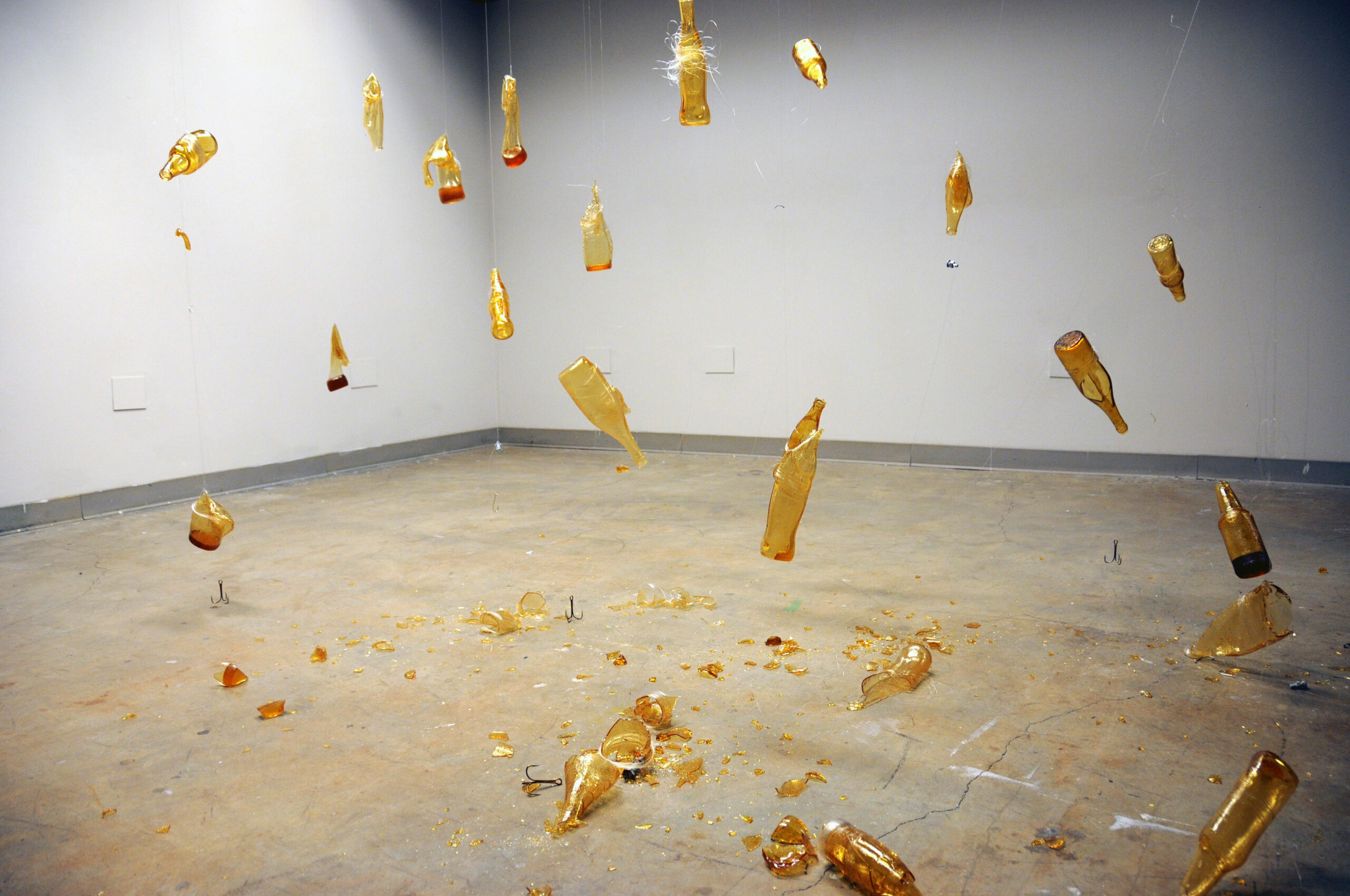
In this vein, Chung developed Sink & Swim, 2013, during her Fulbright Scholarship to Mauritius, where she lived for a year. This island, located in the Indian Ocean, shares a similar history of slavery, indentured servitude, and plantation economies. The artist cast liquor bottles out of sugar to reflect on the fishing traditions using bottles, developed by former slaves who became fishermen upon the abolition of slavery in Mauritius. The eventual melting of the bottles in the gallery space bridges the dematerialisation of the artwork and the disappearing trade due to over-fishing.
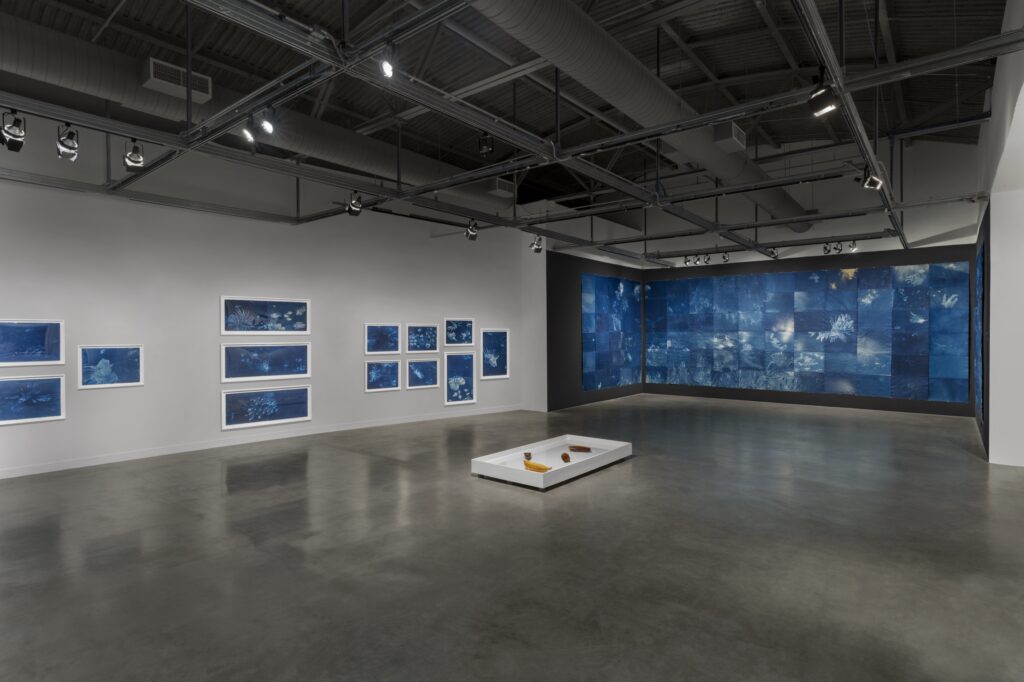
Over time and unintentionally, the deep blue colour of cyanotypes started permeating Chung’s practice. The artist became interested in exploring their expressive possibilities at a time when she was interested in stories bound to the ocean. She is particularly interested in stories about the movement of predator species that invade and destroy ecosystems. She explored the case Lionfish in her work Anthropocene, 2014. Native to the Indian Ocean and western and central Pacific Ocean, the Lionfish was first detected in Florida waters in the mid-80s and since then, its population has grown drastically to the point where the authorities of Caribbean islands are encouraging people to add Lionfish to their diet to manage the invasion and restore the autochthonous ecosystems.
Golden hues also repeat throughout Chung’s works. In her series Crowning, the artist uses gold ink to elevate the women in the archival images of her collages. Equally, the cast sugar of her installations resembles pieces made of gold, paying homage to what is represented while, paradoxically, letting it go.
Chung’s process is slow and somewhat tedious. An unchosen process that allows her to meditate on labour. She is not interested in smooth, sexy pieces; instead, she prefers to leave her imprint visible, allowing for the weight of labour to be evident in the works. “I do want to honour the labour of those who laboured before me,” she reflects, “I do want to do things taking care and time.”
Her latest project, Petty Library, 2024, was born in response to the unempathetic behaviour of the school principal at her child’s school regarding how they handle racism. Completely changing the format and veering towards a socially engaged and participatory art practice, the artist asked people online to donate books by authors of colour on any subject. Some of the titles included were A History of Me by Adrea Theodore and A Kid’s Book About Neurodiversity by Dr Laura Petix. Chung then stamped each of them with the phrase ‘Donated on behalf of ‘son’s name’ and, subsequently, were donated to the school’s library, for all children of colour or children with diverse abilities to have access to reference materials.
In the U.S. current political climate, Chung considers it more important than ever to continue this line of work. One where the artwork and its hyperbolised significance, as we knew it, disappear. To the artist, the Petty Library felt like social justice work because it led on something that engaged people and had an actual impact. ‘I would just like to be able to help people in a very real way,” she says. “And I think that the library gave me the opportunity to do that.”
Home is where we know and where we are known, where we love and are beloved. Home is mastery, voice, relationship, and sanctuary: part freedom, part flourishing… part refuge, part prospect.
– Shoshana Zuboff, The Age of Surveillance Capitalism, 2019
Home is not only the place we inhabit. Home incorporates emotional dimensions, a place where we exist in unity with our surroundings. Yet there are numerous places in which we reside that do not feel like home, such as hospitals, hospices, orphanages, prisons, and immigration detention centres. Although almost no one makes the decision to dwell there, these places remain occupied. Inspired by the history of Landskrona Citadel, Greta Alfaro’s Music of the Spheres reflects on the nature of these spaces in relation to the society we live in.
This new site-specific commission occupies the spherical eastern tower of Landskrona Citadel, in which inhabitants were kept continuously under watch. The fortress became a major penitentiary for inmates serving life sentences. In 1902, it became a forced labour facility for vagrant women, including prostitutes and less able-bodied individuals who did not fit the norms of the time. In the 1940s, the establishment stopped functioning as a prison in order to receive refugees coming from Nazi extermination camps.
The inscriptions on the walls of the cells bear witness to those who inhabited them. Why were there spaces where people who had not committed a crime were confined? Why are historical buildings preserved as museums to remind societies of the brutalities performed by past governments, while new ones are being built for that same purpose, with the only difference being the prosecuted social groups?
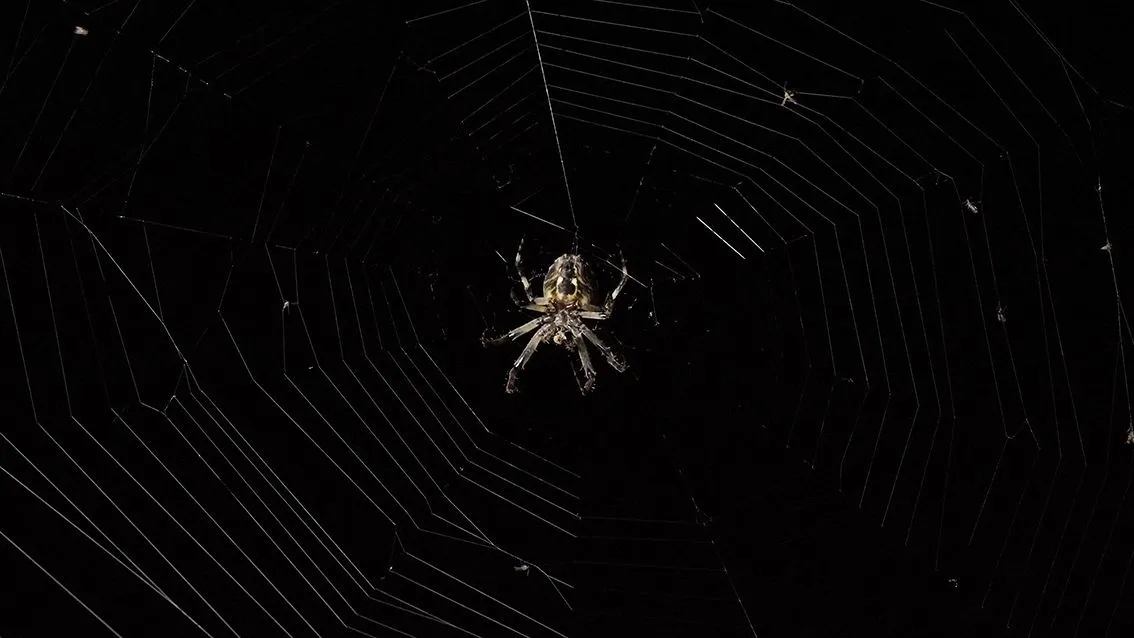
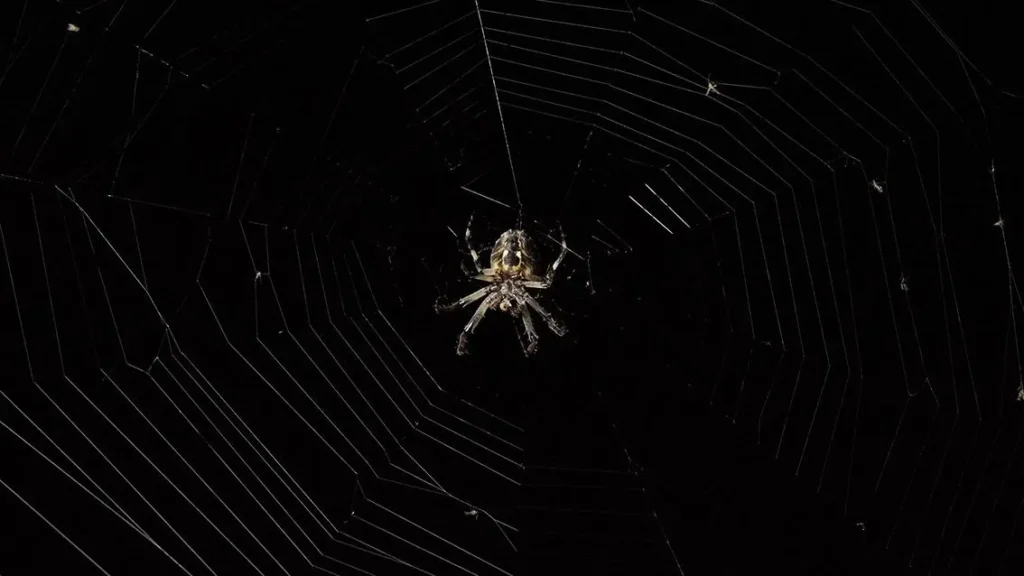
Music of the Spheres reflects on one of the biggest topics our times: the violence of covert surveillance. Peepholes allow the audience to look into the cells as if they were guards checking on the prisoners. Inside some of the cells, a ghostly image of an orb-weaver spider and its distinctive spiral wheel-shaped web occupies the darkened space. The giant arachnids appear suspended in the centre of the units, oblivious to the spectacle they have become.
Despite being harmless, these hard-working creatures are the origin of one of the most common phobias amongst humans, causing disgust and fear. Spider webs are at once home to the custodian spiders and a trap to the distracted and unwelcome Other. In contrast, many cultures associate spiders with good luck, creativity, feminine energy, and some even with the portrayal of the mother figure due to their web-knitting skills used to weave the world into existence.
The correlation between spiders and the women and refugees who inhabited the cells of Landskrona Citadel is not fortuitous. Alfaro invites us to reconsider the ambivalence of archetypes, how these change through history, and what is our role in criminalising targeted communities.
Multilayered and complex, Alfaro’s Music of the Spheres invites us to consider the paradoxical relationships of order versus chaos, safety versus entrapment, powerful versus disempowered, us versus them. The fluctuation of our roles within the social structure, the convergence of the physical and digital worlds, and the establishment of covert surveillance, challenge our sense of the world, jeopardising the yearned-for notion of home and the privacy, intimacy and safety associated with it.
The title in Alcázar-Duarte’s exhibition played with the antithetical fact that new understandings of clouds lose their primary purpose.
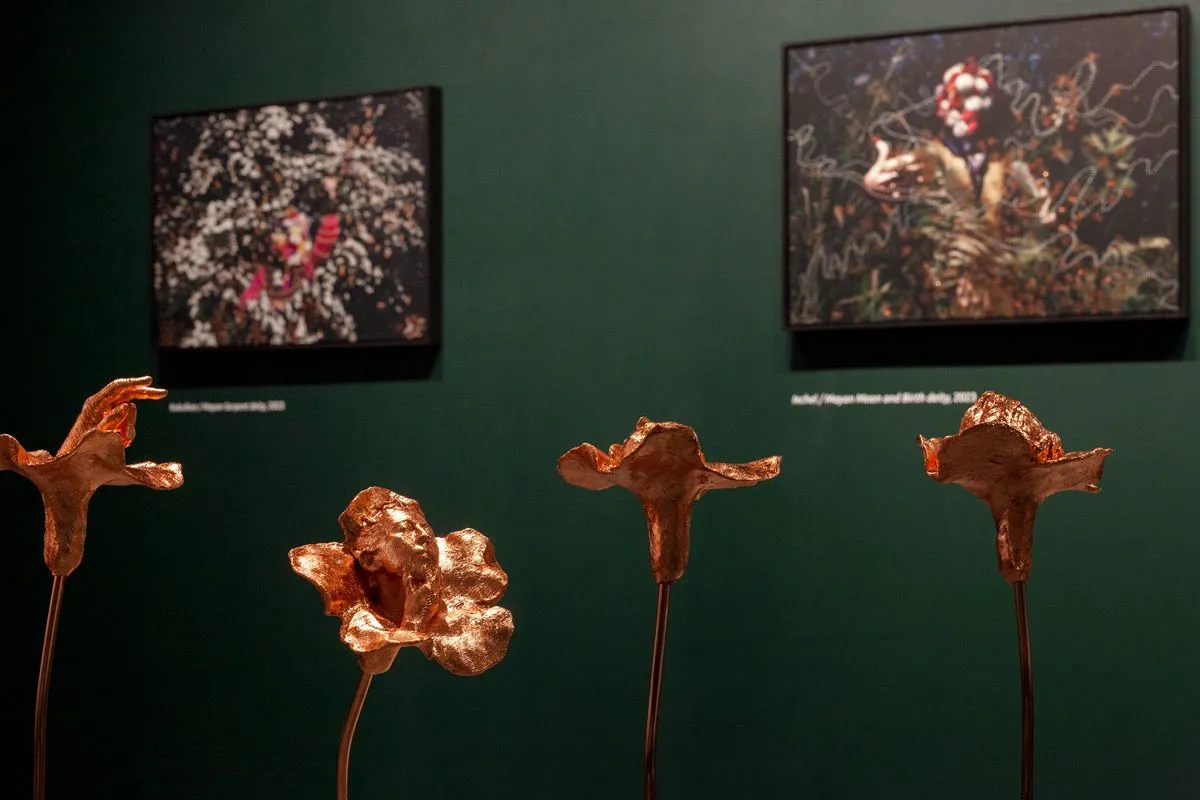
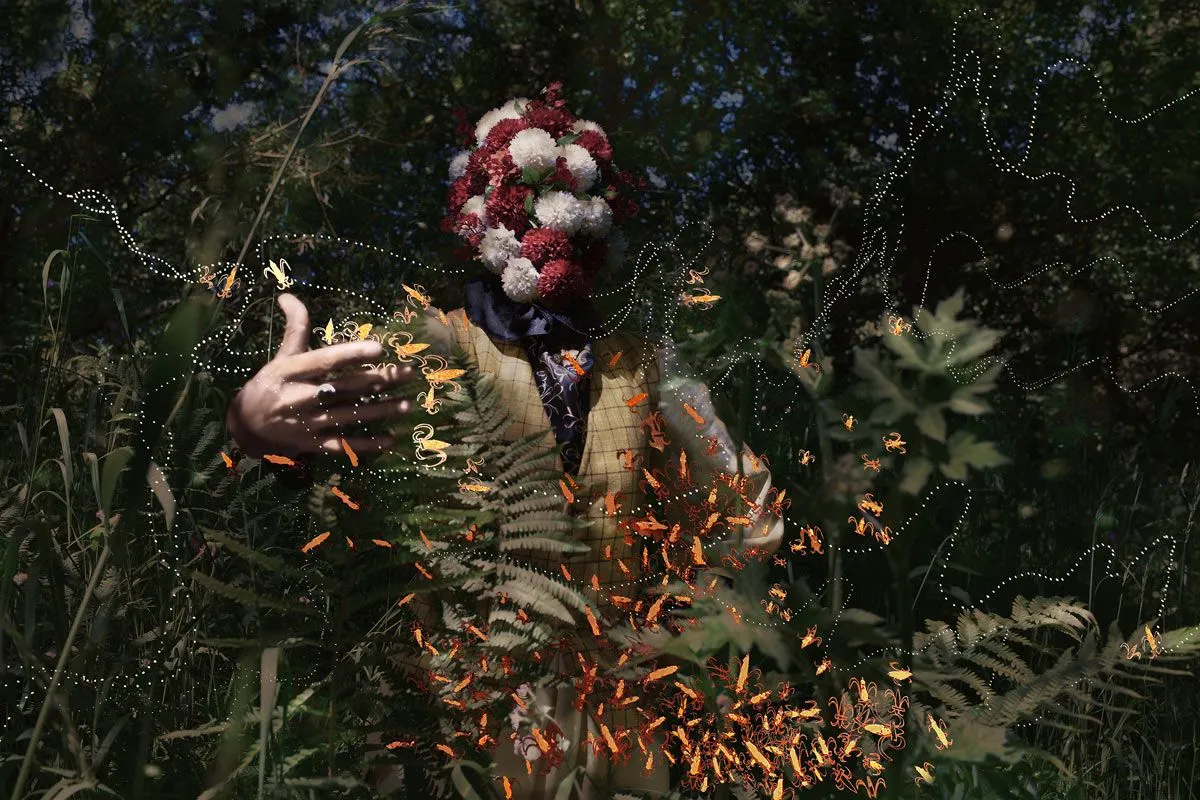
Mónica Alcázar-Duarte, Ixchel – Mayan Moon and Birth deity, 2021. From the series Digital Clouds Don’t Carry Rain. Courtesy Mónica Alcázar-Duarte and Autograph ABP.
I visited Mónica Alcázar-Duarte’s first solo exhibition in the UK, Digital Clouds Don’t Carry Rain at Autograph in London about a month ago. The title left me pondering on the idea of clouds. A quick google search brings up results related to the modern use of the word: cloud computing, the cloud, a global network of servers that amasses vast amounts of data supported by software and digital architectures only accessible through the Internet. Pero a mi entender, las nubes también son un fenómeno meteorológico y metafórico. Cargadas siempre de agua y de naturaleza impermanente, estos algodones de azúcar en escala de grises adornan el cielo. A lo largo de la historia y a través de culturas, las nubes han simbolizado la residencia de deidades, elevación espiritual, transformación y vida. (1)
The title in Alcázar-Duarte’s exhibition played with the antithetical fact that new understandings of clouds lose the primary purpose of these. Witty, intelligent, multi-layered and complex,Digital Clouds Don’t Carry Raincontinued Alcázar-Duarte’s long-standing exploration of prevailing systems of knowledge and how these are being transmitted, the human obsession with progress, and the impact it all has in the environment.
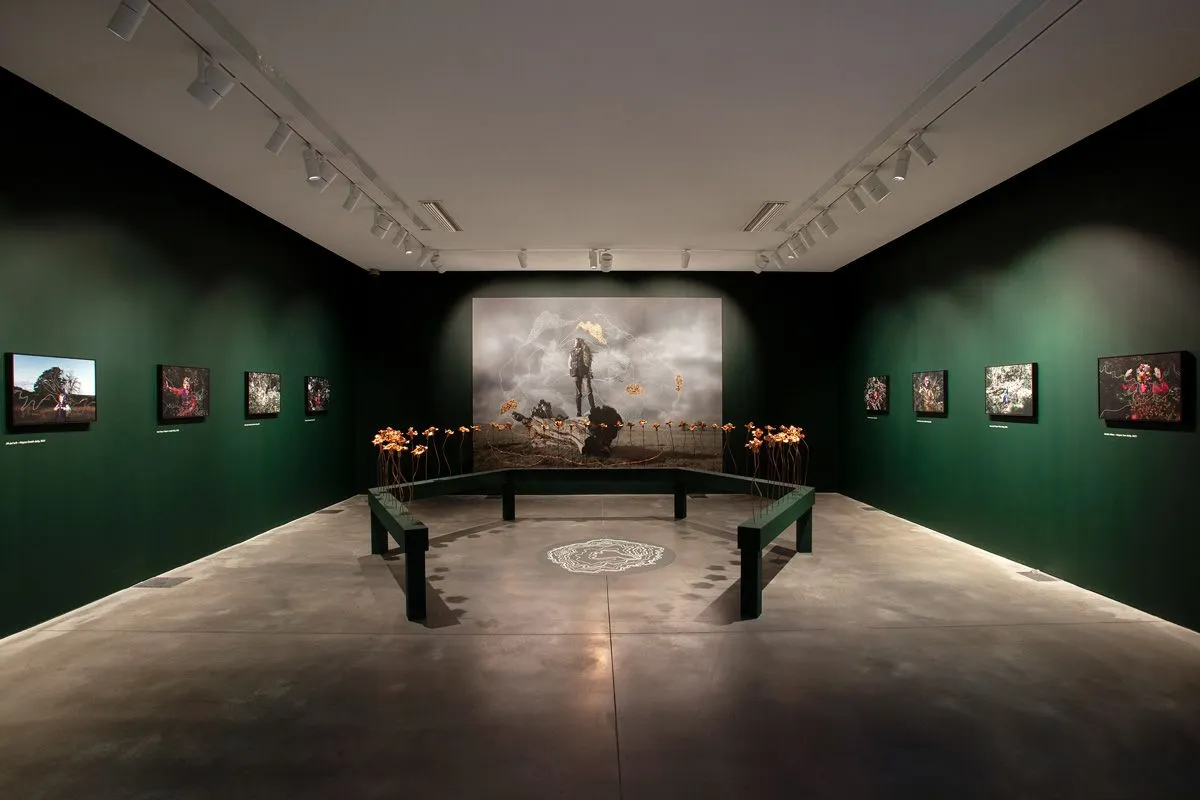
The exhibition juxtaposed three very distinct elements: a film, eleven self-portraits, and an installation around which everything else orbited.
Mónica Alcázar-Duarte: Digital Clouds Don’t Carry Rain exhibition at Autograph. Curated by Bindi Vora. Photograph by Kate Elliott. Mónica Alcázar-Duarte, The coming storm! I, 2021. From the series Digital Clouds Don’t Carry Rain. Courtesy Mónica Alcázar-Duarte and Autograph ABP.Mónica Alcázar-Duarte: Digital Clouds Don’t Carry Rain exhibition at Autograph. Curated by Bindi Vora. Photograph by Kate Elliott. Mónica Alcázar-Duarte, The coming storm! I, 2021. From the series Digital Clouds Don’t Carry Rain. Courtesy Mónica Alcázar-Duarte and Autograph ABP.
‘U K’ux Kaj / Heart of sky, Mayan god of storms’ begins ‘Para entender el mapa del universo, hay que empezar por el principio, y para empezar por el principio, uno necesita fuego’ (2). Tu men tu laakal káaj yéetel k’aak’. Yéetel jump´éel k’aak’ jach óolak u k’askunt tu laakal (3). The film was narrated in Spanish and Mayan, a language native to the Yucatan Peninsula in Southern Mexico, Guatemala and Belize. It centred around the stingless bees Xunan-Kaab, cultivated by the Maya civilization more than 3,000 years ago. Also known as Regal Lady, these bees are imperilled due to the ever-expanding deforestation of the area. The short feature foregrounded their collective intelligence and knowledge system of communication and organisation, prompting us to explore what we could learn from these other-than-human beings. Bey uchak ik súut tik óol ka’ tik íilaj u jach k’a’abetil le kaabo’obo’. Tu men le kaabo’obo’ leeti’o’ob áato’on tik laaklo’on (4).
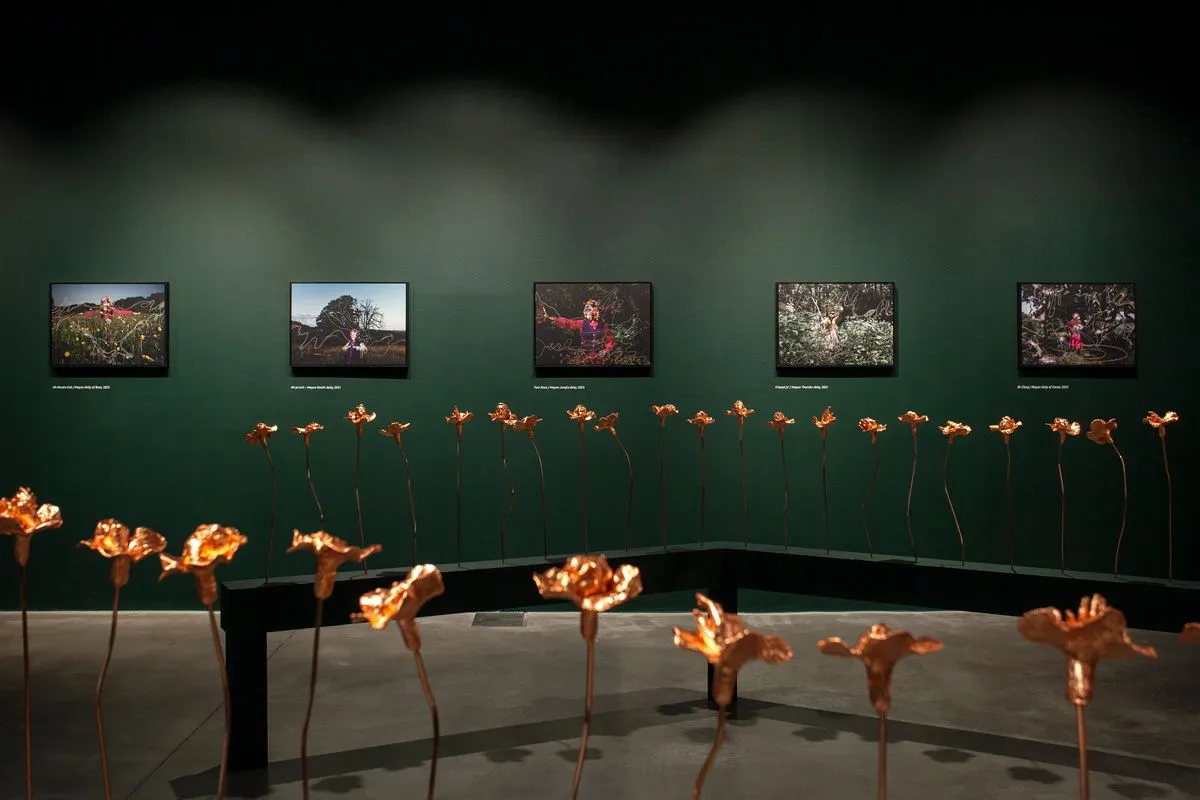
References to fire and bee communities were present again in the installation ‘T’aabal chukChuuk / Embers’. Un jardín de flores de metal anaranjado se erigía silenciosamente en el centro de la galería. 56 fleur-de-lis estaban colocadas cuidadosamente encima de una estructura hexagonal que asemejaba un panal de abejas (5). Fleur-de-lis are associated with royalty and virtue and was incorporated to the coat of arms of the Spanish king Felipe V, 1700-1759.
Mónica Alcázar-Duarte, Itzamná – Mayan Time deity, 2021. From the series Digital Clouds Don’t Carry Rain. Courtesy Mónica Alcázar-Duarte and Autograph ABP.
The flowers were coated with copper foil, giving them their orange appearance. The choice of this metal wasn’t fortuitous but an active attempt to interrogate the large-scale mining practices of this valuable material in Central America since Spanish colonisation. Further, the flowers included faces and gestures present in Casta paintings, a genre developed in Mexico during the colony that presented up to 16 typologies of human races based on race-mixing. According to scholar Ilona Katzew [i] , Casta paintings not only abode by European ideas of the exotic Other; their system of classification stimulated racist beliefs against Indigenous and Black peoples that still prevail.
At the centre of the honeycomb structure, on the floor, there was, what seemed, a topographic map of the Yucatán peninsula.Con la ayuda de una aplicación de realidad aumentada en un dispositivo inteligente, un árbol cobraba vida, sugiriendo una nota esperanzadora de que no todo está perdido, si invocamos los saberes ancestrales(6).
Mónica Alcázar-Duarte, Kukulkan – Mayan Serpent deity, 2023. From the series Digital Clouds Don’t Carry Rain. Courtesy Mónica Alcázar-Duarte and Autograph ABP.
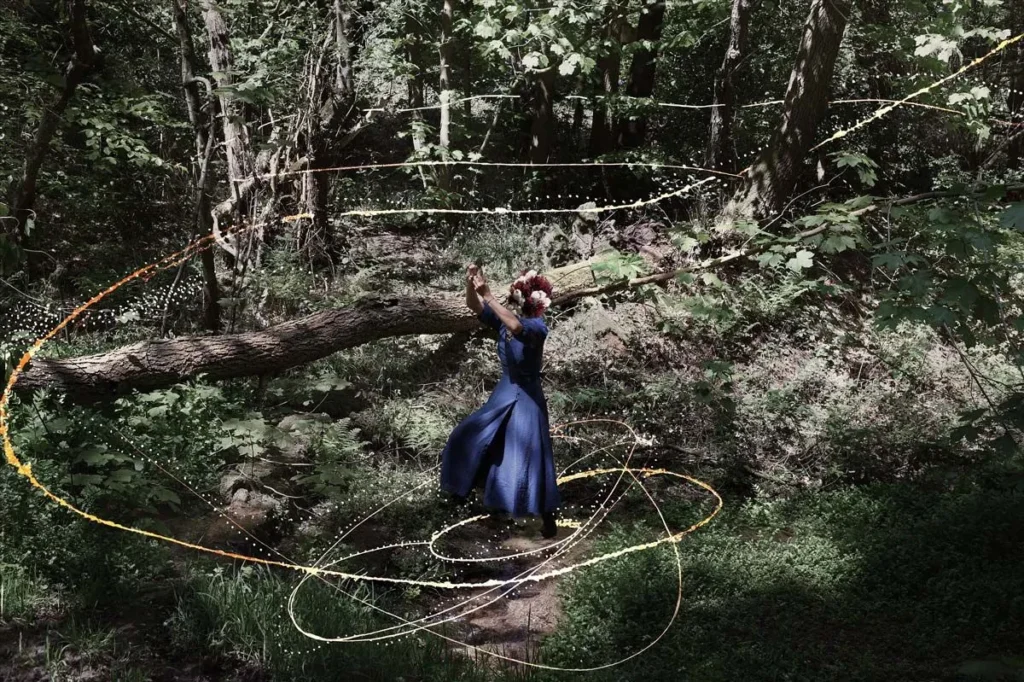
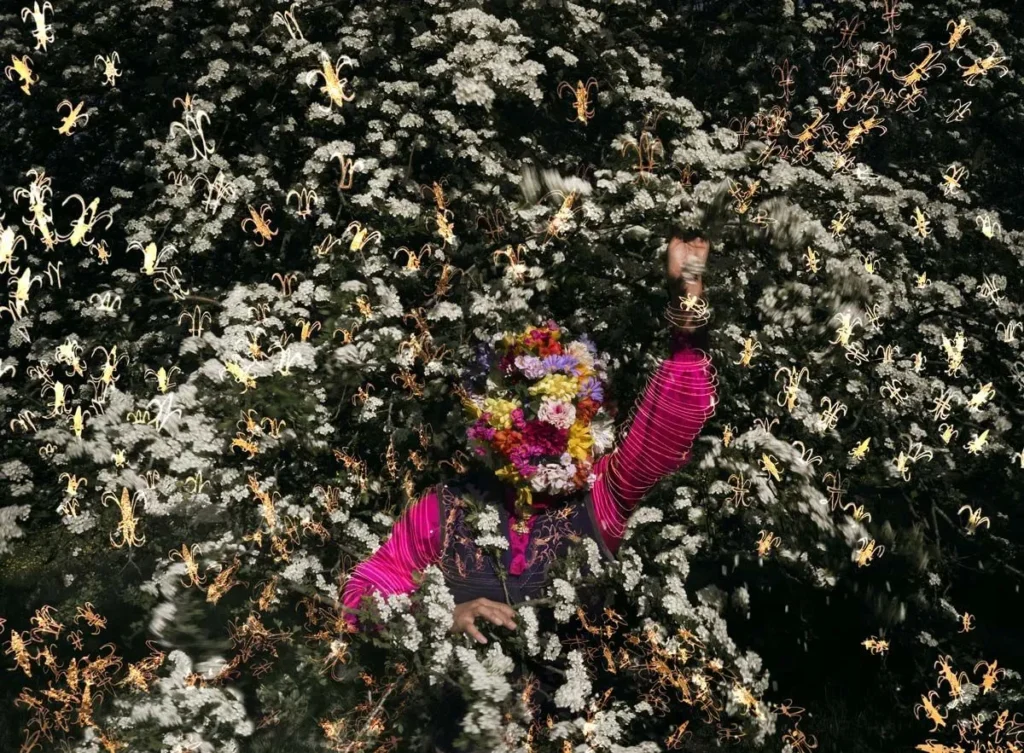
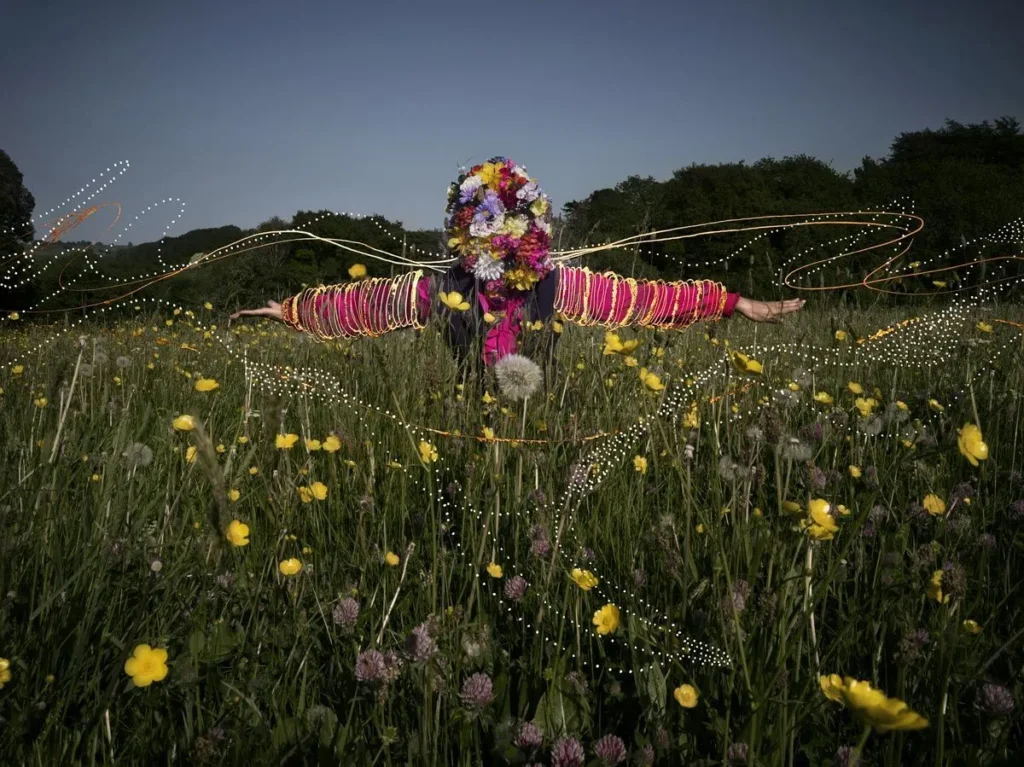
Alcázar-Duarte used the decaying landscape of Derbyshire, birthplace of the industrial revolution, combined with lush green woodlands as a backdrop of 11 self-portraits. The artist also returned to systems of meaning and symbolism from Casta paintings, the fleur-de-lis, and copper. She re-enacted poses from the Casta paintings to paradoxically embody Mayan deities in a gesture of commemorating Indigenous ancestry. Fleur-de-lis and copper threads were present throughout. Seemingly, the symbol of the fleur-de-lis was seared into the skin of runaway slaves that were recaptured, particularly, in French colonies. Its appearance in the works in copper foil, possibly connected the mining of the metal with slavery and forced labour in Central America. The continued extraction of the raw material to date, which supports digital computing systems globally even in rural areas, was suggested with the addition of multiple copper strings to the surface of the photographs.
Nonetheless, in another twirl of hope, the artist threw a nod to the retrieval of Indigenous practices, by incorporating flowers to the masks she wore in many of the portraits. These reminisced the native flora of the Yucatán peninsula from which bee colonies collected nectar and pollinated.
Mónica Alcázar-Duarte, film still from U K’ux Kaj / Heart of sky, Mayan god of storms, 2023-2024. 8’00” min. Mayan with English subtitles. Commissioned by The National Geographic Society.
La obra de Alcázar-Duarte se movía cómodamente a través de disciplinas y lenguajes. Con su trabajo, la artista recuperó simbologías, modos de entender el mundo y conocimientos indígenas, fusionando temporalidades en una presentación de la historia perpendicular (7). The project proposed a non-linear narrative that foregrounded simultaneity and circularity of time present in Mesoamerican cultures. It calls forth the idea of ‘pidginization’[ii] as described by Bonaventure Soh Bejeng Ndikung, a process that ‘proposes indigenised, syncretic ways of going forward’. Digital Clouds Don’t Carry Raindid not pose absolute answers to the big questions of our time; instead, Alcázar-Duarte asked: what gets classified and how? What are the systems used to create and maintain knowledge? What would happen should we retrieve the customs and practices of our ancestors?
Mónica Alcázar-Duarte, Ah-Muzen-Cab – Mayan deity of bees, 2023. From the series Digital Clouds Don’t Carry Rain. Courtesy Mónica Alcázar-Duarte and Autograph ABP.
Author’s note:
This review plays with language. It mainly combines the use of English and Spanish, the author’s and artist’s mother language, as mixing up the two languages is how they communicate among themselves. The insertion of sentences in Mayan references Alcázar-Duarte’s effort to retrieve the language of her ancestors. Ultimately, this text attempts to incorporate the notion of pidginization to the exhibition review.
(1) But, as I understand them, clouds are also a meteorological and metaphorical phenomenon. Carrying always water and of impermanent nature, these cotton candies in greyscale adorn the sky. Throughout history and across cultures, clouds have symbolized the residence of deities, spiritual elevation, transformation and life. (2) To understand the map of the universe, one must start at the beginning, and to start at the beginning, one needs fire. (3) Because it all started with fire. With a fire that almost destroyed everything. (4) That’s how we realized how important bees are. Because the bees were the ones that saved us all. (5) A garden of orange metal flower stood quietly at the centre of the gallery. 56 fleur-de-lis were carefully placed on top of an hexagonal structure that resembled a honeycomb. (6) With the help of an augmented reality app on a smart device, a tree came to life, suggesting a hopeful note that not all is lost, if we invoke ancient knowledge. (7) Alcázar-Duarte comfortably circulated through disciplines and languages. With her work, she recovered symbols, ways of understanding the world and indigenous knowledge, fusing temporalities in a perpendicular presentation of history.
__________
[i] Ilona Katzew, Casta Painting: Images of Race in Eighteenth-century Mexico.
[ii] Bonaventure Soh Bejeng Ndikung, Pidginization as Curatorial Method: Messing with Languages and Praxes of Curating.
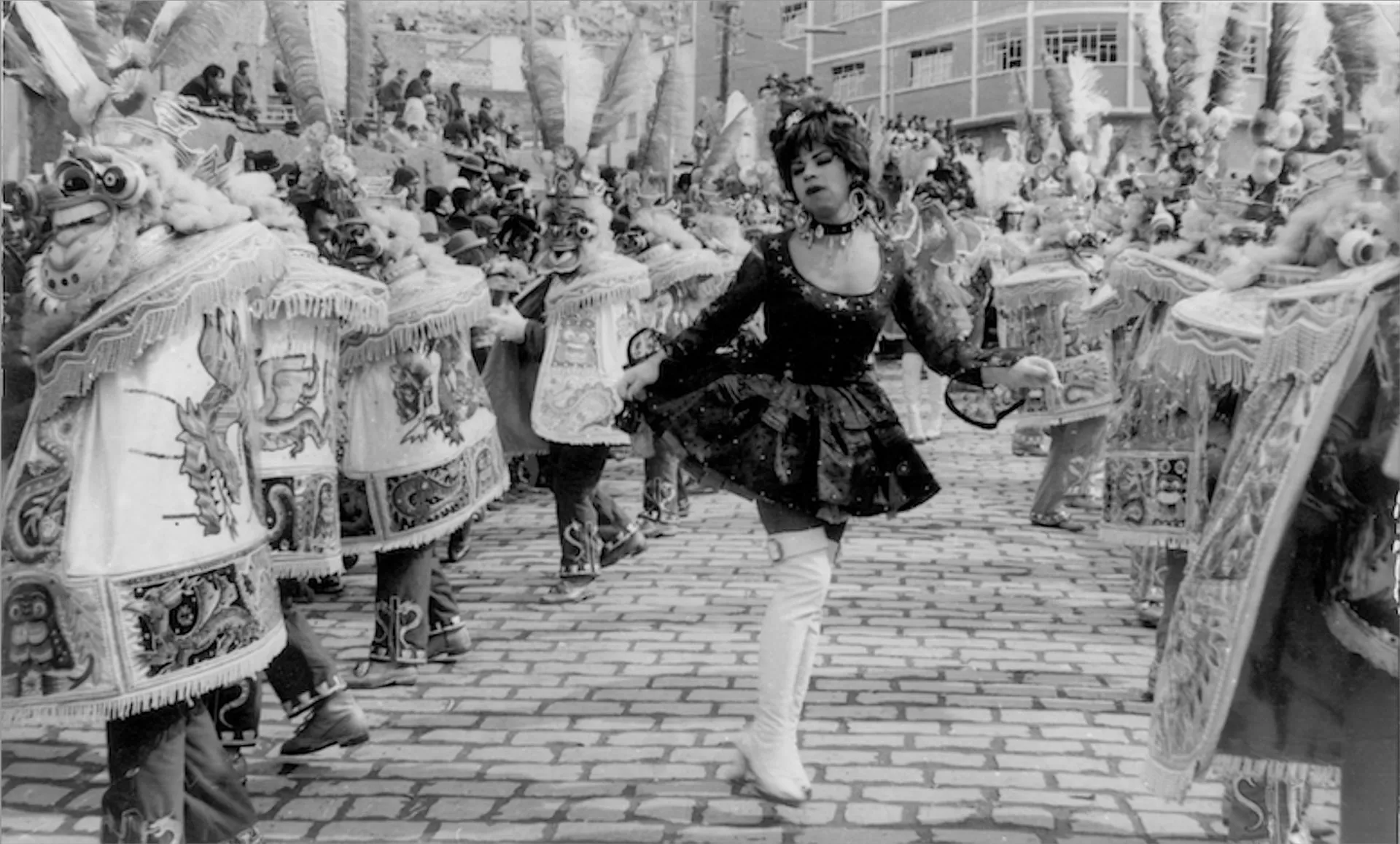
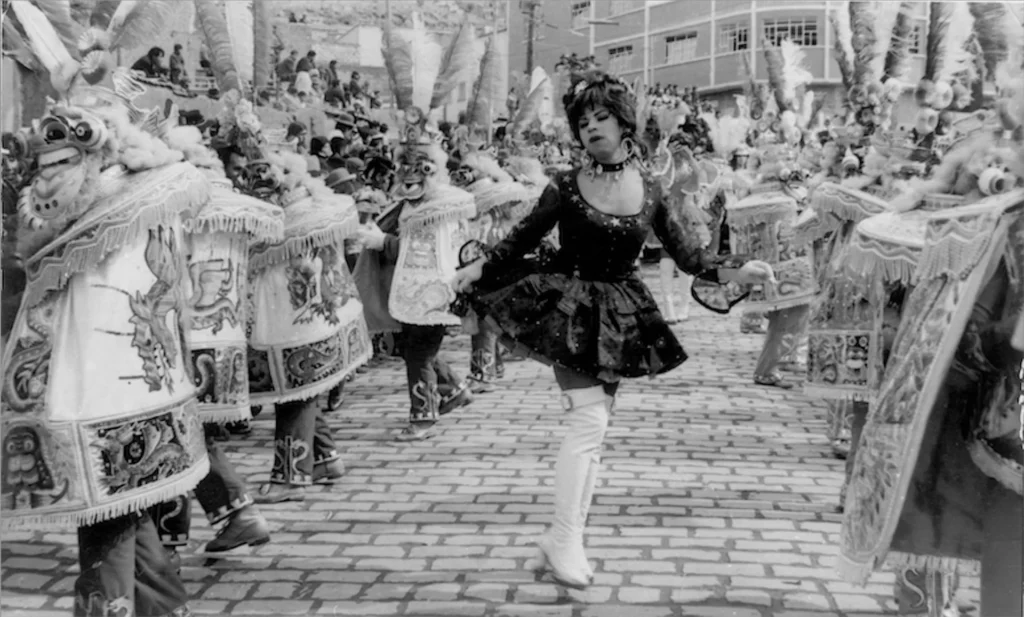
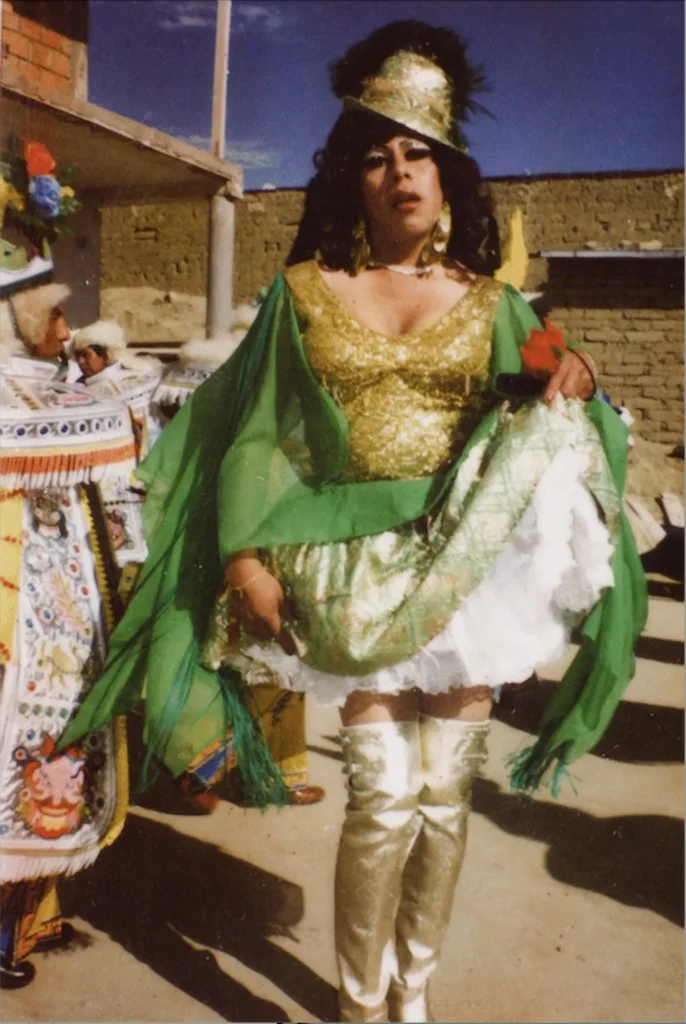
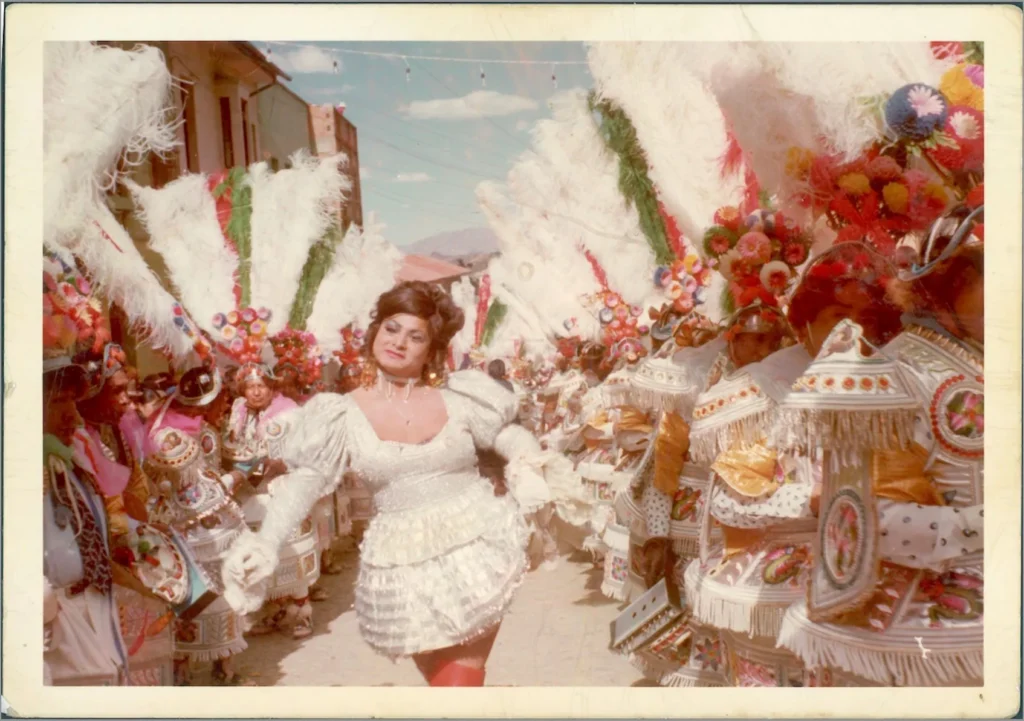
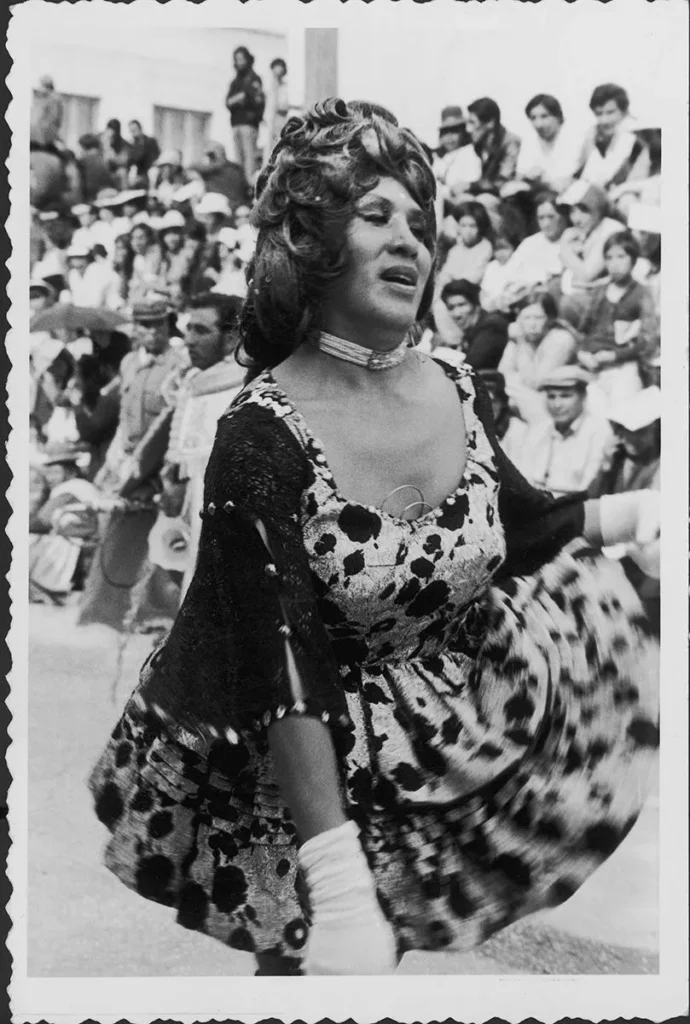
The photography exhibition documents how gender-diverse performers embodied the historical character La China Morena in order to partake in the LGBTQ+ movement in Bolivia as a celebratory and non-violent form of protest, allowing them to personify the Q’iwa, in Quechua, a person who embodies both the feminine and the masculine.
Rommy Astro at the Festival of Señor Jesús del Gran Poder, La Paz, Bolivia, 1974. Courtesy David Aruquipa.
A new exhibition at Auto Italia in London tells the story of La China Morena, a historical performance character who afforded liberation and freedom of expression to LGBTQ+ and gender-diverse communities in Bolivia.
Barbarella was a travesti carnival dancer who, in 1974, dared to kiss the president of Bolivia, changing the course of history for the queer community in the Andean region. Barbarella’s Kiss is also the title to the most recent exhibition by Bolivian artist, archivist, and activist David Aruquipa Pérez, on display until 11 June 2023 at the London art space, Auto Italia.
The exhibition presents a selection of extraordinary vernacular photographs from the 1960s and 1970s from the Q’iwa Archive. Under the care of Aruquipa Pérez, this archive is a depository of prints, dresses, letters, and other ephemera that belonged (and still belongs), to travesti performers of traditional popular dances in Bolivia, items that helped them define and give visibility to their identities.
Lucha (Luis Vela) at a rural festival, La Paz, Bolivia, c. 1973. Courtesy David Aruquipa.
The photographs on display chronicle the socio-political and cultural impact of La China Morena, a character portrayed in Morenada dance performances, which are part of traditional patron-saint street carnivals in Bolivia. These performances date back to colonial times and were inspired by the slave trade in South America. In Bolivia, La China Morena was a flirtatious feminine character who performed sensual dances for the enslaved workers, enticing them to work harder. Historically, La China Morena was played by men, but since the 1960s, the ambiguity and gender-fluid nature of the character has been viewed by travestis as an opportunity to give visibility to the queer struggle in the Andean region through radical performance. It is also seen as a way to allow them to personify the Q’iwa, which in Quechua means a person who equally embodies the feminine and the masculine, also known as Two Spirit. From then on, the performance has become the exclusive domain of travestis, and La China Morena has become a symbol of liberation for homosexual and gender-diverse people, foregrounding the role of LGBTQ+ communities in the popular street carnivals.
The title of the exhibition alludes to the kiss dancer Barbarella gave Hugo Banzer Suárez, military dictator of Bolivia from 1971 to 1978, who was enjoying the festivities of el Gran Poder in La Paz in 1974. The seemingly minor event was perceived as a gesture intended to bring bad luck on the dictatorship’s head of state. In response, Las Chinas Morenas were persecuted and banished from urban centers. Many fled to rural areas where they continued dancing. Moving to rural areas put an emphasis on the overlapping syncretic nature of the character, bringing together religion, popular culture, and indigenous knowledge.
The photographs in the exhibition cover two decades of radical transformation of La China Morena, highlighting wider changes for gender-diverse people in the region. In this reinvented character, the Two Spirit community found shelter to be themselves, while retreating to rural areas also meant reconnecting with local indigenous cosmologies where Q’iwa people are welcomed and venerated as symbols of good luck.
Juana Carrasco at the festival the Festival of Señor Jesús del Gran Poder, La Paz, Bolivia, c. 1973. Courtesy David Aruquipa.
The 41 original photographs presented in Barbarella’s Kiss, reflect the passing of time, showing signs of age and deterioration. With both black and white and colour images, the memorabilia is organized loosely chronologically, carefully laid flat in four vitrines placed around the gallery space. They document the performers Ofelia, Liz, Danny, Barbarella, Veronica, Juan Carrasco, Candy Vizcarra, Lucha, Rommy Astro, and Juana Carrasco at work or accompanied by representatives of the local government. They look glamourous in their high-heeled, knee-high leather boots and colorful mini-polleras, coinciding with the mini-skirt revolution of the feminist liberation movements of the 1960s. The performers donned heavy makeup and voluminous wigs, at times crowned with a borsalino hat, the traditional bowler hat worn by Cholas.
Aruquipa Pérez, a travesti performer themself, learned about La China Morena when, on a quest to find their own identity, they joined la Familia Galán, a movement of gay men, cross-dressers, drag queens and androgynous people from Bolivia, established in 2000. Members of La Familia told Aruquipa Pérez about the Q’iwa people who came before them, and the artist embarked on a journey to unearth, collate, systematise, and disseminate LGBTQ+ history in Bolivia.
Barbarella’s Kiss tells a story of gender diversity in the Andean region. Following the advent of worldwide LGBTQ+ liberation movements in the 1960s, the exhibition demonstrates how gender-diverse performers embodied La China Morena as a way to partake in this movement locally through a celebratory and non-violent form of protest. The photographs offer a unique view into the expression of nonconforming gender identities in the region and are an example of queer memory politics in Latin America.
Ofelia (Carlos Espinoza) at the central Morenada, Carnival of Oruro, Bolivia, c. 1973. Courtesy David Aruquipa.
Daniel Mayrit is a Spanish politician who, in 2008, initiated an eponymous political movement in Spain with the motto ‘One of Yours’. It has reached every corner of the world today. A firm believer of the power of images over words to convey messages and connect with people, Mayrit has made photography central to his political career. His social media profiles are his primary distribution channels to the extent that some have wondered whether he stands as the first politician-turned-influencer, or the first influencer to ever lead a political party. What follows is a conversation about politics, images of politics, and the politics of images.
From One of Yours, 2021. Courtesy Daniel Mayrit.
Raquel Villar-Pérez: Let’s talk about the Mayrit Movement. When and why did you feel the need to start a political movement?
Daniel Mayrit: Let’s say that for someone who is observant of the current political landscape, it’s easy to think that there are many political options in most national contexts, but for someone who was a teenager and developed his political vision in the ’80s and ’90s, this was not the case. There were only two options – red and blue, left and right – and in fact, they were very similar to one another. Besides, the system did not respond to the interests of the people but only to the interests of the political elites. I humbly believe that I was one of the first few to realize that this had to change.
It was inspiring to see that, at the time, some public figures, like Silvio Berlusconi, began to speak clearly and directly to people outside the usual system.
RVP: What is the scale and impact – local, national, global – of the Mayrit Movement? How does that impact happen?
DM: I’m Spanish, and although I was educated abroad and my entire political career has developed in the international context, I feel closely linked to the politics of my country. When I returned to Spain after many years in London first and the United States after, I quickly realized that the Spanish political context was extremely parochial. Various political parties offered me to join them, but none understood what the movement I had in mind was about. That’s why I decided to launch a movement of global reach capable of tackling issues much more important than an election here or a referendum there. It seems it worked, because years later, Steve Bannon himself, who was instrumental in the growth of the Mayrit Movement, launched his own idea of global populism but focused on what he calls economic nationalism. Although it seems evident that things haven’t gone as well for him as they have for me.
From One of Yours, 2021. Courtesy Daniel Mayrit.
RVP: Can you be more specific? Perhaps contextualise what we’re talking about when we talk about global populism. What is Steve Bannon’s perspective, and what is his notion of economic nationalism? Readers may not know who he is.
DM: Let’s say that my goal – which, as I said, was later copied by Bannon – is not to win an election in this or that country; it’s not to generate real political change. My project is much more ambitious, and over time it has consolidated itself as a network of national projects that share similar interests and objectives but that are applied to a local context and its specificities. My job is to preach those messages throughout the civilised world and embrace all those who want to join our mission.
Bannon’s problem is that he was obsessed with exporting to Europe the economic protectionism that he launched in the United States. That’s bullshit – it didn’t work in the 1930s and it doesn’t work now. Beyond putting nationalism against globalism, what the Western world needs is a force that is capable of retaking control of the world economy in the face of threats from China and the Middle East to ensure the prosperity of our people and the security of our values and our Christian culture.
RVP: Can you be more specific? Perhaps contextualise what we’re talking about when we talk about global populism. What is Steve Bannon’s perspective, and what is his notion of economic nationalism? Readers may not know who he is.
DM: Let’s say that my goal – which, as I said, was later copied by Bannon – is not to win an election in this or that country; it’s not to generate real political change. My project is much more ambitious, and over time it has consolidated itself as a network of national projects that share similar interests and objectives but that are applied to a local context and its specificities. My job is to preach those messages throughout the civilised world and embrace all those who want to join our mission.
RVP: The contemporary world is characterized by the movement of people, with societies becoming more multicultural, and an important element of each culture is its religion. When you appeal for ‘the security of our values and our Christian Europe’, you exclude those people who practice other religions. Are you putting forward protectionist nation-state policies? And to what extent should religion be kept out of politics?
DM: Let me tell you, first of all, that your question is misleading, and you’re trying to oppose concepts that do not exist.
We have been called all sorts of names in the media like your magazine, that only seek to release flashy headlines, even if twisted, so that people click on the news. If we do or say some things, we’re nationalists; if we do or say other things, we’re racist; and if we do the opposite, we’re populists.
Look, I’m telling you with resounding sincerity, there is no one more supportive than us, because solidarity is also at the core of the Christian tradition. We welcome with open arms everyone who wants to join our movement and come to our homes. But it’s common sense that to do so, they have to accept our rules of coexistence that have been in place for centuries. What is not acceptable is to let into your house anyone who comes to turn everything upside down. Would you do it in yours? We embrace globalism, but in an orderly way. Anyone who comes with proper papers and wants to be part of our culture will be welcomed. Now, if you don’t like our culture and our tradition, I don’t even understand why you would want to come.
That is why the division between religion and politics is false. The question goes much further and affects our values as a society, and that’s why the progressive left is incapable of giving the answers and the certainties that our people need. I will give you one last example. The same progressive left that defends ferociously feminism remains silent when it comes to condemning the cultures that treat women like animals, covering them with veils and denying them the basic rights.
From One of Yours, 2021. Courtesy Daniel Mayrit.
RVP: Let’s talk about your image. How do you manage the connotations of the photographs that are taken of you as a political leader and distributed by your communications team?
DM: I have always been passionate about art. Since I was little, I was fascinated by Hollywood and watched movies with my father. I loved going to museums and seeing those paintings of kings on their horses. I was fascinated by the world of advertising – the ability to convey a message with images and not with words has been present in my emotional education, so I guess it was just a matter of time before all that passion spilled over into my understanding of politics. At the beginning, I spent a lot of time building and caring for that image, but now for obvious reasons I can no longer do everything myself and I have the best team of people to do it. They are day and night looking after everything that is posted about me. I won’t mention names, but in our crew, we have photographers and editors who used to work for Vogue, Le Monde, and Fox News, until they realised that working with me was much more fun. People rave about the photographic work Pete Souza did during the Obama years in the White House, but honestly, next to the work my team does, Souza looks like an apprentice.
From One of Yours, 2021. Courtesy Daniel Mayrit.
RVP: Are there any specific images of your political campaign that you feel proudest of? Why?
DM: I suppose my campaign advisers and even my fans will disagree, but there is one that I especially like: I appear to be melting into a hug with a woman after a rally in the United States. It’s a very simple image, but it perfectly sums up people’s feelings and the spirit of this movement. On top of that, it’s irrefutable proof that our way of communicating is not at all prefabricated, as some of our haters would say. It’s nurtured by these spontaneous moments, in which people are at the centre stage, not me. The feeling that the hug conveys cannot be faked; it cannot be acted. It’s one hundred percent real.
From One of Yours, 2021. Courtesy Daniel Mayrit.
RVP: We’ve been talking about images that you have control over, but how do you manage the flurry of images of you, both positive and negative, not taken by your team, that are shared on social media?
DM: It may surprise you, but neither my team nor I pay much attention to all that buzz. The important thing is to be there where you need to be, and it’s normal for people to take photos in these situations, as a souvenir that proves that they were there with me! They have a good time with me, and I have a good time taking pictures with them. If among all that positive energy some crazy person sneaks in making memes with my face, well, it’s a small price to pay. I’ll tell you the truth, there are some hilarious ones. I also know how to laugh at myself – I think it goes with the job. It’s what being an icon of popular culture has to do (lol).
RVP: Have there been any instances where images shared on social media by others have damaged your campaign? If so, how?
DM: Not that I know of – I guess my team wouldn’t tell me! (lol) But I think that’s impossible. Photos are important, but they’re just photos. What goes viral today has been forgotten tomorrow, and do you know whose fault it is? Socialist fake media like The Huffington Post that have lost their traditional values and have been carried away by the dictatorship of clickbait. What’s really important is the project, the message, and people get what they need first hand from me, without intermediaries that manipulate the information.
RVP: Your image has occupied the cover of printed media outlets such as Time and Esquire. What was the role these images had in relation to your political campaign?
DM: Those media contacted me for an interview, and I, of course, agreed to it. I know some people maintain that we want to manipulate the messages that the press share, but I even lend myself in good faith to appear on the cover of all those fake news media that constantly vilify us!
RVP: So do you think a politician can have complete control of their image?
DM: Well, I don’t think it’s possible, although there are certainly many who have tried. See, for instance, Obama, a puppet of Instagram and Twitter. It’s true that there are actors who have later become politicians, but he is a clear example of the opposite: a politician who has turned a reenactor of himself, a constant simulation. And let’s not forget, all of it is brought about by the mercenary Pete Souza. It’s a pity, really. He did a tremendous job during Reagan’s years in the White House but was seduced by the delusory glamour of the Obamas and ended up producing a permanent ad campaign with them. I don’t know what happened to him after the Obamas left office. I haven’t seen anything new from him for a long time.
From One of Yours, 2021. Courtesy Daniel Mayrit.
RVP: Can images of politicians ‘manipulate’ social opinion?
DM: No one is going to tell you this as clearly as I am: images not only can manipulate, but they must. At least if they want to achieve what they’re aimed at.
For years, the liberal media and the representatives of the politically correct dictatorship have dedicated themselves to infantilising people by saying that they were authentic and that the rest of us were the bad guys. This is not right. All images lie in some way or another, theirs and ours. Images are just one more tool – albeit a very powerful one – when it comes to building your message. And the problem with that caste of politicians is not whether their images lie or not, but what lies their messages hide. They’ve spent years saying one thing and doing the opposite. With me, that doesn’t happen, because everything we do is in the service of the people. Of course, my images are retouched and edited, but we do it so that my message reaches people in the best possible way, and that’s what really matters: that people understand the message I have for them and that they know this message is true and honest. What you see is what I am. It’s that simple.
From One of Yours, 2021. Courtesy Daniel Mayrit.
Note to the reader: One of Yours is the latest photographic project by the Spanish artist Daniel Mayrit, who impersonates a farce politician. Mayrit’s works engage with current political affairs using wit and sarcasm as a strategy that allows him to articulate his visual language.
(Originally published in C4 Journal on 9 May 2023)
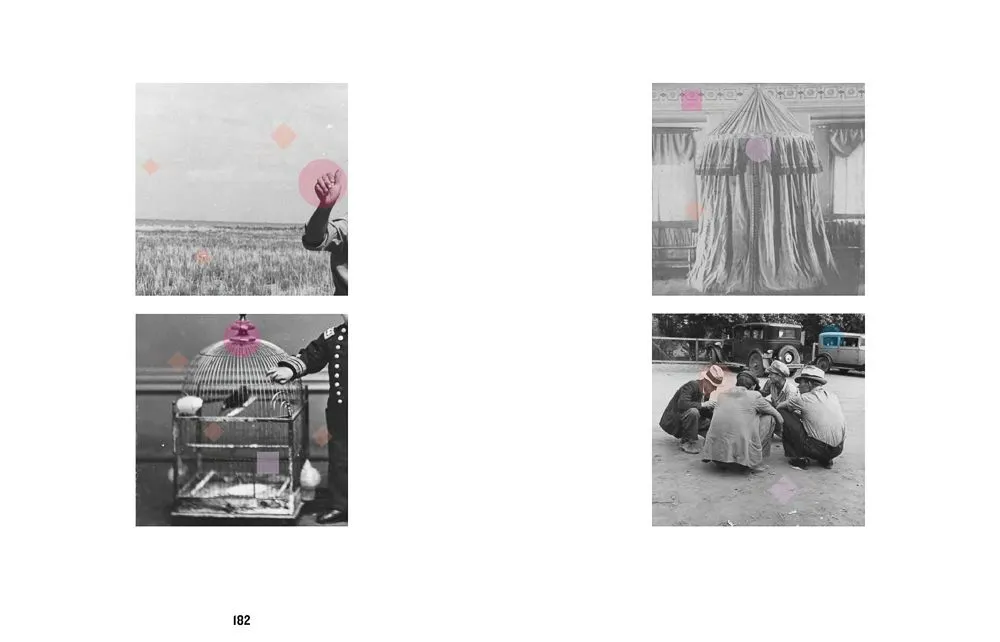
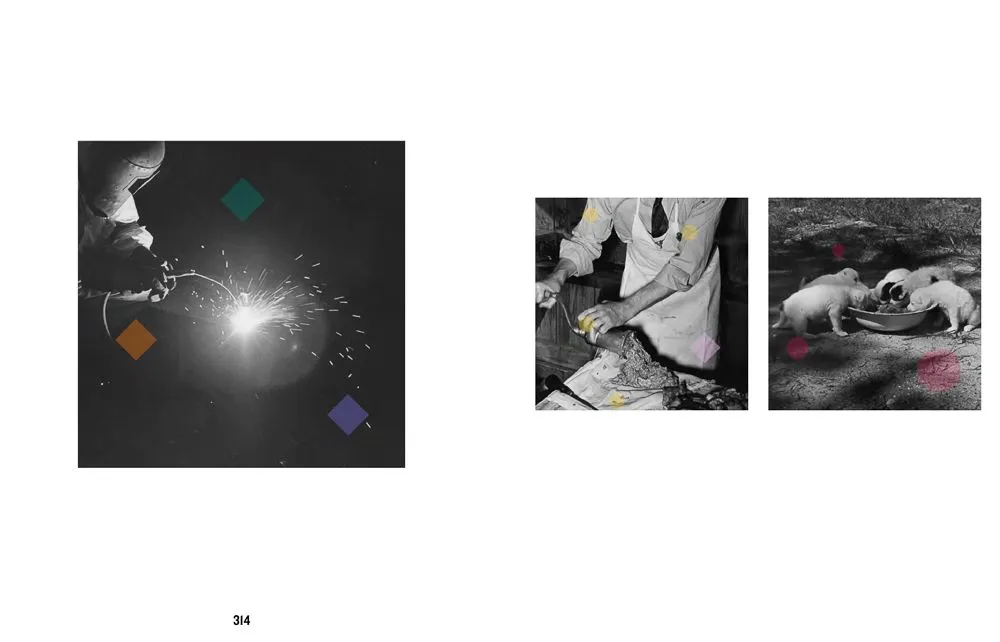
Bindi Vora’s newest book Mountain of Salt (Perimeter Editions, 2023) is an assemblage of sorts. Collecting the works of the eponymous project created during the pandemic, the photobook has afforded the artist a space for play: to deconstruct the images, to re-construct and expand the narrative. In this interview, we talk about words, images, the state of the world, constructing, deconstructing, play, and moments of catharsis.
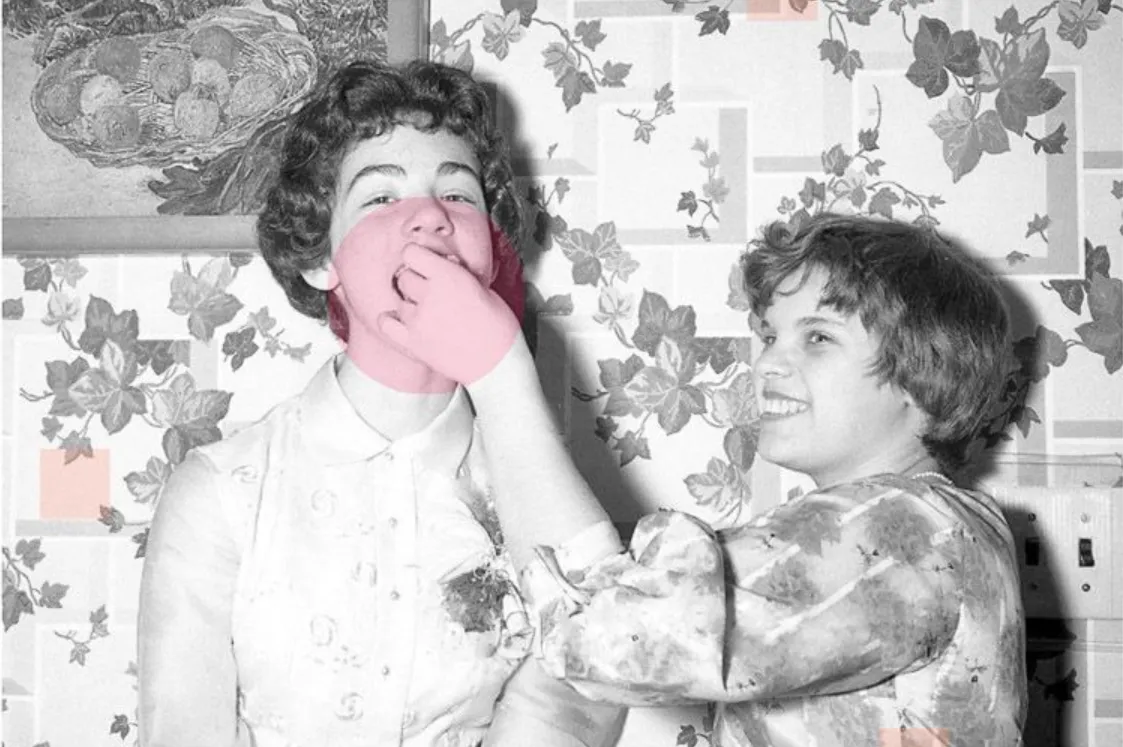
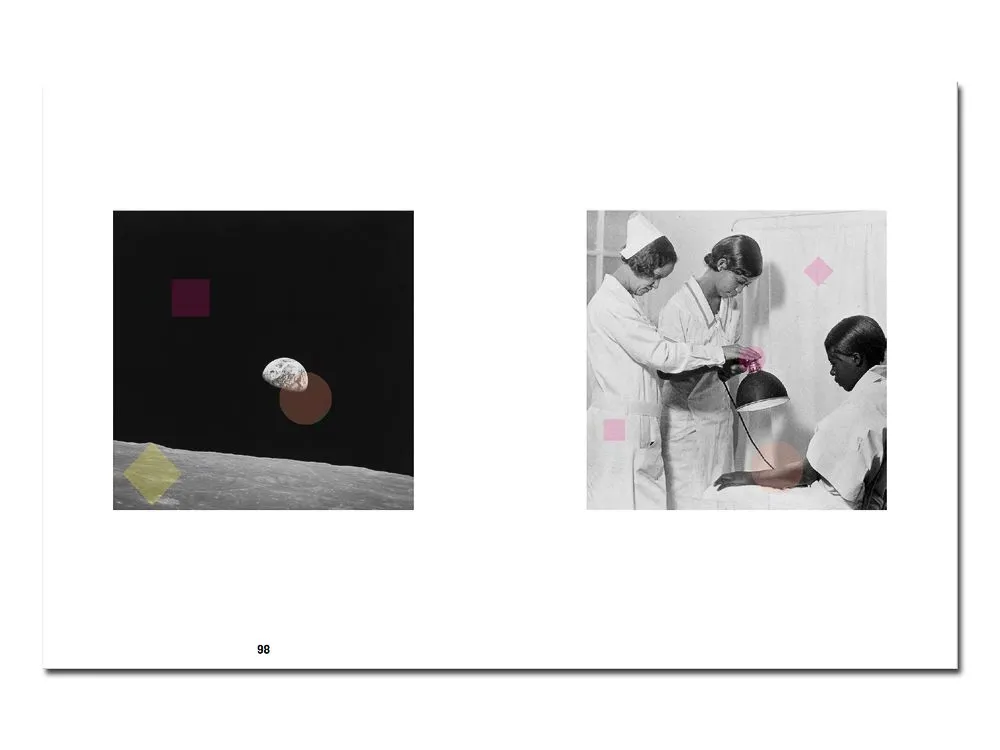
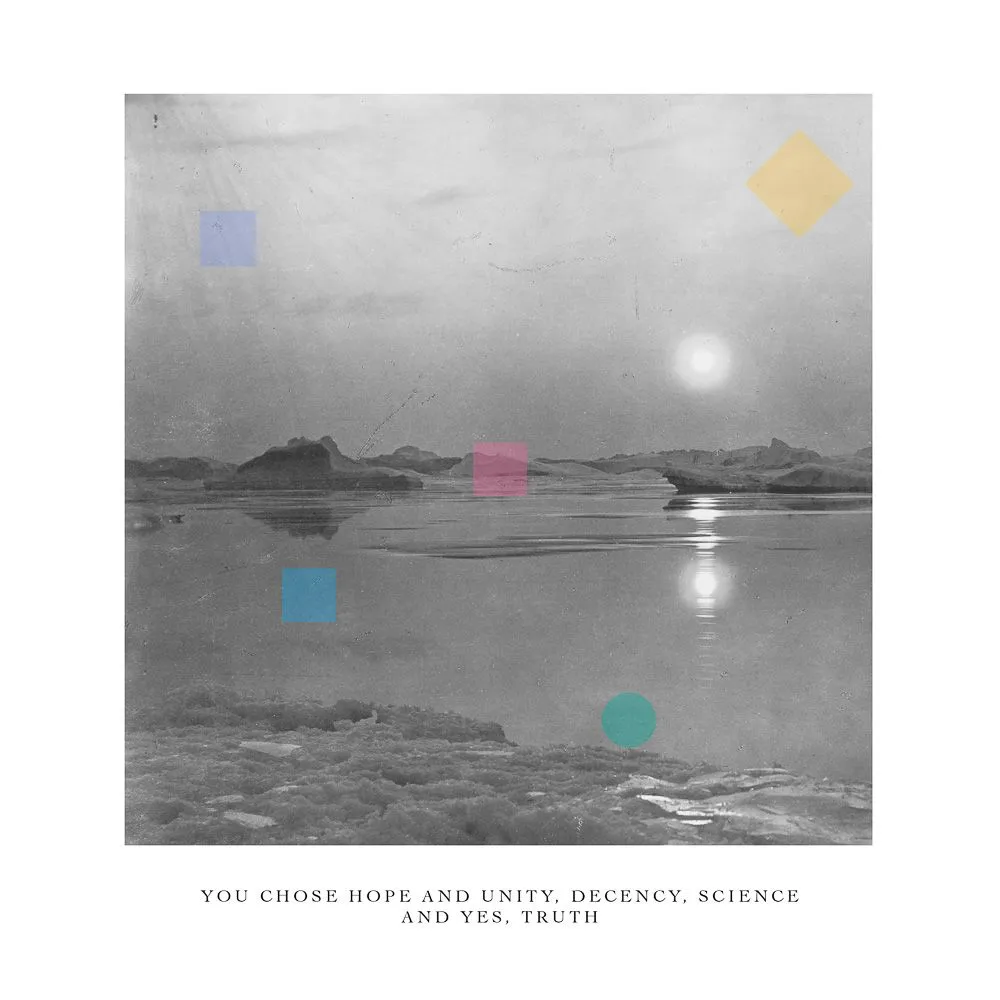
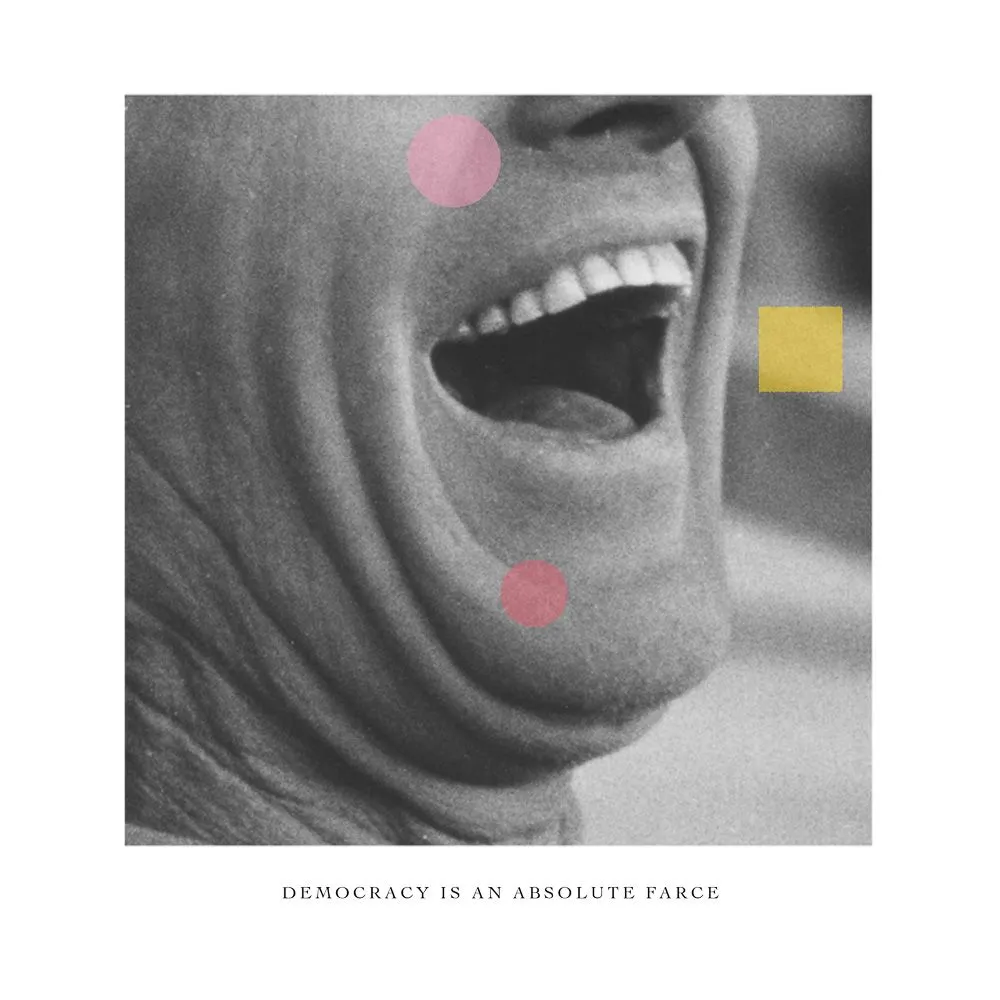
Actually This is Just the Beginning from A Mountain of Salt, 2020-21. Courtesy Bindi Vora.
Raquel Villar-Pérez: Can you tell me about yourself?
Bindi Vora: I am a British-Indian interdisciplinary photographic artist, associate lecturer in photography at London College of Communication and Curator at Autograph. As an artist, I am interested in how ideas of resistance and resilience are influenced by our everyday surroundings. My work combines collage, linguistic motifs, and analogue processes – working with an archive of found images procured over the last decade. I am interested in how these materials can be reused and recycled to create new narratives but can also be traced back to other works too, like interconnected tissues. Currently my research is concerned with practices that articulate thoughts of care and the repercussions of this entangled word.
RVP: How did Mountain of Salt start?
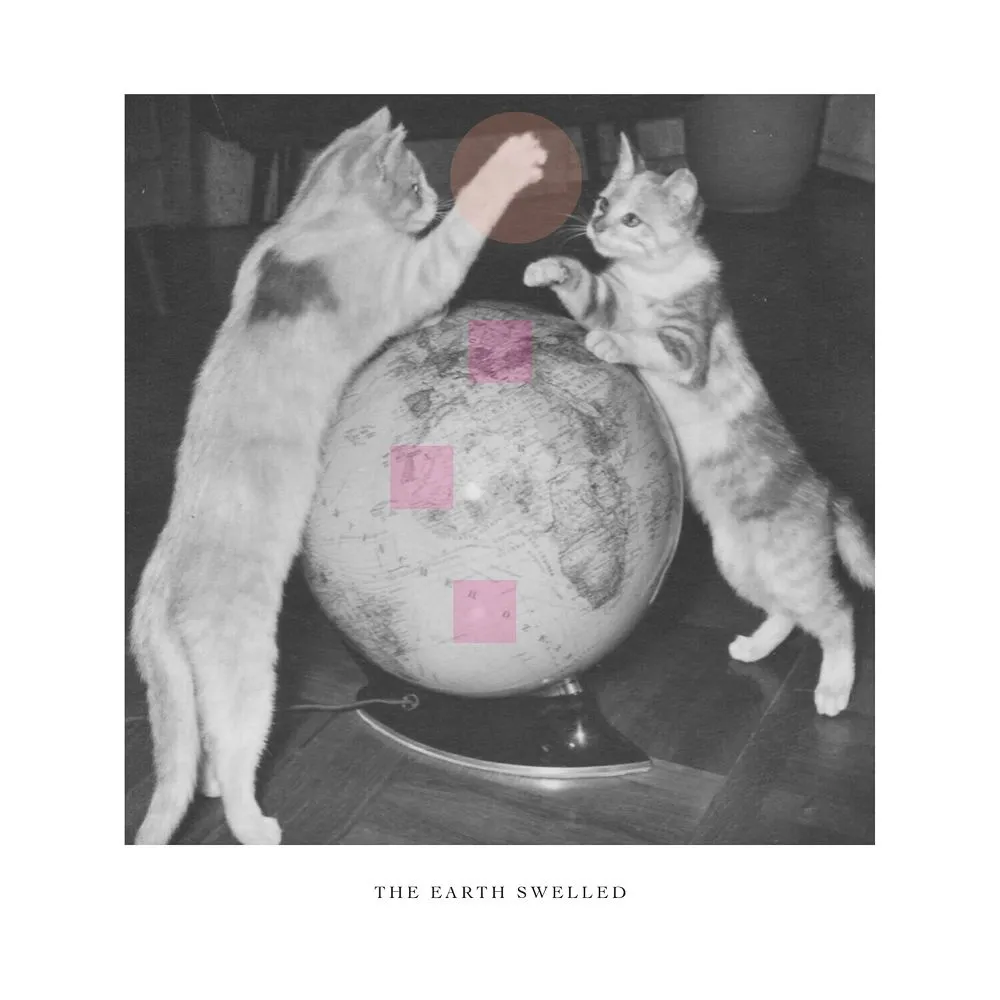
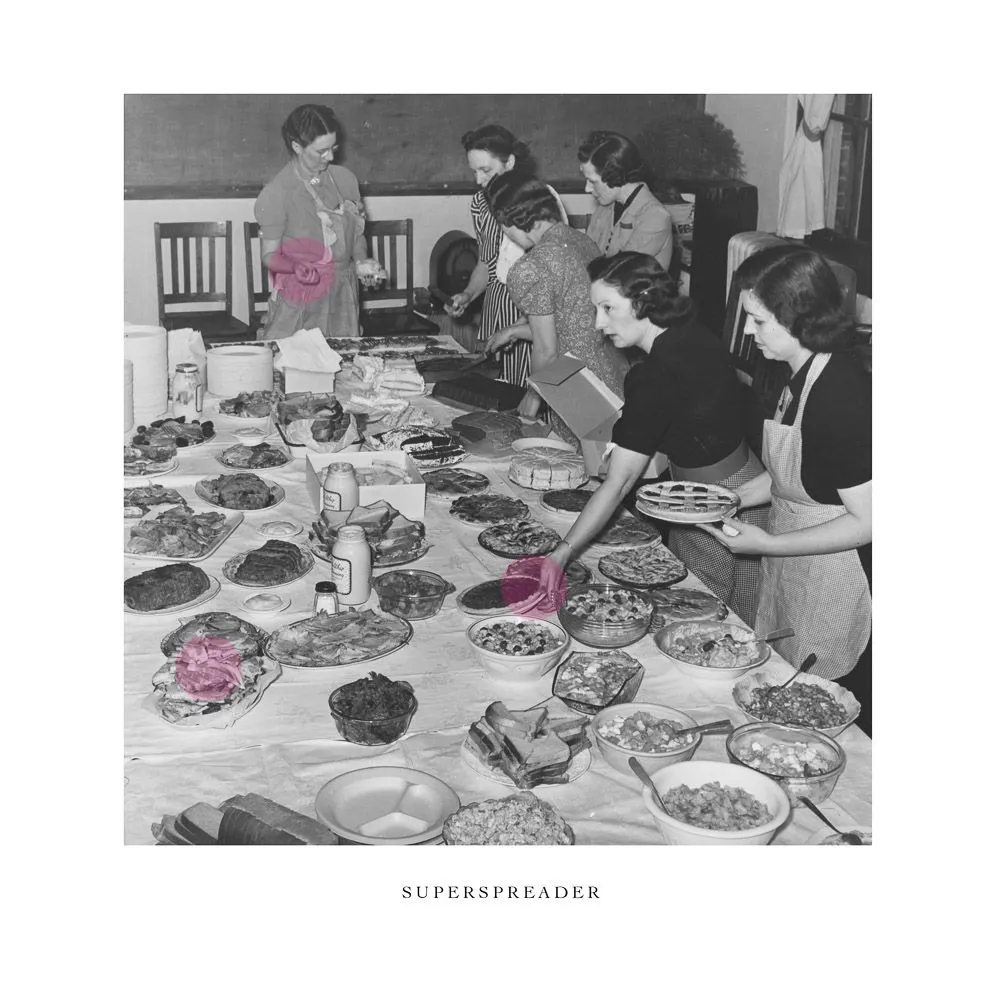
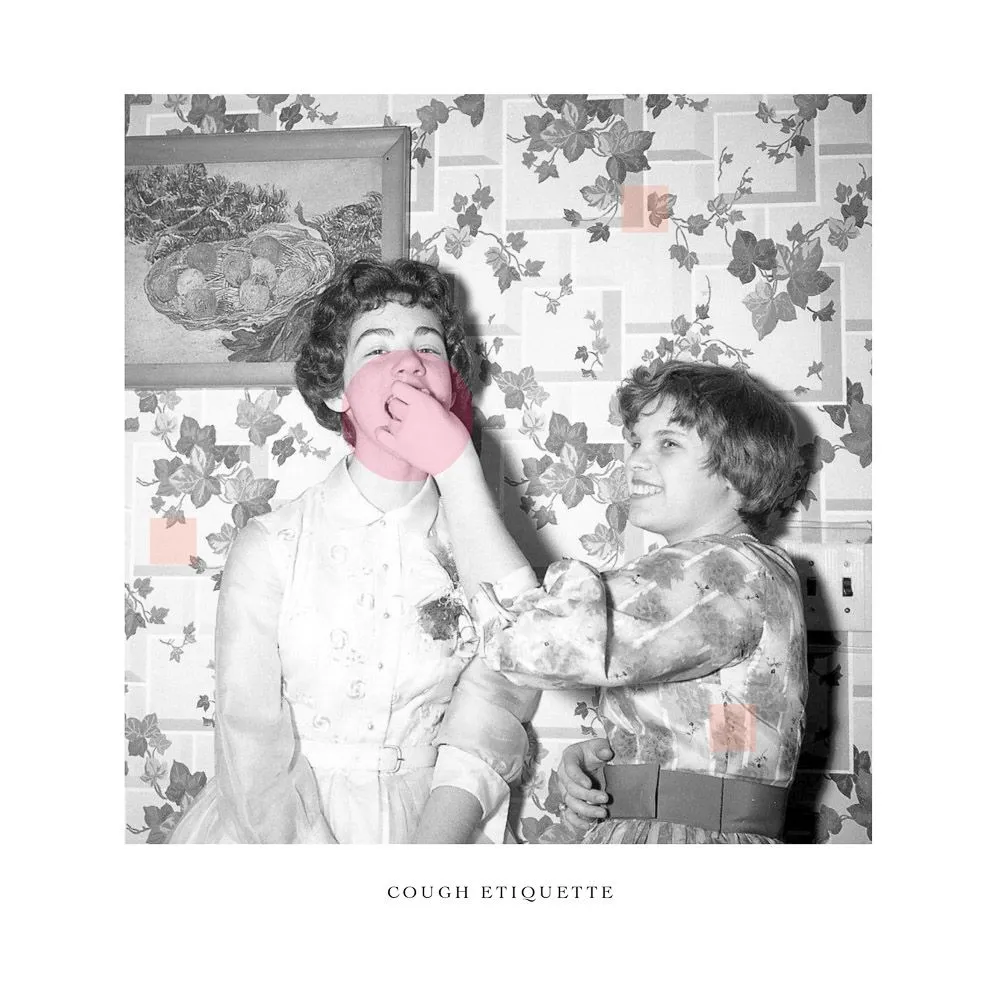
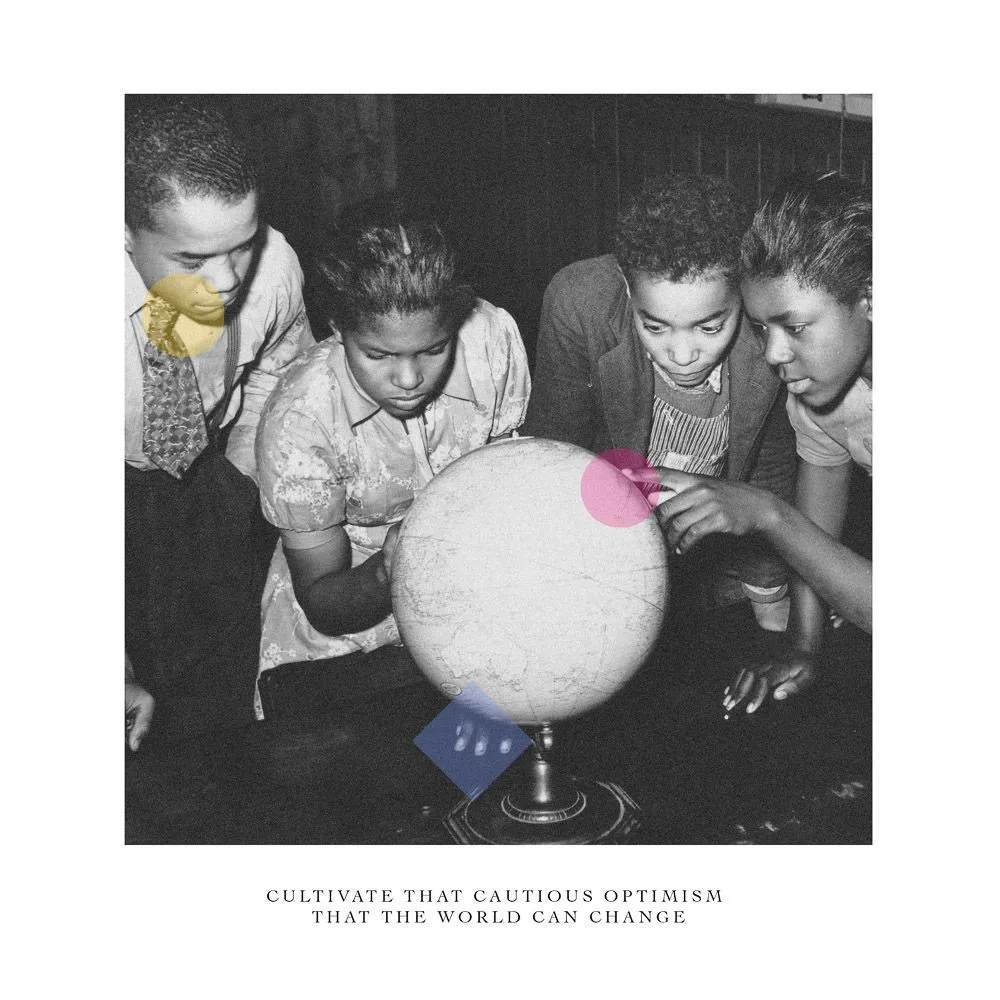
BV: Mountain of Salt is a constellation of 371 works initially conceptualised as a human response to Covid-19. These collages are comprised of found images, appropriated text, and digital shapes. I felt quite overwhelmed by the mass of information being thrown at us; what to do / how to behave. With so much of life, as we knew it, now in flux, and having to quickly adjust to these new ways of being, I felt really compelled to make something as a response and an outlet.
Mountain of Salt is a constellation of 371 works initially conceptualised as a human response to Covid-19. … I made a conscious decision to work with found photographs and archives, as these colossal moments that were unfolding, felt like they had occurred before – through gestures, scenes depicted, or places. For me, finding images became a sort of obsession that allowed me to fill time and be transported somewhere else.
Home became my sanctuary, and that adjustment initially was quite difficult. I remember not leaving the house for weeks on end without even realising it. Doing normal things like going to the supermarket was something so alien. I avoided the shops for nearly a year because I would be overcome with so much anxiety to be around so many people, so my partner would take his mountaineering rucksack with him and stock up for two weeks at a time. It wasn’t healthy at all, but home was a safe space and just with time I realised I needed to get out more. Running became a new healthy habit I got into, and still enjoy now. We spent a lot of time and energy nurturing the overgrown jungle of a garden and turned it into our small haven where we found moments to think and exhale.
RVP: I remember, at the time of the covid-19 pandemic, we witnessed an overload of image-based art projects that felt very similar to each other. I find quite refreshing the fact that you didn’t take one single new image. I also like the fact that it all starts from language. What was your rationale behind marrying together certain words to certain images?
BV: I made a conscious decision to work with found photographs and archives, as these colossal moments that were unfolding, felt like they had occurred before – through gestures, scenes depicted, or places. For me, finding images became a sort of obsession that allowed me to fill time and be transported somewhere else. My method was to make keyword searches, either from the text itself or through words associated with those pieces of text or an emotion it would stir up. These juxtapositions were either meant to glue together meanings or create a friction of some kind.
RVP: How many images does the project have, and how did you decide to bring it to an end? Is the photobook the closure to it?
RVP: Can you tell me more about the choice of title?
BV: The title of the series alludes to the idea of being on this continuous upward climb but faced with the precarity of tumbling at any moment, which is how I felt during the pandemic. As an artist I am interested in how ideas of resistance and resilience can be influenced by our everyday surroundings. Each piece in Mountain of Salt draws on something we each experienced in our individual and collective ways, awkward, rough, smooth, densely layered but ultimately raw. Even now, the pace at which we consume these small fragments feels out of order, speculative in some form, but equally, it all feels completely normal too… these worlds we oscillated through and continue to navigate are ever changing.
RVP: What was your process? How and from where did you source the images/text?
BV: I began by collecting language. Language from politicians, journalists and individuals who were sharing their commentary, thoughts, and directives, collated through a multitude of platforms; daily briefings, twitter commentary, news articles and even placards from the Black Lives Matter protests later that year, such as “Statues Are Not Neutral”. Sifting through information became a strange ritual of monitoring the curves and the new sanctions that were created to try and pacify a virus that could be transferred through the simplest gesture of touch. Even as I reflect now on where we are, I still don’t feel I’ve digested this experience, but rather, we’ve just been jolted back into normality.
As an artist I am interested in how ideas of resistance and resilience can be influenced by our everyday surroundings. Each piece in Mountain of Salt draws on something we each experienced in our individual and collective ways, awkward, rough, smooth, densely layered but ultimately raw.
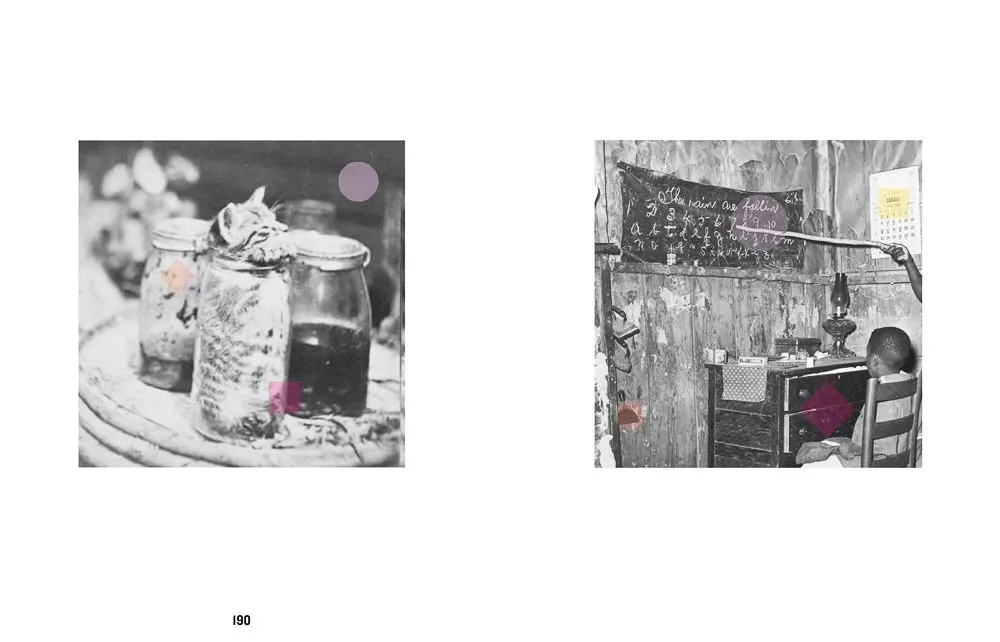
The collages developed very organically. It would always begin with placing the language and from there I would literally spend hours sifting through my own archive of photographs, that I had been acquiring for over a decade – but also using eBay, New York Public Library digital collections and other sources until I found the right image. Working with collections of images is particularly fascinating. I always feel like our relationship to these objects changes as the world around us and context in which these works exist changes. It is this organic repository that continues to provide rich connections, questions, and multiple lines of enquiry. In this context, whilst making this work, delving back into the archive was important. It wasn’t a moment to take or make new images, it was about highlighting the sentiment that these moments, these ideas, these visuals were recurring. The images you see in the final works vary in terms of their age, finish, and type – from early stereoscopes, Polaroids, medium format prints, press photographs – but all are markers of time. By applying the same treatment, cropping them to the same size, they created a sense of uniformity where language and image sit in tandem, creating a way of re-archiving and re-processing these images. Despite this work starting with the pandemic the series really expanded from there.
RVP: The works are all black and white and the note of colour is brought by the geometrical digital shapes. Can you tell us more about their role within the photograph?
BV: The digital shapes that you see layered on the surface are placed strategically, not only to direct the gaze to the various intricacies within the composition or to ask you to pause in the small space, but also speaks to the semantics of what the shapes represent – balance, community, totality, union. All these behaviours, forms of action, statements and observations being forced onto us by those in positions of power, kept conjuring very vivid visual triggers in my mind. While we were being told what to do and how to behave, it becomes farcical that those very individuals were doing the complete opposite.
RVP: The combination of words and images convey a level of sarcasm and wit, rhetorical strategies that you haven’t used in previous works. Why did you choose to use these for Mountain of Salt?BV: There wasn’t a single strategy I set out to use as I was making them, they very much developed in an organic way through the language I was collecting. In some instances, I was thinking about feelings, other times were about depicting historical moments I pictured from books I had previously read, others were about using the image / text combinations to provoke a response. I think for me, what felt so epic about this time was the sheer amount of information we were being forced to intake in one go, confusing, cynical, comical and everything in between. It is the only time in our lifetime where we were forced to stand still and absorb what we were being told in many ways. This work is very different in its own right. It really pushed my practice in a very different direction.
RVP: How do you think previous works inform Mountain of Salt?
BV: Collaging for me has always been a way of juxtaposing myriad trajectories into one visual plane and has been part of my practice in various formats throughout my career. In 2011, I made an artist book titled Journeying a Non-Place, a topographical visual map made of photographs locating the streets I was walking in Paris for the first time as an adult. Ultimately, this format for me becomes an exercise of locating and dislocating. For Mountain of Salt, I felt the book format was appropriate. Each piece in the project is 20 x 20 cm approximately. They are purposefully small as I endeavoured to conceptualise these colossal moments that were occurring in our lives into something smaller that you could grasp in your hands. It was about humanising the succession of events, about coping with reality. Similarly, the book follows this intimate format. It is something you can clutch in your hands, turn pages, close the book, etc. It can be read back to front and front to back.
The word I always return to when I think about this work is catharsis. The process of putting together the photobook meant that I had to revisit the whole series, reprocessing each piece in succession. So many of them pulled me back to the pandemic moment in which they were made. It highlighted once more the sheer power words have when strung together and the deep residual impact the pandemic continues to have.
RVP: Mountain of Salt, is the visual result of how you processed all that was happening at the time, yet, in hearing you talk about creating the photobook, it feels playful, even healing. What has the process of creating the photobook meant for you?
BV:The word I always return to when I think about this work is catharsis. The process of putting together the photobook meant that I had to revisit the whole series, reprocessing each piece in succession. So many of them pulled me back to the pandemic moment in which they were made. It highlighted once more the sheer power words have when strung together and the deep residual impact the pandemic continues to have.
RVP: Tell me more about the photobook published by Perimeter Editions. How and when did this project start?
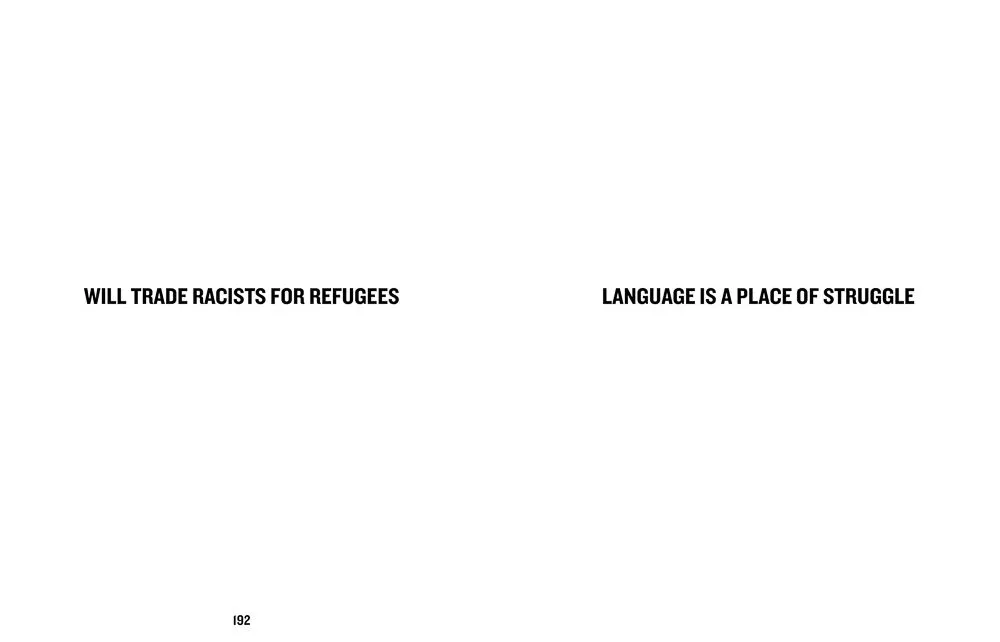
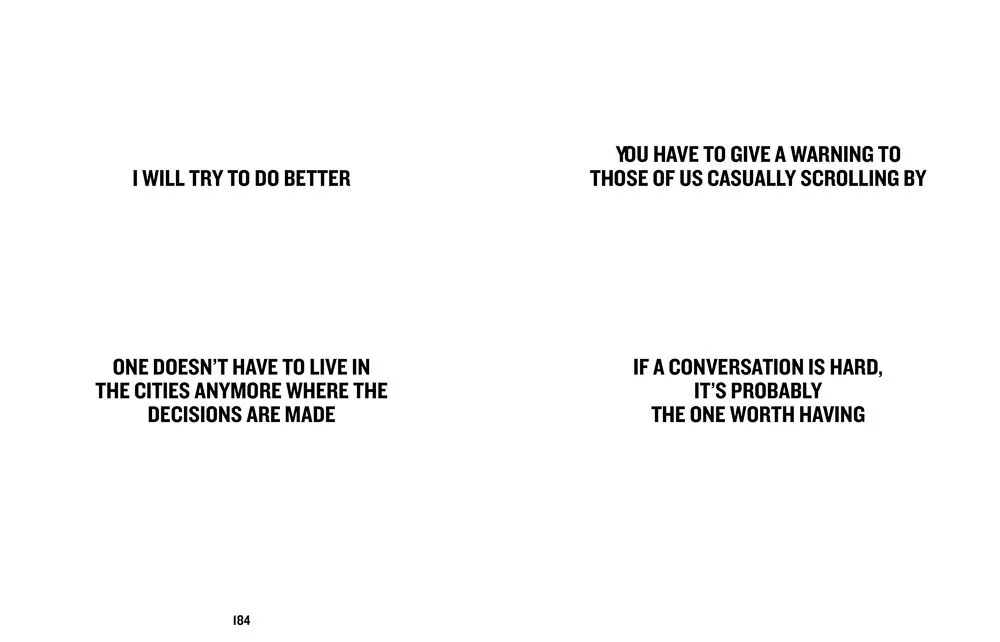
BV: A chance encounter with Justine Ellis, co-director of Perimeter Editions, during the Photo Ireland festival last year, sparked a conversation about shaping this work into a book. Considering the sheer number of works, we spoke about visual strategies already inherent in the work, which were originally conceptualised as single works originally disseminated as works online. Together with Dan Rule, the other half of Perimeter, and Narelle Brewer, the wonderful designer of the book, we considered lots of ways of translating these works into new ways of seeing / experiencing the works. We were all quite set on unravelling the way Mountain of Salt has been seen so far and re-shaping it into a book format. As you leaf through the book, the whole work has taken on a new way of being seen; the text has been split away from the images, the pace at which you see the images has changed, and the font takes its cue more literally from the style of headlines. This works in the book format, as there was more space to play around, without overwhelming the visual plane.
RVP: Let’s talk more about the actual physicality of the book. What is its dimension? How many pages? Are there any essays?
BV: It is a cute but mighty photobook. There are 448 pages, and it is approximately 15 x 19 cm and I liken it to a door stop; it is about 2 inches thick! The book followed the same rationale as the original works, they are meant to be something you can hold in your hands; the book is meant to be something you can grasp, but close, open and leaf through at your own pace. Because of the vast amount of text present in the series, especially now that is split from the original image collages, and the short afterword I have written for the book, between Dan, Justine, and I, we decided not to add more words to it. We wanted people to experience the sentiments in this new fragmented, joined up way at their own pace.
RVP: Are there any other sensorial elements to the book?
BV: The paper textures vary from the cover to the inside papers; one is more textured and the other is smooth. Both papers work beautifully well together. There is a lightweight to the paper for the book block, as you gradually leaf through such heavy content, there is an ease to it. What is interesting about the book is you can read it in a traditional way, or you can land on a page mid-way through it and pick up the pace from there. Narelle did an incredible job; she really thought about the pace at which you were experiencing the image / text fragments. The pages would vary between 1, 2, 3 and 4 images in any spread – there wasn’t a set pattern, but you feel a rhythm as you go through the book.
RVP: In the book, it feels as if you’ve gone back to the purest form of the elements that shape the artworks: language on one hand, images on the other. Was this a deliberate decision?
BV: How do you grapple with so many works and unravel them to still make sense but also provide more pausing moments in between? This is the beauty and anticipation of bookmaking. It is a craft. Working with individuals who really see the potential in the work and can work with you to pull it together is a humbling process. We wanted to take the cacophony of visual and textual fragments and create a new experience to see this work that sits outside of the new images.
RVP: Can you talk more about the narrative order you did choose for the book?
BV: The images follow a chronological order throughout the book. This was something I was quite adamant about as a strategy. It needed an anchoring, especially because the images are presented in a completely new way. The layout follows the entire process of making Mountain of Salt almost like an elongated timeline unfold, then it ends with my afterword, which was more like a reflection about the process of making and the more nuanced subtleties inherent in the work.
RVP: Any suggestions you have for the readers on how to approach the book?
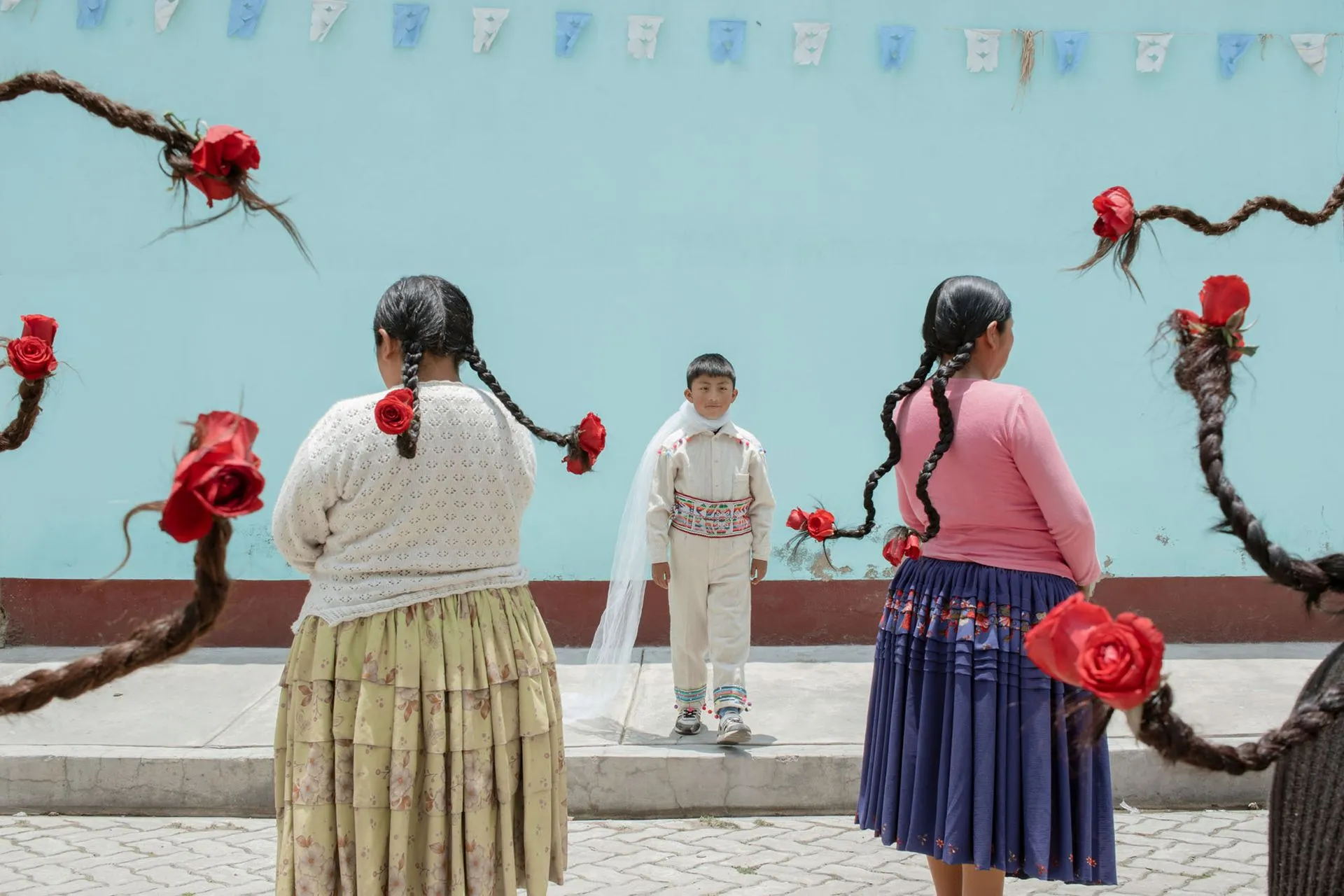
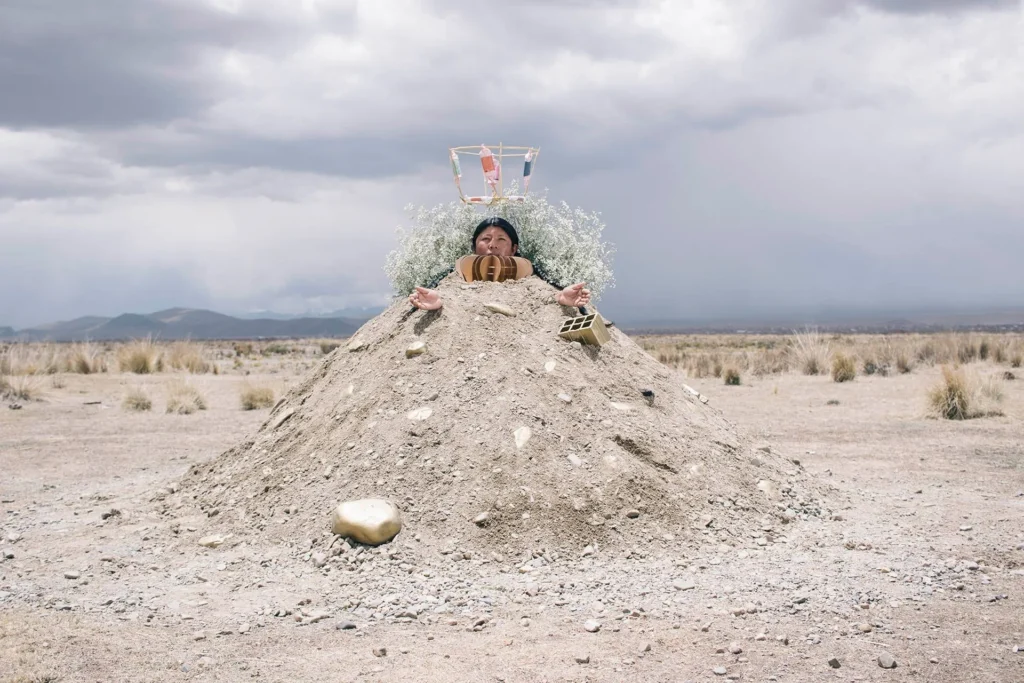
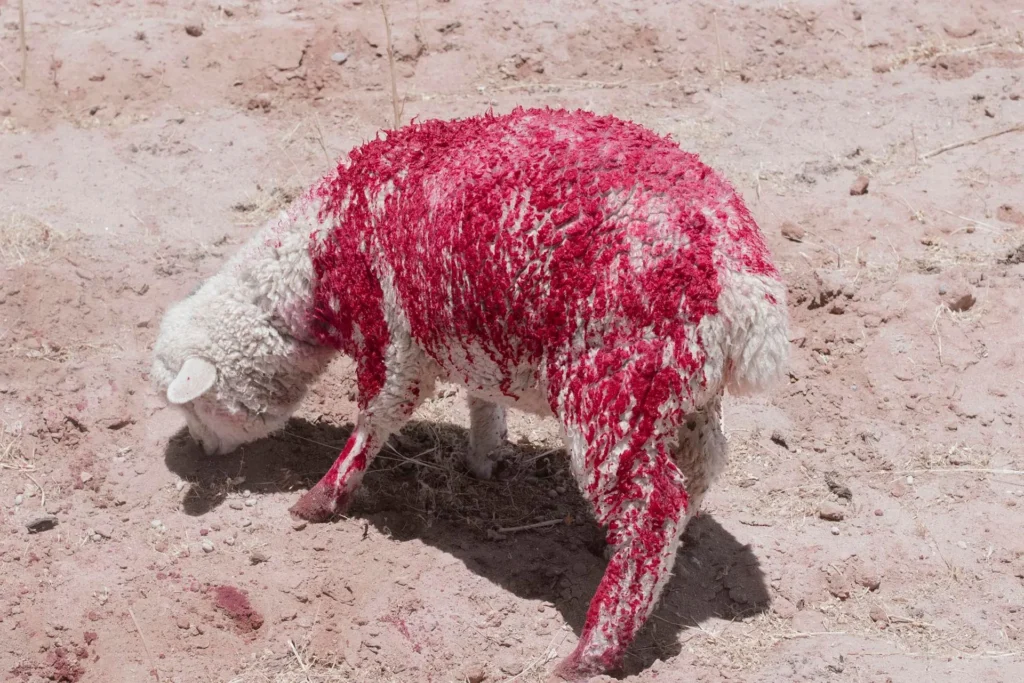
River Claure explores and questions the notion of identity as something essential and stagnant. He also approaches the landscape as an element of identification and identity construction, and how its destruction conditions community identities.
Virgen Cerro from the series Warawa Wawa, 2019- 2020. Courtesy River Claure.
Warawa Wawa is the Andean artist’s first major project, which has led him to exhibit his work at various photography festivals around the world. C& América Latina speaks with River Claure about playing, imagination and artistic endeavor.
Raquel Villar-Pérez [C&AL]: In your work Warawa Wawa, Son of the Stars in Aymara, you created a visual allegory of Antoine de Saint-Exupery’s The Little Prince. Can you tell me more about the project? And why The Little Prince?
River Claure: Warawa Wawa is a project that was born very intuitively and playfully. Something very beautiful about playing is that it is organic. Play is a profound idea that is limited to childhood; however, I believe that playing is an incredible way to generate knowledge.
It’s about recontextualizing The Little Prince in current Andean culture. This point of departure is an excuse to touch on themes such as how the Andes are represented as a rather puritanical and stagnant imaginary construct. It allows me to reflect on my own identity. My grandparents migrated from the Andes to the city in the 1960s and my identity is marked by the modern Western urban experience. The Little Prince allowed me to play, to allude to childhood, to formally produce images that are more pleasant, colourful, etc., and in the end, it was in direct dialogue with the concept of new universes and possible landscapes. The project is me traveling through those imaginary territories.
Oveja from the series Warawa Wawa, 2019-2020. Courtesy River Claure.
RVP: You use the Aymara concept “chi’xi”, which translates as indeterminate color or gray, to refer to that kind of space where cultural hybridity occurs. Your work opposes the idea that indigenous cultures remain fixed as objects of the colonial gaze. You create new images, appropriating the tool the colonizers used. Tell me about how you give meaning to these ideas in your work.
RC: “Chi’xi” means gray, but it also refers to the way to make gray. When they make their aguayos (handwoven fabrics), traditional weavers join colored yarn creating the illusion of a third indeterminate color. Silvia Rivera Cusicanqui was the first to use this concept in cultural sociology. She talks about cultures that are contradictory, but at the same time complementary, and that is what interests me, the variegated, things that coexist in the same place at the same time but are disparate. That is an interesting term for thinking about cultural hybridity, and I think that fantasy can render those heterogeneous identities visible.
In my practice, photography itself is secondary, highly utilitarian and marked by the capitalist logic of mass production and retribution. I think a lot about the construction of the image, and I make that visible through sketches. The camera allows me to record them.
Villa Adela from the series Warawa Wawa, 2019-2020. Courtesy River Claure.
RVP: Can you tell me about the role that play and fiction have, respectively, as process and as visual strategy in your work and how you became interested in those strategies?
RC: Photography carries a very heavy burden in relation to truth, but my work does not address those debates. Play interests me a lot. For me, it’s a space where the emotional meets what is rational and visceral. We have a very modern idea of what it is to be thinking beings, but in reality, I think that we are “senti-thinking” beings and playing is a way to reconcile feelings and emotions with reason. Playing, in part, shapes children and they learn through it. As adults, we maintain a certain rigidity toward play, and I think that we need to unlearn those molds that we have imposed on ourselves growing up. I believe we need to learn how to play.
RVP: Tell me about your process working with communities.
RC: The communities I’ve been working with are communities with whom I identify. I have been engaging Andean communities with my projects and currently mining communities. The way I incorporate them in my projects is very simple: I talk a lot. Working with communities is a long process of dialogue, earning their trust and being honest about my intentions.
Yatiri from the series Warawa Wawa, 2019-2020. Courtesy River Claure.
RVP: What are your plans for the future?
RC: Right now, I am finishing a second big project. The project has to do with former mining towns in Bolivia, where post-industrialism has left its mark on the landscape, where the landscape has been damaged and where the identities of the mining communities have been damaged. I reflect on mining extraction and its cycles, through which the mineral is depleted, and how those cycles impact communities and how their quality of life is depleted. Compared to the first project, it has some more negative and sordid emotions than all the fantasy, play, etc., of the first project.
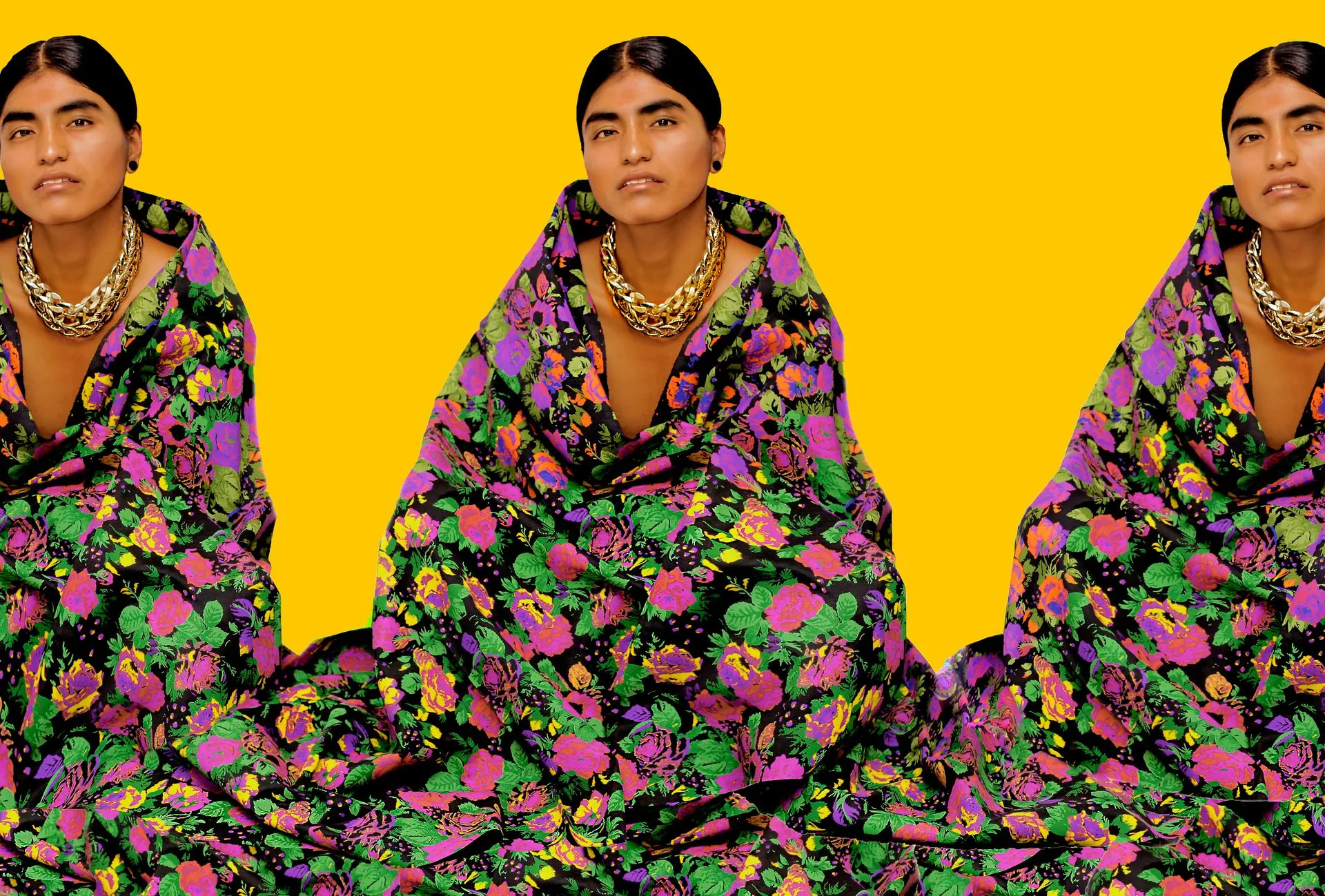
Through their pop art, the duo, Cholita Chic, visualizes the cholita, who for them became the symbol of a physically, intellectually, and emotionally emancipated Andean woman. Inspired by the Latin American Chicha artistic movement, Cholita Chic iconizes and extols this super woman that the cholitas represent.
Inti from the series The Last Heiress of Atahualpa, 2014. Courtesy Cholita Chic.
Because I am part of this revolution, I am the daughter of the sun, granddaughter of the dominion of the highlands, I am Putipa, I am Chelele, I am Mamani, and I am popular art I am Cholita Chic.
Cholita Chic is an anonymous artistic duo based in Arica, a Chilean city on the border with Peru. Formed in 2014, the collective came into being out of the need to make visible and problematise the macho reality in which many Latin American societies find themselves and to create a visual record of the emancipated woman of the future who at the same time preserves tradition.
Raquel Villar-Pérez: How was Cholita Chic formed?
Cholita Chic: Cholita Chic came into being in October 2014, as a result of our participation at an art fair with works by other university students. At the time, we were interested in feminist issues and continuing popular traditions with a view toward the future. At that time, I was living near the market where the cholitas go to sell different items and I was interested in the idea of the entrepreneurial, independent woman. For us, the cholita became the symbol of a physically, intellectually, and emotionally emancipated woman, and Cholita Chic is a manifestation of our commitment to iconise and extol this super woman that the cholitas represent. On an aesthetic level, we were interested in Pop Art and its connection to the popular.
Series emancipation of the ñustas, 2018. Courtesy Cholita Chic.
RVP: Talk to me more about the aesthetic influences of Pop Art on your work. What led you to appropriate and reinterpret that style?
CC: In the 1960s, paralleling Andy Warhol’s Pop movement, there was an artistic movement in Latin America called Chicha, and that was Andean popular art. The concept is practically the same, but it did not have the global impact that Pop art had. Popular art here was focused on music, particularly on cumbia, which is the only cultural element that all Latin American countries shared, and typography to create posters. We decided to appropriate that aesthetic and that creative mode, and we incorporated the use of photography, and we created a post-Chicha movement, focusing mainly on day-to-day images of women. What came out of that was something obvious, something we somehow created as a movement in and of itself, which we call Chicha photography.
RVP: In your work, there are six axes: the border, migration and globalized territories as well as folklore, women and indigeneity. Can you talk about how those six axes intersect in your work?
CC: I think it’s about the territory where we live, Arica. Here, we have three borders—the Chilean, the Peruvian and the Bolivian. Arica historically has been a disputed territory. Before it was Chilean, Arica was Peruvian, and Bolivia wanted to access the Chilean Sea, which is Arica’s. Peru and Bolivia became allies during the War of the Pacific at the end of the 19th century after which Arica became part of Chile. Yet, the city of Arica does not belong to any country. Here, there is no Chilean, Peruvian or Bolivian identity. Rather, a multicultural community has formed here, because of the border. The work moves through the idea of cross-border women, attempting to dismantle the social, political, economic, and judicial patriarchy.
Cholita Chic are the first women to take off their skirts and opt not for an indigenous life, but rather for an independent university and professional life. They are a visualization of the independent indigenous woman of the future.
Skirt Guardian, 2018. Courtesy Cholita Chic.
‘Cholita Chic are the first women to take off their skirts and opt not for an indigenous life, but rather for an independent university and professional life. They are a visualisation of the independent indigenous woman of the future.’
RVP: Can you tell us about this imaginary you are creating about indigenous women and the Andean American experience and how audiences are receiving it?
CC: Creating Cholita Chic was like a political responsibility because it was something that had not been seen yet. As a photographer, one always looks for a story to tell, and as a designer, one looks for a visual solution to a problem. Subconsciously, we started creating visual solutions to problems that we didn’t even think existed. Cholita Chic started out as something small and has grown to such an extent that it is now part of Latin American art history.
We did not expect that Cholita Chic would have the impact it is having. A hashtag #cholitachic was even created, which many young girls use who attend events and identify with what Cholita Chic represents, an independent, entrepreneurial Andean woman, etc. In the end, our practice is generating collective memory.
RVP: Can you explain how you establish an Andean-American message with regard to the Chile-Bolivia contingency?
CC: Arica has its own identity, and the women from here have their own identity. That’s why we talk about an Andean-American identity; in that way we eliminate the imaginary border lines and base ourselves more on territorial existence, which is real. We work with visual language and try to make it as sensitive and inclusive as possible. On the other hand, we rely on the research of anthropologists, curators and other intellectuals to strengthen our visual message.
Series The Last Heiress of Atahualpa, 2014. Courtesy Cholita Chic.
Brown Chinese (Woman), 2019. Courtesy Cholita Chic.
RVP: Why is it important for you to remain anonymous and who are the models of your works?
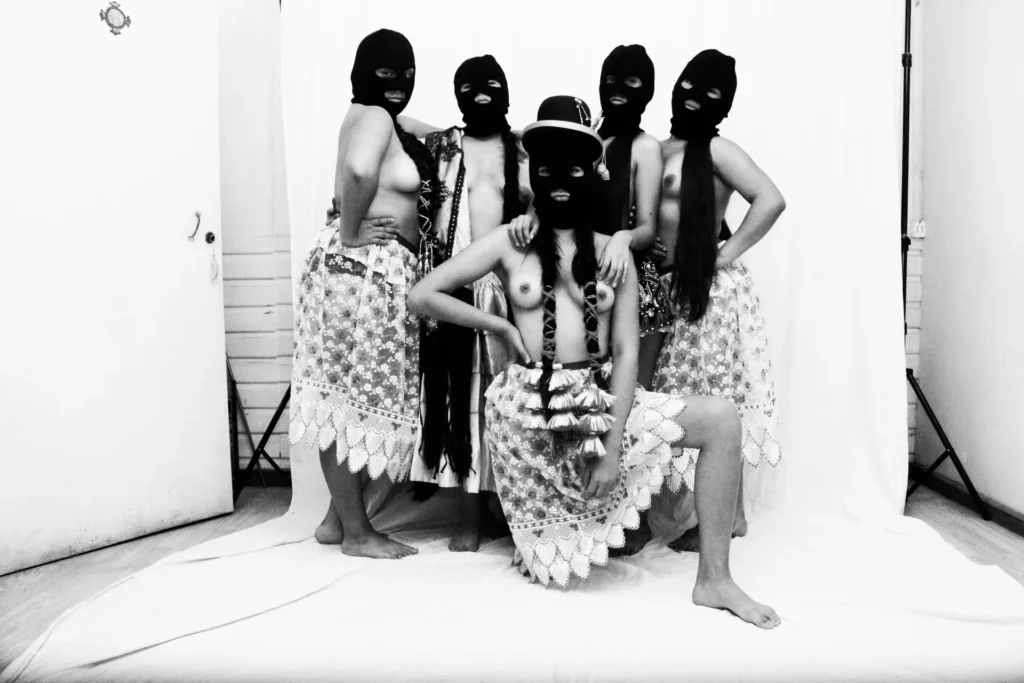
CC: For us, what is most important is conveying the message. We believe that when you know who the author is, it is automatically incorporated into the work, and we did not want the message to be attributed to us. We wanted to create a visual heroine that other women can identify with. In urban interventions we have used ski masks to accompany the work without revealing who is behind Cholita Chic. The performativity of the process of protecting the work; on the one hand, gives the work dynamism and, on the other, brings a poetic solution because in the end we become part of the work.
We recruit the women who pose for the photographs from professional schools located in the valleys where the students are of Aymara and Quechua origin. Also, through acquaintances and friends of friends. For many of them, participating in the photo session means acknowledgment and validation of indigenous beauty. By giving visibility to them and making ourselves anonymous, Cholita Chic could be any one of them. They are the next generation of cholas.
RVP: What does the future hold for Cholita Chic?
CC: We are going to compile everything we have done with Cholita Chic since it began in 2014 and make it into a book format, including other artists’ opinions and interpretations since they feed the collective imagination that we’re trying to create. That catalogue will be published in February 2023.
The next themes we want to work on with Cholita Chic have to do with transvestites in recent folklore. We are going to talk about what it is to be feminine, reflecting on how the feminine is considered a risk factor for the macho system.
(Originally published in Intervenxions part of the Latinx Project, New York University, on 29 November 2022)
Imagined Future 127 from Imagined Futures, 2019. Courtesy Rafael Soldi.
Raquel Villar-Pérez (RVP): Can you tell me who you are, where you come from, what you do, how and when you decided to become an artist, and what the main topics are in your work?
Rafael Soldi (RS): I’m from Peru, born and raised in Lima. I relocated to the U.S. as a teenager. I didn’t always know I wanted to be an artist, but I knew I wanted to do something creative, and photography always intrigued me. I attended an all-male Catholic school in Peru, and the dynamics of masculinity were very charged and difficult for me to navigate. As a queer kid who spent a lot of time isolating from my peers, I could relate to the darkroom as a quiet, safe place to be with my thoughts. Many queer children use imagination and world-building as a coping tool, sometimes this involves magical thinking too. There was a small darkroom in my school, and it was magic to me—the process of creating worlds of my own with my camera and then watching them appear before me was a language I understood. I don’t really work in the darkroom anymore, but images remain at the core of my practice. My work centers on how queerness and masculinity intersect with larger topics of our time such as immigration, memory, and loss.
RVP: That’s a great response and really gives a fantastic overview to your background. How was relocating to Washington DC with your family and then deciding to stay and separating from them? What did you study at university and when did your career start shaping up as that of an artist?
RS: My father’s work with the Peruvian navy brought the whole family to D.C. and after a 2-year term it was time to return to Peru. I was finishing my last year of high school and had decided I would pursue art school. By then I also had come out to my family. With my parents, we decided that it would be best if I stayed in the U.S. I remember my mother telling me that—because of my queerness and my desire to be an artist—I’d be better off staying here. I’m really grateful for that experience and opportunity. Eventually I was accepted into the Maryland Institute College of Art (MICA) where I studied photography and curatorial studies. I loved my time there. The school was so well resourced compared to Peru and I feel like many of my peers took that for granted.
When growing up, I always felt like the world wasn’t built for people like me. Things really opened up for me in the U.S., but no matter what, there was still this lingering feeling that I was away from home. I had an unresolved relationship with Peru, now I understand that to be a sort of grief.
A body in transit (installation Image at Frost Art Museum, Miami, FL), 2022. Courtesy Rafael Soldi.
RVP: I can imagine it must have been brutal for you to realise that you had to stay somewhere whilst your family goes back ‘home’ because ‘home’ is not a place that would accept you. Your work Imagined Futures in a way reflects on the sense of migration, belonging, and what could have been. Can you tell me more about this project, when and how the need to address these topics came about, and how did you connect your lived experience with the universal experience of migration?
RS: It took me a long time to process what you mentioned above, this paradoxical relationship to ‘home.’ At first there was some anger and denial, both a rejection of my home but also a protectiveness of it. Deep down I knew this was a core part of my identity but didn’t know how to contend with it. Over the course of 15 years, I felt sadness and longing and a haunting feeling that I really needed to resolve this. I am now just realising these are the stages of grief. I hadn’t properly mourned that departure, that loss.
I constantly imagined what my life might have looked like if I had never left. And when I shared this with fellow immigrant friends, they immediately shared similar feelings. I called these ‘imagined futures,’ and it struck a chord with me and others who had also had an abstract emotional relationship to this strange experience.
I also thought about the ways I imagined my future as a young person. I was aware of my difference from an early age, and I always knew that the acceptable options for me as a man were all incongruous to my way of relating to the world. I understood quickly that I was incompatible. So, there are these imagined futures too: the ones I imagined as a child, and the ones I imagine now. Imagination traveling from the past and from the future to converge on a point in time altered by migration.
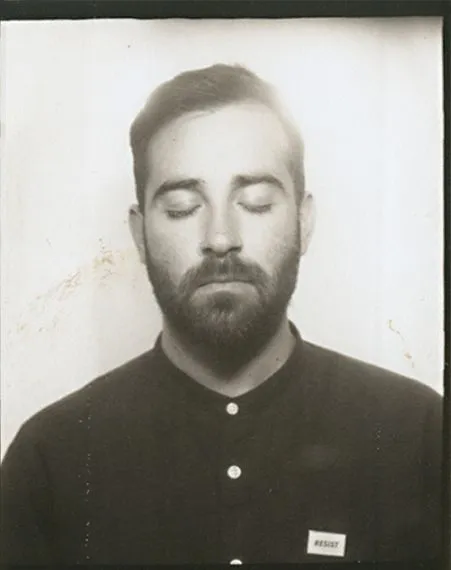
I decided to address these ideas through performance, ritual, and photography. Over the course of two years, I used photo booths, resembling the Catholic confessionals of my youth, as a stage for performative rituals and a witness to a farewell. I have had a complicated relationship to Catholicism, so this became a way for me to reclaim the experience of confession. Every time an imagined future visited me, I found an empty cabin in which to close my eyes, acknowledge its presence, thank it, and give it permission to leave. Through this process I was able to say goodbye again and again, and the repetitive action of acknowledgment, gratitude, and release became very healing. It was how I addressed this monumental and yet very ambiguous grief that I and so many immigrants experience.
A body in transit (installation Image at Frost Art Museum, Miami, FL), 2022. Courtesy Rafael Soldi.
RVP: Your project Entre Hermanos, also included in your current solo exhibition A Body in Transit at the Frost Art Museum, expands from Imagined Futures by zooming into the experience of migration of the queer male identifying Latinx community. How was it to reach out to this community and get them excited about participating in the project, and what did it mean for them and you as a community to come together and share your own experience and ‘imagined futures’?
RS: My intent is always to use personal narratives to create a language that others can relate to. When I completed Imagined Futures, I immediately knew that there was an opportunity to share this framework for grieving with other people with similar experiences. I worked with an organisation in Seattle called Entre Hermanos, founded during the AIDS crisis to provide services to Latinx LGBTQ community.
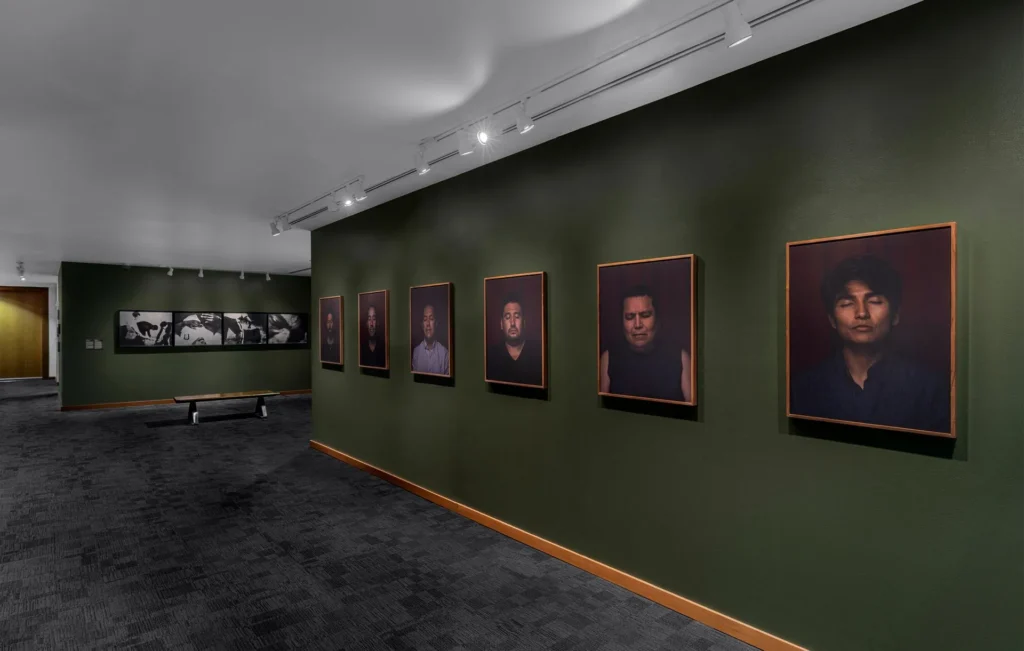
Through them I invited male- and queer-identifying Latinx immigrants for a collective moment of discussion and reflection. We facilitated a private conversation around how each perceived their future as young people in their countries of origin, and how that perception may or may not have changed over time. We continued to reflect on the role of imagination for queer Latinx people, and how we could reimagine our pasts and futures today. It was an emotional evening, with varying levels of acceptance, forgiveness, and grief, as well as stories of rebirth, transformation, and resilience. Each participant was then invited into a photobooth that I built, asked to close their eyes and hold a shutter release while I walked them through a deep meditation. At any point during this quiet, intimate time, the individuals were able to make a self-portrait if they desired.
RVP: These two projects, Imagined Futures and Entre Hermanos, are portraits and the subjects appear with their eyes closed. Can you tell me more about this choice?
RS: The closing of the eyes was an intuitive choice at first. It just made sense to me, this was an internal process, a ritual. It was also a strategy of refusal. The eyes are often the way we connect to portraits, and by closing them I am turning the viewer away from an internal world, forcing them to use their own imagination and look inward into themselves.
Curator Miguel A. Lopez put it beautifully in his essay in my book. He wrote, ‘each photograph has a ghostly quality, as if his body were both present and absent. What is truly important about this work will not be found in what we see—in the photograph—but in his private reunion with himself, to which we are but distant, mute witnesses. This simple act of not looking into the camera’s lens perverts the intended function of the traditional ID photo, symbolically refusing to be defined by that homogenizing form of representation and its commitment to surveillance. Through this archive of photographs of his own motionless body, Soldi not only expresses his own personal grief; he also describes a shared mourning for all that we are often forced to leave behind—a land, a family, a language—in order to be able to keep living.’
RVP: Your next project, CARGAMONTÓN, has a very different approach, where we can see intertwined bodies and limbs, with no frontal faces. Can you tell me more about CARGAMONTÓN and your process for this project?
RS: CARGAMONTÓN naturally developed from these earlier projects. I started thinking a lot about the all-male Catholic school I attended most of my life, and how much it influenced me and the boys around me. It was a hotbed for toxic behaviour and now I look back at it as a laboratory for understanding masculinity.
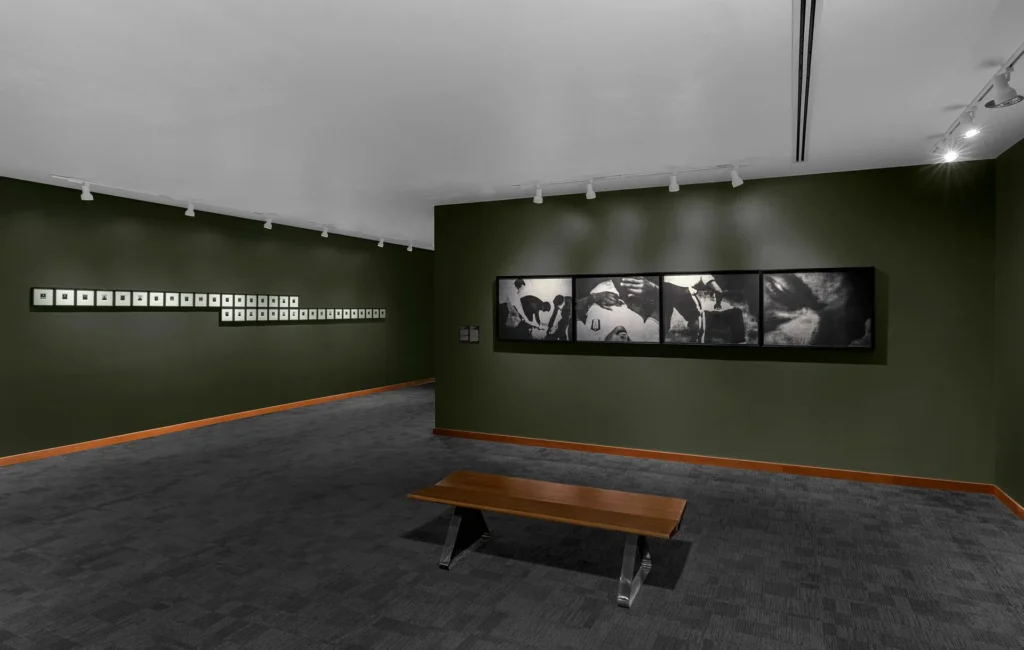
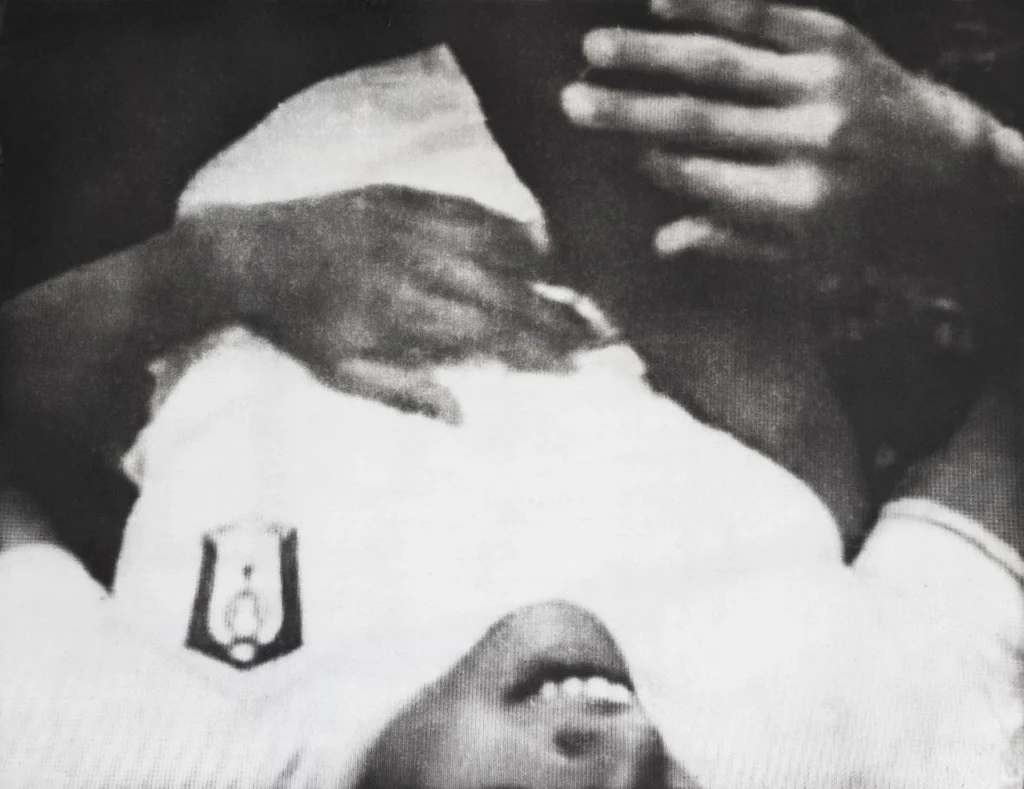
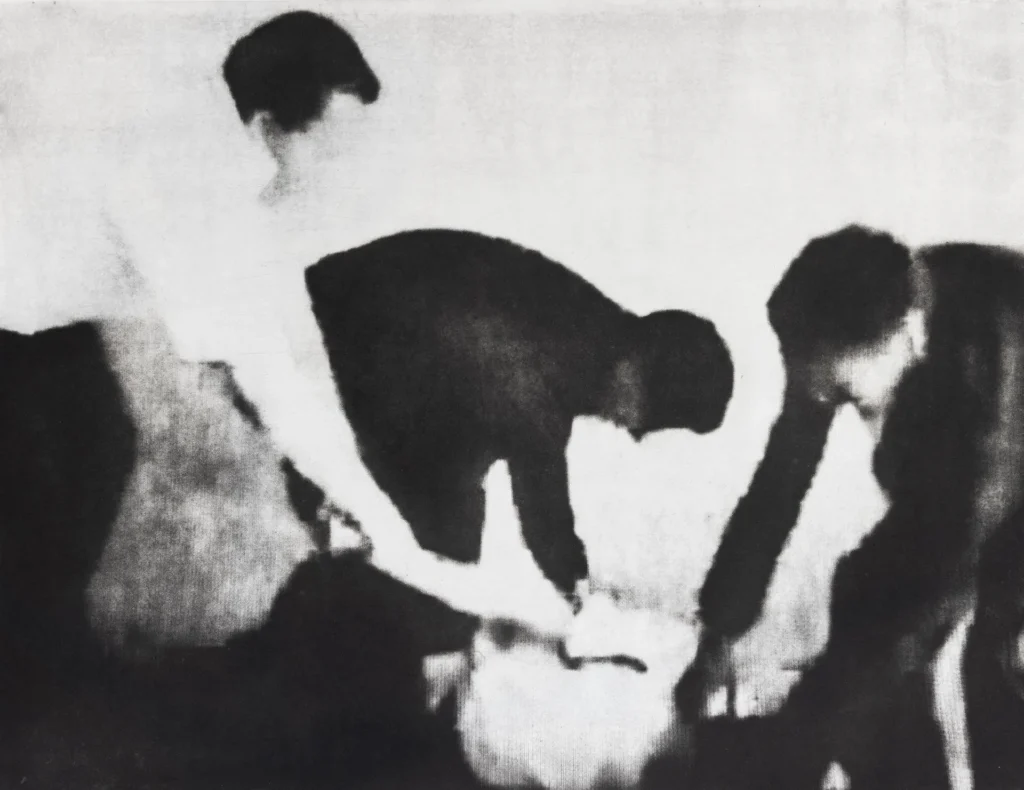
CARGAMONTÓN is a portfolio of eight aquatint photogravures probing masculinity, intimacy, violence, and rite found in adolescent horseplay that hovers between bullying and homoerotic self-discovery. It began with the memory of a “game” we played in the school yard named “Cargamontón” (which translates to gang harassment). The object of the game is to wrestle a boy to the ground, and then bury him under a pile of classmates’ bodies. It was a form of bullying, of exerting power over that one person, of humiliating him. I’m interested in the vehicles boys create to access touch and intimacy. As someone who was teased for being gay and a frequent victim of this action, I both resented the humiliation and welcomed the opportunity to be entangled with the bodies of other boys. I knew that homosexuality was considered unnatural, and therefore I felt the price to pay for intimacy was violence. Now I understand how isolated all boys are from touch, and I see these rituals as mechanisms for asserting power and masking desire, as part of a larger exploration of masculinity in Latin America.
I began by accumulating an archive of found videos that Peruvian teens engaged in this game posted on the Internet. I then selected stills, which were transformed into enormous copper etchings with which we made beautiful prints through the aquatint photogravure process, merging 21st- and 19th-century processes. The result is a series of images akin to obscure memories that depict bodies vacillating between torture and pleasure. My intention is to place the viewer in the position of having to decide whether they’re witnessing violence or playful intimacy.
Cargamontón (CM02), 2022. Courtesy Rafael Soldi.
Cargamontón (CM01), 2022. Courtesy Rafael Soldi.
RVP: I find it very interesting how you describe this situation of violence and expand on its ambivalence. I read a paper where the writer argued that teenage bullies become so because of how ambivalent they are regarding expectations from adults and society at large; they desire something because it is what they’re told they should wish, and at the same time they rebel against it. In societies where toxic masculinity prevails, I imagine there will be many teens struggling with the aspiration to become and perform the idea of ‘macho’ within the society’s imaginary. Do you think is this the case? Do you think Latin American societies are changing to this?
RS: Absolutely, this is true. I think the obsession with projecting a certain masculine image is the product of a paradoxical relationship to it. There is both a pressure—from society, the media, friends, religion, fathers, and mothers—to perform and embody this identity, and at the same time a deep sense of loss of who we were before we were told how to be a man. So we embed our own rebellions into the system. There is a great artwork by Barbara Kruger, it shows a group of men brawling in suits and over it the words ‘You create intricate rituals to touch the skin of other men.’ That’s it, essentially—we lean on these systems of violence and aggression, which affirm our masculinity, to legitimise our desire for intimacy. We take opportunities for touch and connection and turn them into power struggles so we can say, in the end, that we were just trying to prove who was more of a man. That’s why often the most charged arenas of masculinity also tend to be the most homoerotic.
I should clarify a few things here. First, masculinity is not a monolith. Masculinity isn’t inherently bad; it is simply a fact of life. Bell Hooks’ book The Will to Change does a great job in explaining the importance of looking at masculinity critically through a feminist lens. Hooks says that the real issue is the system that produces patriarchal masculinity. It’s important to shift how we think about men who participate in patriarchal masculinity—not to think of them as just abusers and bullies, but to think of them as victims of the patriarchy. We must understand that we are all born free of these concepts, and at a certain age someone decides that the time has come to ‘act like a man.’ That child is now a victim of patriarchal masculinity.
I do think Latin American society has made big strides in the right direction. Sadly, at its core, we’re still governed by very traditional values. I like to point both of these realities out because I’m aware that my work focuses primarily on my experiences during my school years, in the ‘90s and early ‘00s. My understanding is that things are quite different now in many ways, and I’ve seen many of my heterosexual childhood friends develop caring, intimate relationships with one another that stand for a beautiful and honest version of masculinity that requires a real investment in authenticity. At the same time, I’m amazed at how little things have changed. I still encounter very toxic views, and it’s like whiplash! The patriarchy is alive and well.
RVP: Lastly, are there any new projects you’re working on? When should we expect to see some sneak peeks of them?
RS: I am preparing for a solo exhibition at the Frye Art Museum that will open in October 2023. The centerpiece of this exhibition will be a large-scale, 4-channel video work expanding on my exploration of masculinity in Latin America, through the lens of my school memories. The film will follow a group of uniformed school-aged boys as they perform a series of rituals in a black box theatre, thus revealing the absurd nature of the architecture of masculinity once removed from its context.
I’m also working on a new series of text works exploring language and bilingualism. These are in early stages, but they use humor, queering, mishearing, journaling, translation, and word construction/deconstruction to reveal the liminal space between languages that many immigrants find themselves in.
Tracing the practices of Ana Teresa Barboza, Sandra Monterroso, Yee I-Lann, and Aboubakar Fofana, this essay elucidates on the colonial history of indigo dye as well as how contemporary artists from the Global South are giving new life to this famed and unique pigment.
Sandra Monterroso, El Agua Se Volvió Oro, El Río Se Volvió Oro, El Oro Se Volvió Azul, 2019. Courtesy Sandra Monterroso Studio.
Indigo in English, añil in Spanish, and adire in Yoruba are the different names that this singular blue pigment extracted from the plant Indigo tinctoria and its many variants has. Textiles and ceramics are the most extended examples of the ancient use of indigo dye in elements of the material culture of these regions. The earliest evidence of indigo was found in a piece of cloth in Huaca Prieta, an ancient Peruvian burial site located in the north of the country, and it is believed to be about 6,200 years old. Nowadays, this multipurpose tincture has also entered the cosmetics industry, and is also used for its medicinal properties.
Like almost with every endemic product to the Global South at the time, the increase in the cultivation of indigo was closely tied to the history of imperial expansion, colonisation, and the transatlantic trade of enslaved africans. Particularly in Latin America and Asia, the pigment extract was highly valued as the world’s finest source of blue. The proliferation of indigo cultivation in plantations became a top priority in the agenda of settlers in these regions as it became an instrument for political influence and a marketable commodity used to feed the European demands on produce from the colonies. In the late 19th century, with the popularisation of blue jeans, the artificial tincture was invented to respond to the rising demand of this dye, provoking a steep decline of indigo crops.
Nowadays, the indigenous use of natural indigo persists even if at a small scale. Contemporary artists across the world incorporate the use of this pigment to their work to reflect on notions of nature and indigenous knowledge, and to interrogate colonialism, and the decolonial turn.
Ana Teresa Barboza, Hilar from Detrás del Textil series, 2018. Source: https://www.anateresabarboza.com
Ana Teresa Barboza (Perú, 1981) is a multidisciplinary artist who employs principally textiles. She is interested in exploring the provenance of the natural fibres and pigments in connection with the different landscapes where these are found and their peoples, guardians of ancestral knowledges. Barboza uses indigo extensively, a dyeing process that, as if a magic trick, only starts showing the results after you remove the fibres from the mixture. In Detrás del textil –Behind the textile– (2018-19), Barboza intervenes photographic images with textiles, contrasting the immediacy of printing on paper with the laborious and meticulous work of weaving. Ultimately,Barboza’s cloth works are a meditation on time.
Indigenous artist Sandra Monterroso‘s (Guatemala, 1974) video-performative practice addresses the vagueness of temporality. Similarly to Ana Teresa Barboza, Monterroso also finds inspiration in nature and ancient practices of dye that she blends with three conceptual axes in her work: the materiality of the medium, a connection with spirituality and ancestry, and the history of coloniality in Mesoamerica, the Abya Yala. In her works, she incorporates natural dyes for their political load –particularly indigo pigment or Mayan blue as it is known in Guatemala, was levelled up to the status of gold during the Spanish colony, as well as for their healing properties, symbolically appealing to the revival and appreciation of Mayan ancestral practices for the definitive healing of the colonial wound.
In her work El Agua Se Volvió Oro, El Río Se Volvio Oro, El Oro Se Volvio Azul, 2019, Monterroso appears lying under a large cloth hanging from the wall and on to the floor. The textile is made up of indigo-dyed güipiles, an indigenous garb hand-embroidered by women. This work interrogates extractivist practices in Guatemala that contaminate natural sources of water such as rivers, lakes, and oceans. By turning gold and then blue, the artist metaphorically suggests their initial appeal and consequently, the loss of their healing properties.
Yee I-Lann, The Orang Besar series: Fluid World, 2010. Courtesy Silverlens and Yee I-Lann.
The artist Yee I-Lann (Malaysia, 1971) has referred to indigo as a ‘shared global language.’ I-Lann has incorporated the pigment to various of her works. In her Orang Besar series (2010), the artist merges photography and batik together in an attempt to expand both mediums. Within the series, the work Fluid World combines Japanese indigo dye on Chinese silk using the Malay batik technique to talk about influence and resistance. It shows a map of the Southeast Asian region, particularly the oceans that surround Southeast Asia mainland. Fluid World is a map about exchange across the region, understanding oceans as highways of knowledge. It is also a map about resistance and the choice of batik is not fortuitous; batik is a technique of wax-resist dyeing applied to a piece of fabric and it is originally from Indonesia although now is found in other places such as West Africa. Dye doesn’t infiltrate the waxed areas, resisting that way the influence of the colouring process, but it does enter the cracks. I-Lann is interested in the poetics of the batik crackle as a place of hybridisation. The artist utilises this symbolism to talk about Southeast Asia as a cultural melting pot favoured by the ebbs and flows of the seas.
It’s been seen that indigo is used largely for dying textiles, traditionally considered to be a space for the feminine, and in fact, when looking back at the history of art, traces of women’s voices across the globe tend to be found in the visual language of textiles. Yet the male artist Aboubakar Fofana (Mali, 1967) who fell in love with the technique of indigo dyeing at a young age, is a guardian of this ancestral knowledge at the same time that he experiments with the traditional uses of the pigment in his oeuvre.
In the work of the Malian, we also find the themes addressed by the artists above, that is communion with nature, time and atemporality, and spirituality. For Fofana, his practice functions as a conduit to the divine. The artist was one of the participating artists at documenta 14 in Greece 2017 with his work Ka Touba Farafina Yé – Africa Blessing, an installation consisting of 54 live sheep, one for each of the countries composing Africa, dyed with natural indigo.
This project reflects on the divine and the paradoxical reality of migration. On the divine because sheep are a revered animal as it is a source of food and clothing. And on the paradoxical reality of migration because, on one hand, it is a traumatic experience having to leave behind one’s country and the loved ones to travel on to the unknown facing a multitude of perils, and on the other, the migratory process only brings richness into to country the travellers settle in.
Circling back to Yee I-Lann’s consideration on Indigo being a ‘shared global language’ and the metaphor of the batik crackle, indigo dye withstands modernity and the fast pace of life. Yet through conceptual art, it moves beyond the handcraft realm, creeping into the art world and allowing for experimentation and expansive creativity.