Author: raquelvillarperez.com

  • Guerra and its Unexpected Polysemic Unfolding 

    Guerra and its Unexpected Polysemic Unfolding 

    (Originally published in A*Desk on 12 September 2022)

    Exquisite materials, seamless not-all-familiar-for-Western-eyes shapes, and a rich multi-layered background is whatGuerra, Nikki Luna’s most recent series, encompasses.

    Guerra, 2021. Courtesy the artist.

    Luna’s oeuvre addresses notions of misogyny and women’s rights. She engages particularly, with the stories of vulnerable women, reversing their position of subjugation into one of power. For years, Luna had been ruminating how to tell and elevate the story of the women closer to her, and how to tell her own through theirs, that of an educated independent woman that is where she is because of them. Guerra, the maiden name of Luna’s matrilineal lineage, is an exercise of care and appreciation towards the women in her family; her mother, grandmother, great great grandmother, and aunts.

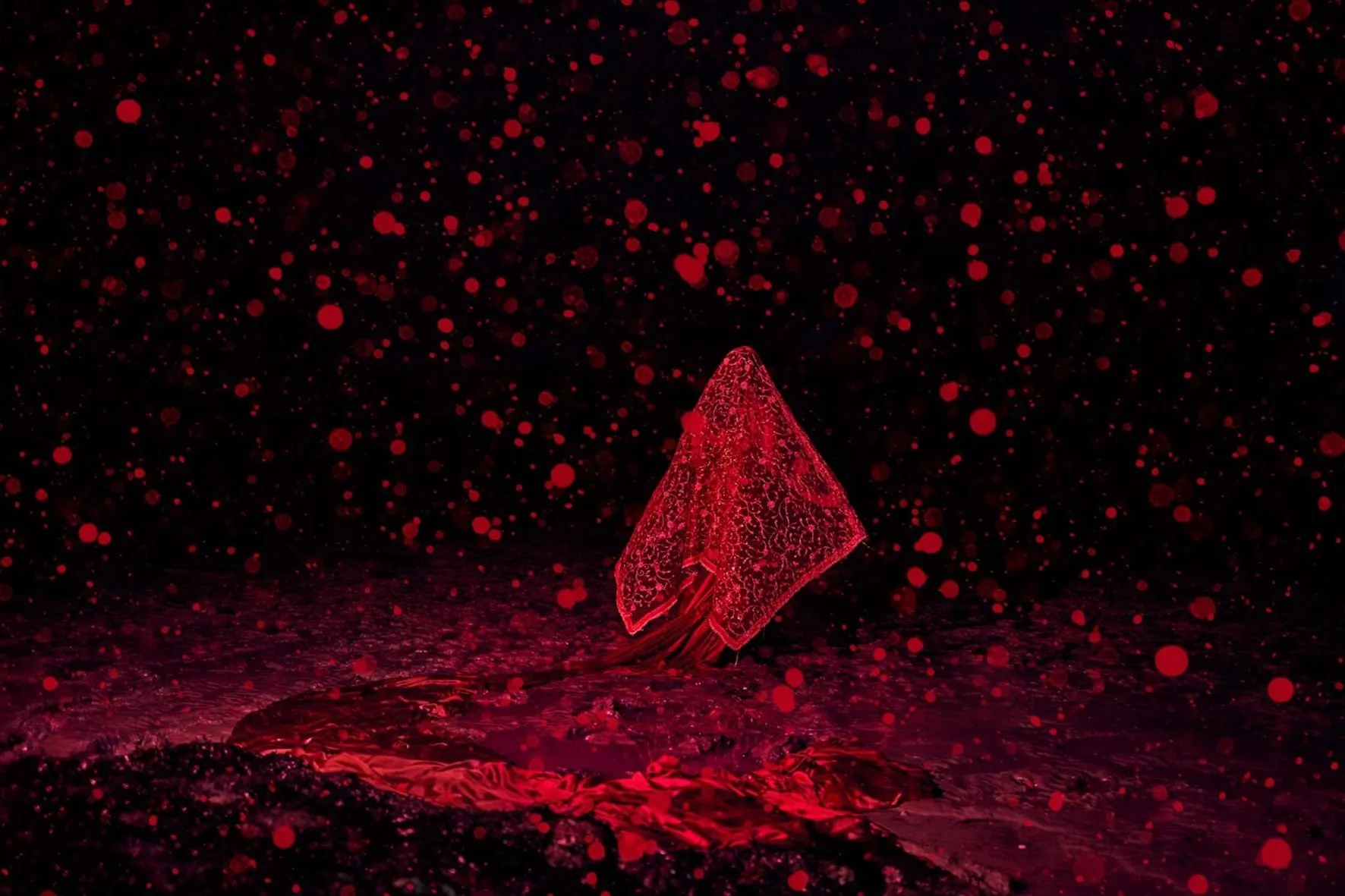
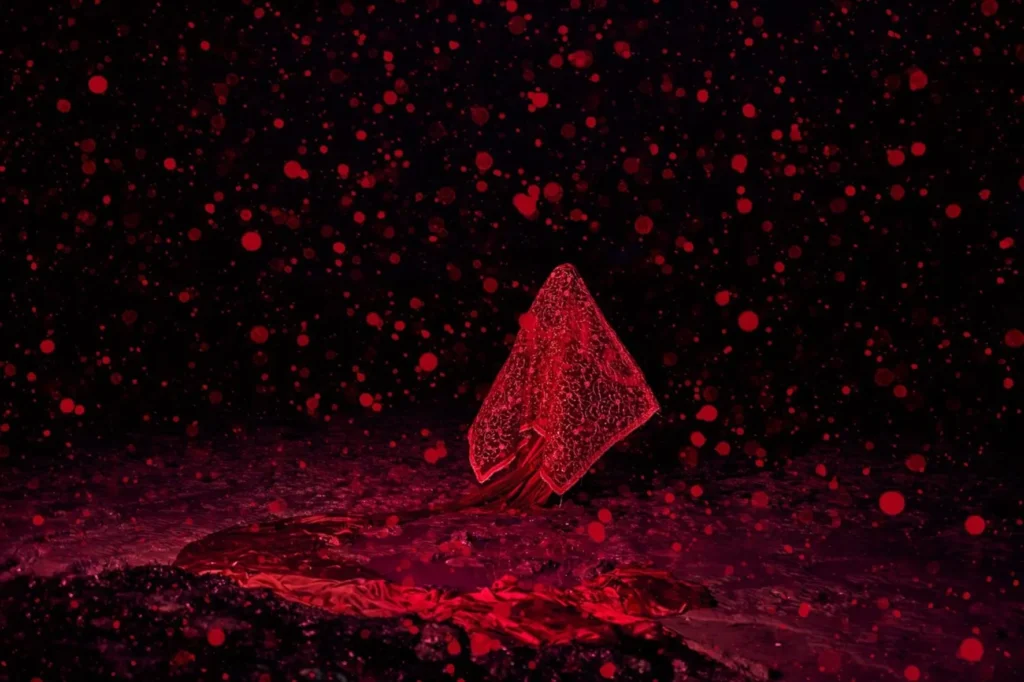
    In the past few decades, the Philippines has seen a steep economic growth, a direct consequence of the remittances of millions of Filipino citizens working abroad. As of 2005, about 70% of the international labour migrants were Filipino women, who fill up the demand for unskilled workers particularly in the care sector. Five of the eight of Luna’s aunts left the Philippines undocumented to search for work opportunities abroad. Her mother and three other aunts stayed and became a homemakers instead, commonly, an undervalued job. The Labour Landscape pays respect to the struggle lived by these women by safeguarding on mulberry silk their sweat and tears; precious bodily fluids that embody the longingness to come back home, shared by labour migrants.
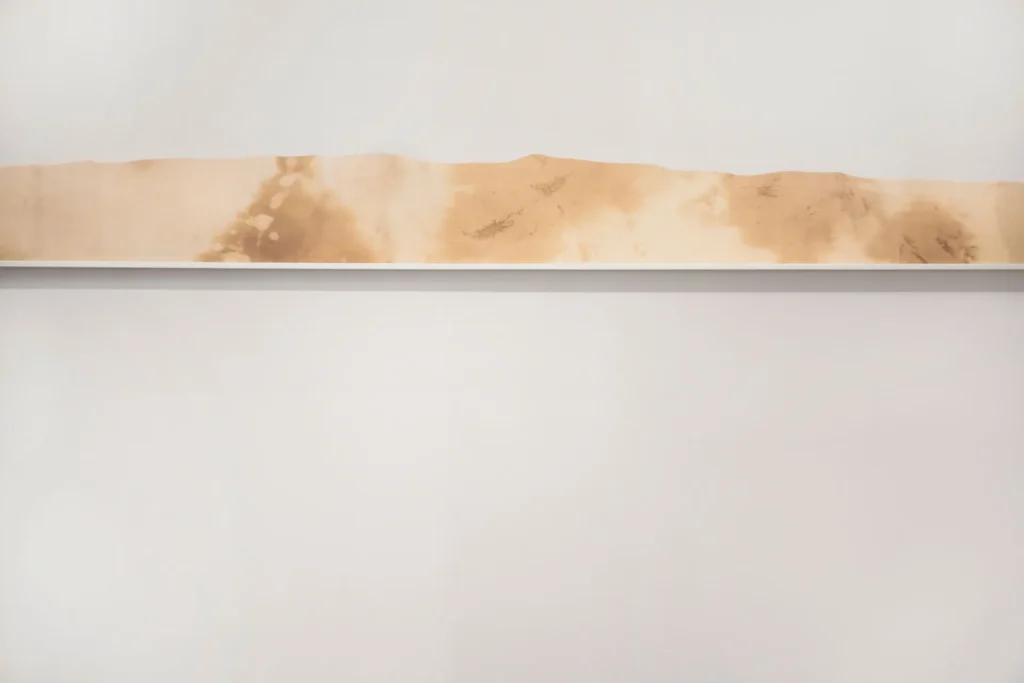
    The Labour Landscape, 2021. Courtesy the artist.

    Eight are also the number of blades or bolos represented in Steely Bloom, one for each of the women who Luna grew up with, but also the number of rays in the sun of the Filipino flag. The 8 rays represent the 8 provinces that revolted against Spain and one of them, was Luna’s mother’s province, Batanga. Used primarily in farming, upon arrival of the Spaniards, the bolo became a revolutionary weapon that helped the locals to uprise against the colonial settlers. In the context of Luna’s work, these bolos become a metaphor of the battles fought in silence by women who give themselves to others. The steel mirror finishing invites the audiences to confront their colonial past and to interrogate the preconceptions they have on the Philippines and Filipino women.

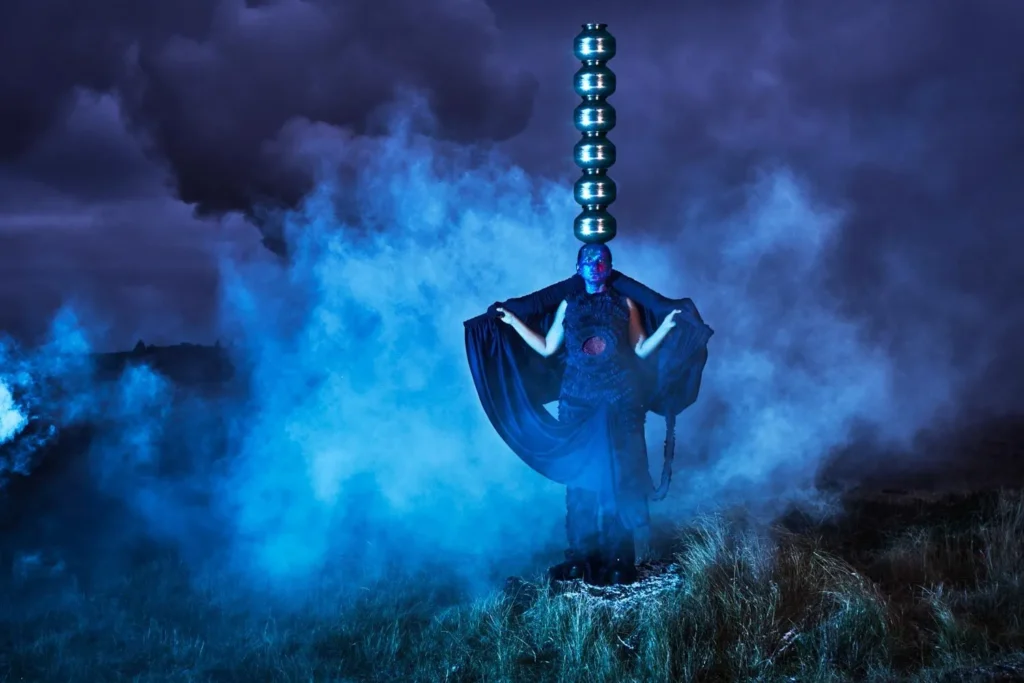
    Learning about the story of her great great grandmother who used to head carry homecooked tulingan (mackerel tuna) and fermented bagoong (shrimp paste) or commodities to sell outside the market, made the artist find the root of her interest in the stories of women working in the informal sector. Wound Cloth is an installation of fifteen pieces made of porcelain, three of which are bathed in 18 karat gold, resembling gikins –headgear– hung from the ceiling. It symbolises the carrying of the heavy load of reproductive and productive work, that is unpaid and paid work, a well-too familiar scenario also shared by women across the world.
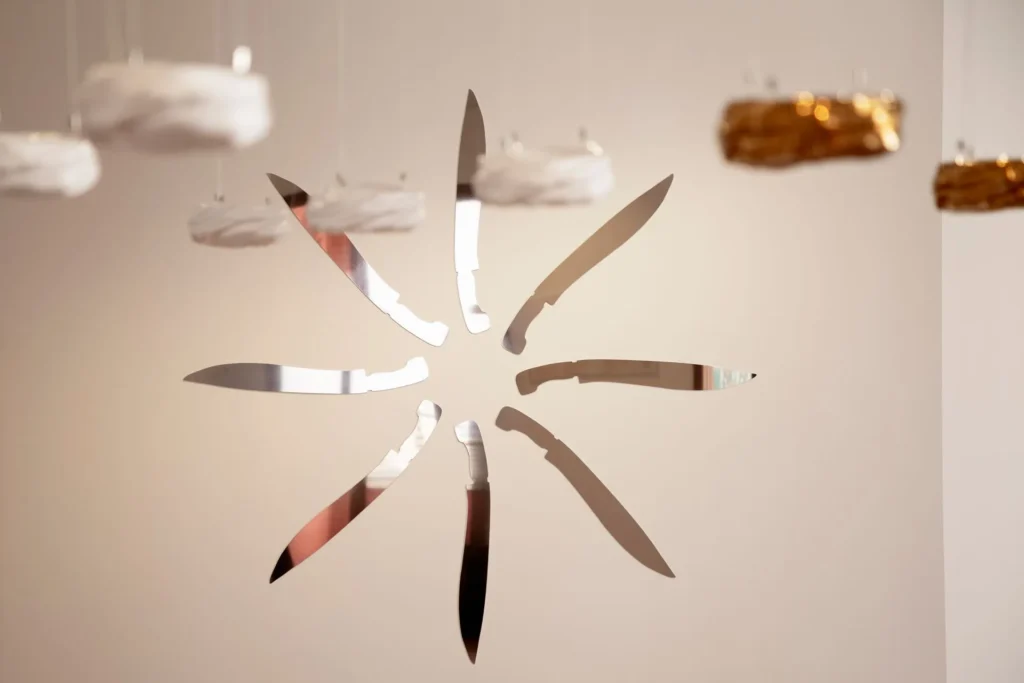
    Steely Bloom and Wound Cloth, 2021. Courtesy the artist.

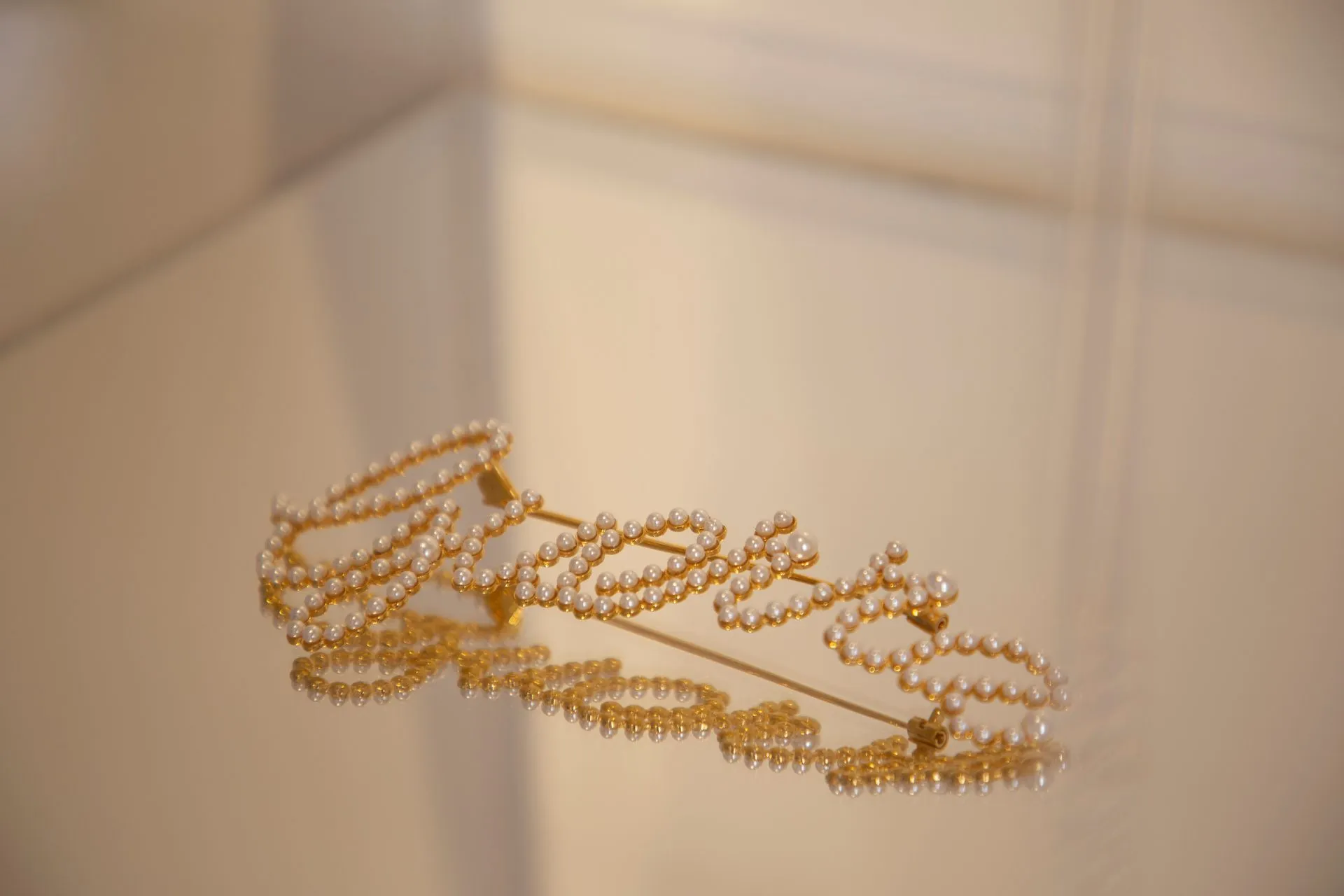
    In 1751 the Spanish missionary Father Juan J. Delgado dubbed the Philippines  the ‘Pearl of the Orient Seas’. The artist has produced a brooch spelling the word ‘Guerra’ using pearls and 18 karat gold to talk about the beauty, richness, and abundance found in the archipelagic country, and consequently, its susceptibility for looting and exploitation. The work shines light on the way Spain first, and the United States and Japan after, seized and abused the Filipino lands and peoples during colonisation, and how it carries consequences to date, not only in the Philippines, but also on the imprecise and essentialising profiling of Filipino nationals abroad.

    Guerra was Luna’s first solo show in Spain, exhibited at Casa Vicens in Barcelona during the first half of 2022. Paradoxically, the title of the project became the leitmotiv of the artist’s exhibiting experience. As the artist explains to me, a succession of bad practices on the part of the curator and the institution, tinctured the experience with frustration, anger and, in last instance, with call-outs on social media on Luna’s part, in search of shaking the institution into awareness. Nil financial support towards the production of an exhibition to premiere in their premises, neither towards the artist’s transport or accommodation  whilst she was installing the show and/or for the various artist’s tours she has delivered throughout the exhibition, and the suggestion of a percentage of any potential sales to go towards the exhibition curator’s private artist’s residency, amongst others.

    I cannot help but to ponder about power-relations in the art world in connection with colonial elements of white superiority and privilege. As a foreign artist willing to enter a new art ecosystem, Luna saw this exhibition as an opportunity that could open doors to her. As a Brown woman, was she thought to be naïve, inexperienced in the Western art world, and eager to show her art at a weird and of questionable-practices hybrid art experiment? If so, they were definitely wrong. Not only did Luna manage to disassociate her name and exhibition from the curator’s name, but in an interesting turn of events, the artist decided to start her own war against the senior team at Casa Vicens. She used her social media channels (@nikkiluna) to publicly denounce the ignorance, mismanagement, and obstruction of the exercise of her moral rights as an artist. Luna finally managed to tell her story the way she chose, and she and her work were paid some respect.

    Guerra pays homage to all the selfless women in Luna’s life who, despite any difficult circumstances kept their head up and pushed forward for the benefit of new generations of women to come. Similarly, by standing her ground and assertiveness, Luna has helped to improve art environments and make way for professional practices in the arts.

    For more information on Nikki’s work, please visit http://www.nikkiluna.com/

  • Winding the Roads to the Self

    Winding the Roads to the Self

    (Originally published in Photomonitor in May 2022)

    ‘I am basking in the unexpected warmth of the heliosphere… You were there, standing alone, offering prayers for the days past and the days to come. As I walk towards you, you recede from me, you surround me. I am no longer afraid. I fear no more.’

    – Poulomi Basu, Fireflies

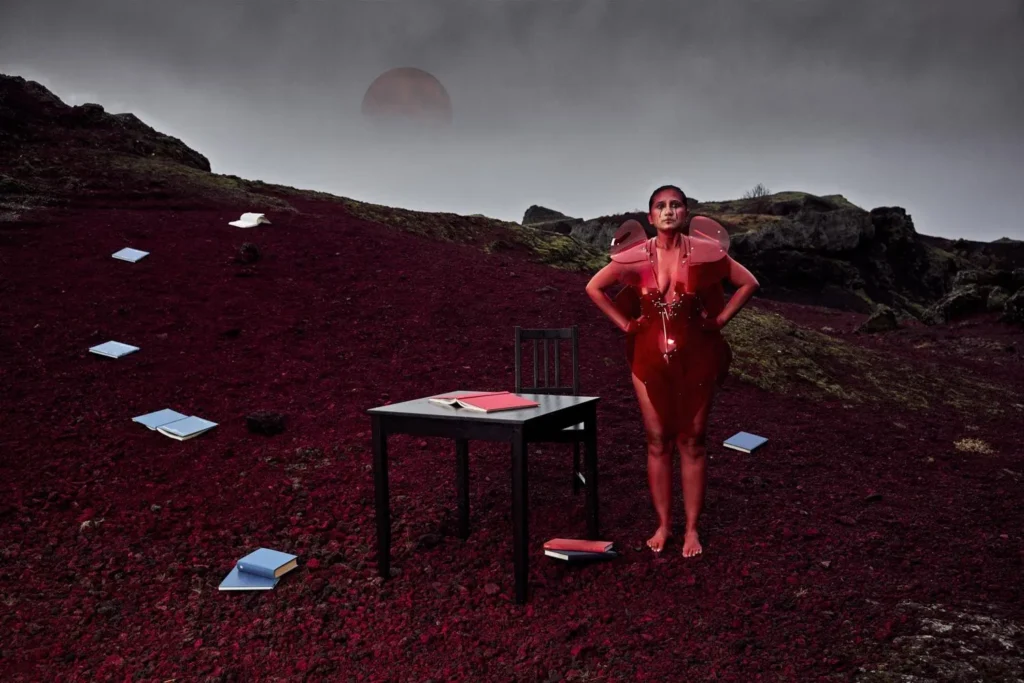
    Walking into Darkness, from Sisters of the Moon, 2021. Courtesy Poulomi Basu.

    The above verses stayed with me for weeks after I visited Poulomi Basu’s latest project Fireflies on show at Autograph (2022). The artist’s personal journey is one of defiance, resistance, growth, and healing – should the ghosts of the past ever completely disappear. Fireflies functions as a visual ode to the long and winding road that the artist has taken to confront and assert the one true self.

    Basu uses the imaginary power of magic realism – a narrative strategy that inserts mythical elements into an apparent realistic fiction – and science-fiction to foreground her own story, her mother’s story, and the story of other women who have opened themselves up to the artist. Deeply personal and emotive, Fireflies means a radical turning point in the Bengali artist’s career, aesthetically and conceptually where she turns the camera upon herself to reflect on her own experiences of trauma and rebirth; ‘vulnerability is often seen as a weakness, but to me it’s quite the opposite; it’s always been my strength. By being vulnerable and showing it, is how I have learned to conquer shame and embrace the fact that I’m not alone.’1

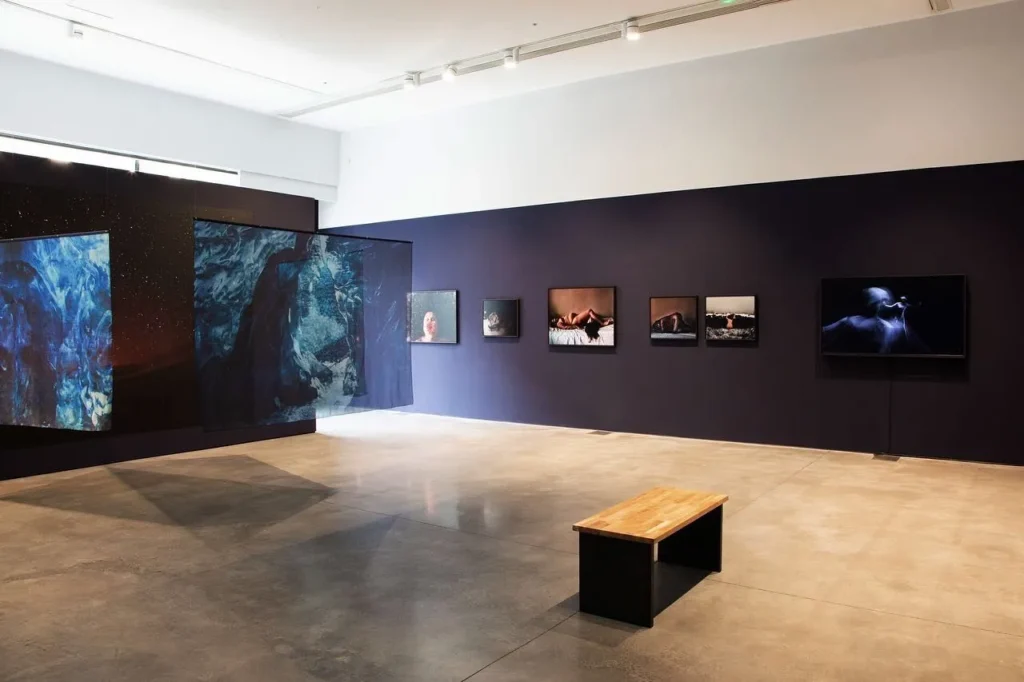
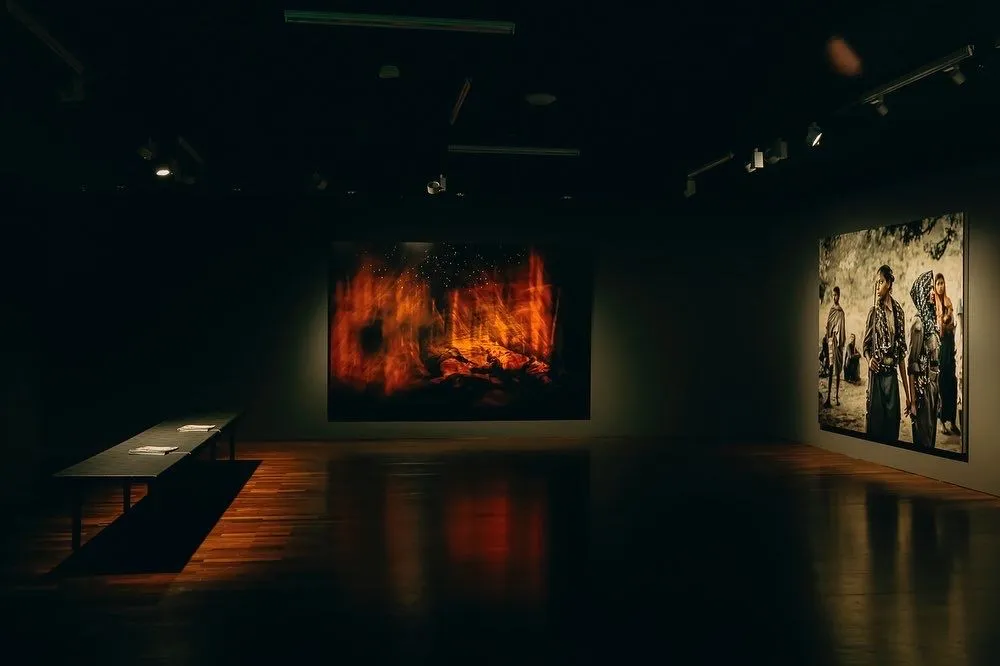
    Fireflies, installation view at Autograph ABP, Rivington Place, London. Courtesy Poulomi Basu.

    Born in Calcutta, in the bosom of a male-dominated and abusive household, Basu soon understood the situation of inferiority to which women in her surroundings were left. Encouraged by her mother and grandmother who had been child brides, Basu left for Bombay at the age of 17 and later migrated to the UK. ‘I remember how you told me that tradition would trap me if I did not leave. So, I ran, and kept on running.’2 And the journey to her resurrection began.

    Fireflies symbolises the closure of a full circle whereby Basu’s practice has taken her back to her origins; the artist incorporates cinematic influences she was exposed to from an early age into her newer works. Informed by the Parallel Cinema movement in India, and highly influenced by the master Satyajit Ray, Basu, alongside filmmaker CJ Clarke, created two video works as part of the project. In one of them, a lone faceless figure dressed in a grey bodysuit dances to no music in a spatial void; in the other one, a feminine voice off interlaces a present story of space exploration with the memories of her personal one. Having always given visibility to other women’s stories, Basu now narrates her personal life-story where the artist faces her past and starts making peace with it.

    The artist combines carefully crafted portraits of herself and her mother where their bodies embrace, with images of lone figures against the vast and sublime backdrop of beautiful natural landscapes. Formalistically the artist expands beyond the frame of the photograph and experiments with different supports and display formats. Images of glaciers are printed on translucent fabrics that form an immersive installation in the middle of the space. On one hand, the fabrics that resemble veils function as portals through which you can experience the framed works on the walls; on the other, they add to the enigmatic yet solemn atmosphere within a gallery that honours all the women who have supported Poulomi along her journey: ‘I owe it to the women who have opened themselves up to me. I want them to know that we are fighting this oppression together. We are doing this with collective agency. Our voice of resistance.’3

    The Burden of Carrying Water, from Sisters of the Moon, 2021. Courtesy Poulomi Basu.

    Basu’s practice has revolved around advocating for women and girls, greatly influenced by the injustices she witnessed when volunteering at women’s care homes during her teenage years. Many women in India are considered disposable and dumped by their families, so, following a story-telling style, the artist decided to employ the power of photography to enable spaces for empowerment of other women where they can safely share their stories, and where the violent Western gaze’s strategies of objectification are rendered obsolete.

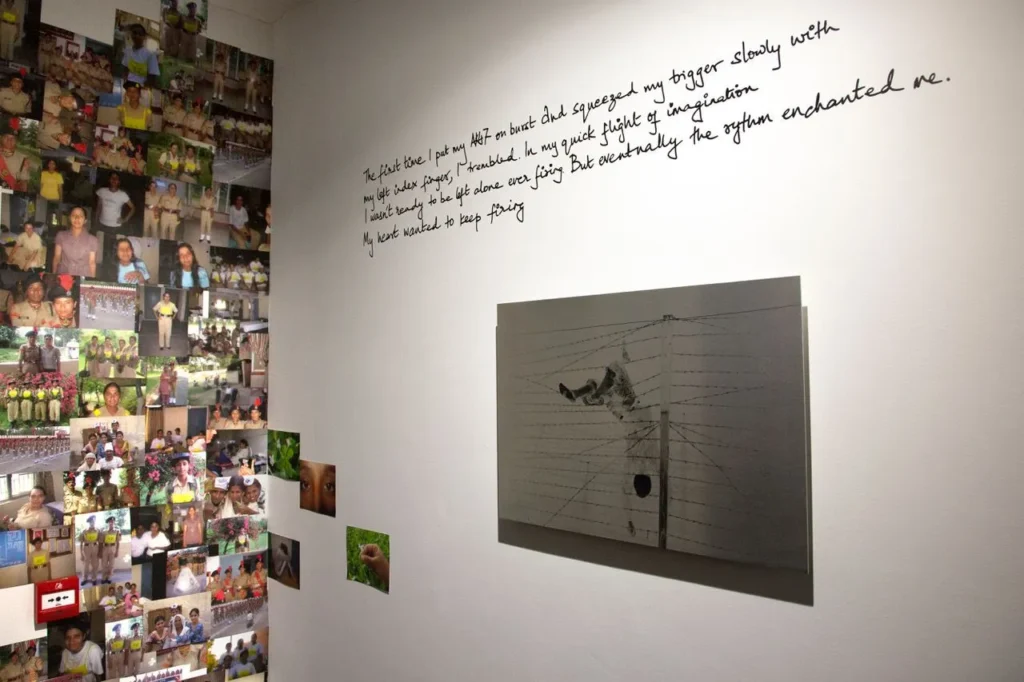
    In To Conquer Her Land, Basu’s first long-term project, the artist wove colour landscapes and black and white portraits to tell the story of an extraordinary cohort of Indian women who were recruited and deployed to patrol the India-Pakistan border created after the partition in 1947. The project leads us through the process of women becoming soldiers and trying to redefine their identity: ‘To Conquer Her Land wrestles with intricate issues of conflict, psychological warfare, class, youth, gender and queerness, love, peace, the concept of home, an undefined idea of patriotism, and the strength of the mind’,4 she comments.

    To Conquer Her Land, 2009–2012, installation view at Side Gallery, Newcastle. Courtesy Poulomi Basu.

    An activist at heart, for Basu the work does not end when it is exhibited in a conventional white cube, rather she seeks tangible impact. Her second large body of work Blood Speaks: A Ritual of Exile, a project about the Nepalese-Hindu practice of chhaupadi whereby girls and women are confined to mud huts during their menstruation cycle, managed to get the Nepalese government to pass a law in 2018 that punishes people who force women into exile during their periods. That same year, the spectacular portraits and photographs of landscapes taken by the artist during her research were exhibited alongside three VR pieces as part of the Kathmandu International Mountain Film Festival. Women and girls who collaborated with the artist had the opportunity to share their stories more broadly.

    Basu’s third and, possibly, largest body of work, Centralia, formed by a book and the film Ghost Dance, takes the form of Indian docu-fiction. It attempts to shed light over the underreported yet on-going conflict for land and resources in Central India between the indigenous tribes, rebel soldiers, and the governmental forces. Seemingly straightforward, the artist masterfully starts introducing fiction strategies to expose how our perceptions of reality and truth are manipulated, such as the title that refers, in a Kafkaesque way, to a town in Pennsylvania, US, where fire burned the town down and today it is a dead zone. ‘I have become interested in how magical realism intersects with surrealism and creates this middle space. Centralia is really the start of it. In the book I take the reader through all these apocalyptic landscapes, but they don’t really know where or when the story is placed.’5 The film, produced in collaboration with CJ Clarke and premiered at The Photographers Gallery in 2020, when Basu was shortlisted for the Deutsche Börse Prize, removes the specificity of a dystopian location to predict a global post-apocalyptic scenario as narrated by a female voice-over; it functions as a warning of where the world could end, unless there is a radical turn of events.

    The interlacing of women’s portraits and landscape photographs is present in all of Basu’s projects. The Indian artist continuously refers to the spiritual and magical connection that there is between women’s bodies and nature, not only are both creationists: ‘women have an inherent role in nature, in creating the habitat’6, but also, in situations where the notions of conquest and misogyny collide, women’s bodies become contested territories that help men consolidate control over what they forcedly take as their property.

    Centralia: Ghost Dance, 2021, installation view at Biennale für aktuelle Fotografie. Courtesy Poulomi Basu.

    Sisters of the Moon, Basu’s most recent and still in-progress project, is an eco-feminist tale that examines women’s access to education and elemental rights, and how the lack of them decimates the potential of women and girls in the global South. Set against a dystopian magical landscape on the frontline of climate change, in this work the artist uses her own body as an activist vehicle to dismantle social and environmental injustice. The arresting self-portraits not only represent the many different realities women and girls face, but also shine a light of hope and empowerment where the artist recreates ‘the future of the planet tied to the full realisation of women’s elemental rights to water and the earth’.7

    Ultimately, Poulomi Basu uses the power of images to draw attention to the interconnectedness of patriarchy, water crisis, and environmental justice. She creates space for under-reported stories and is interested in highlighting those of women and girls in the majority world because ‘without their magic, their spark, the world withers and dies.’8

    For more information on Poulomi’s work, please visit https://www.poulomibasu.com/

    Education and Menstrual Change, from Sisters of the Moon, 2021. Courtesy Poulomi Basu.

    [1] Author’s conversation with Poulomi Basu on 3 April 2022
    [2] Fireflies, (film extract) by Poulomi Basu and CJ Clarke
    [3] Fireflies (wall text), Bindi Vora/Autograph 2022
    [4] poulomibasu.com
    [5] Interview with Poulomi Basu on 3 April 2022 
    [6] ibid
    [7] https://www.wateraid.org/uk/stories/sisters-of-the-moon
    [8] ibid

  • Los Historiantes

    Los Historiantes

    (Text for catalogue, published by Liliana Block Gallery, USA, 2021)

    ‘… Bajó cabalgando en las grupas de los caballos que los 

    guerreros

    llevaban de Francia a España, y se montó en las

    carabelas cuando

    los marinos más locos del planeta partieron rumbo a 

    América.’

     ‘… it rode down on the rumps of the horses that

    warriors

    took from France to Spain, and mounted on the

    caravels when

    the craziest sailors on the planet set out for

    America.’

    Ricardo Lindo, in Rara Avis in Terra, 1974.

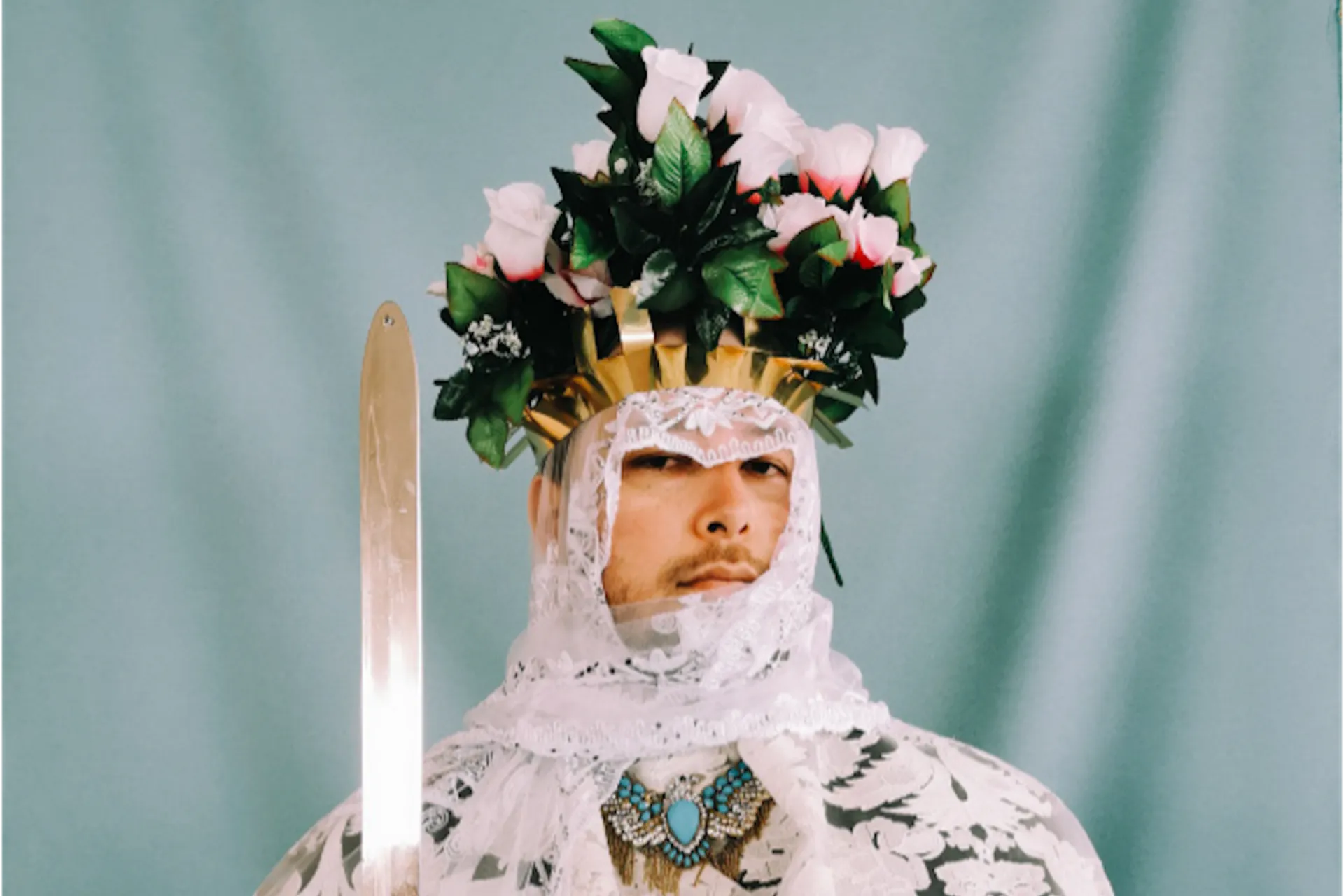
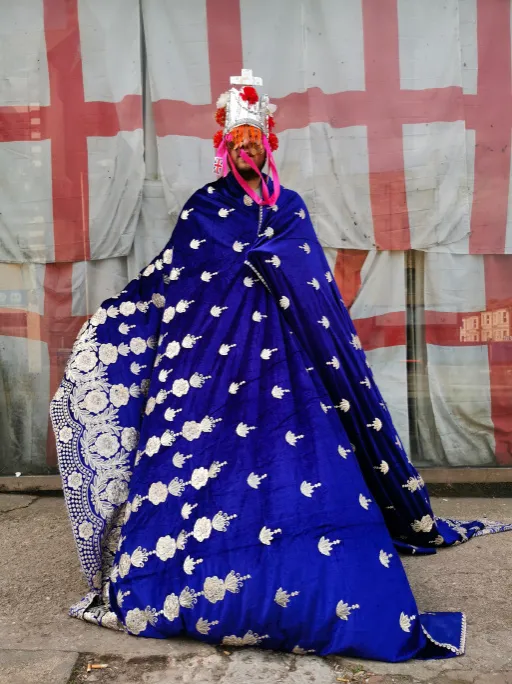
    El Historiante de Inglaterra, 2019

    In the second half of the twentieth century, the Salvadoran historian and writer Ricardo Lindo wrote his poem Historiantes, in which he tells his mother of certain men who divulge a history from another time, another land. Lindo calls them witnesses of eternity, responsible for seeing that this history survives the passage of time. Studio Lenca’s Los Historiantes interrogates whose history is being told in a multi-layered photographic project.

    The Historiantes is a folkloric theatrical dance that dates back to the colonial era in El Salvador. Historiantes, the Spanish word for storytellers, are the witnesses of history. The stories they re-enact through their dances are, on one hand, events from the Bible, principally the birth of Jesus and the adoration of the Three Wise Men; and on the other, the battles that led to the Spanish Reconquest and the expulsion of the Moors from the Iberian Peninsula in 1492. Originally taught by Catholic missionaries, these stories served as a way to evangelise and subjugate the indigenous peoples of El Salvador. Today, historiantes have become living archives of this long-gone time. Artefacts pertaining to the material culture of the indigenous peoples animate the performances, as the dancers carry pre-Columbian masks, headpieces and basic agricultural tools. If the Historiantes dance represents the Salvadoran peoples celebrating the triumphs of their colonisers, it also has served, paradoxically, to preserve elements of indigenous cultural practices, making of this traditional performance a mismatched melting pot.

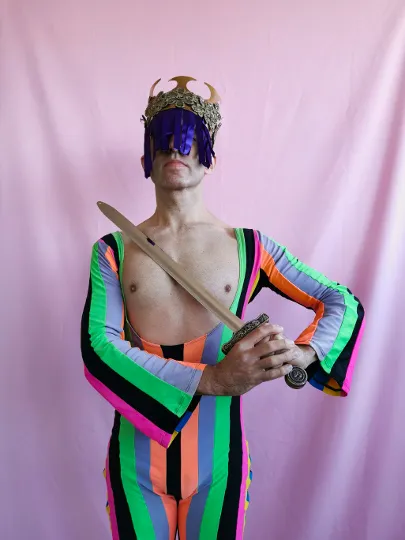
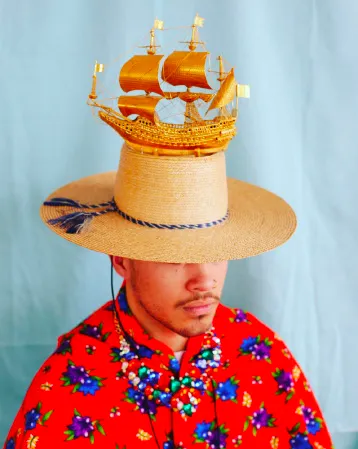
    Historiante de Colores, 2019
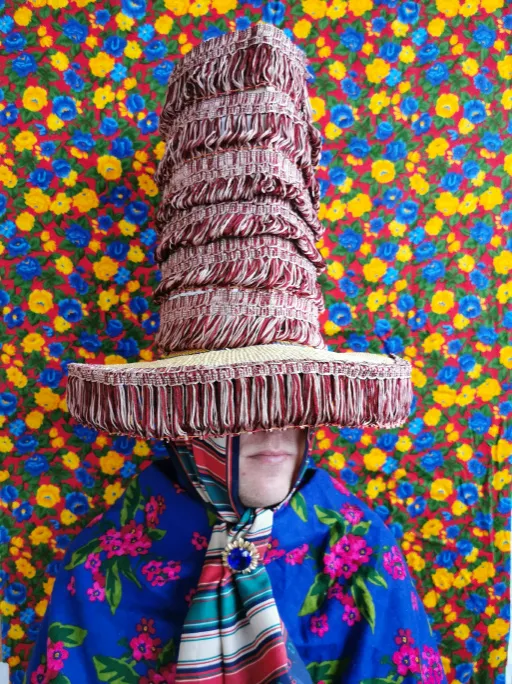
    Gorra, 2019

    El Salvador’s recent history is shaped by the legacy of a vicious, almost 13-year-long civil war in the 1980s and early 1990s. Hundreds of thousands of Salvadorans were forced to flee the country. Whereas large numbers initially moved northward searching for shelter in the United States, the Salvadoran diaspora is now scattered all over the world, and the Salvadoran identity is far from being singular and constant. Studio Lenca’s Los Historiantes confronts history as a disembodied and stagnant field in a gesture to expand the breadth of stories told about what it is to be Salvadoran today

    Studio Lenca started this project in 2019 with a series of self-portraits in a quest to learn his own heritage, but soon started inviting others to take up the role of modern historiantes. Having done so to take formal control of the image-making process, this subconscious gesture also suggests the multiplicity of stories missing from the social Salvadoran imaginary that ought to be included in order to piece together a comprehensive historical narrative. The resulting images are an intricate play of composition and resignification. 

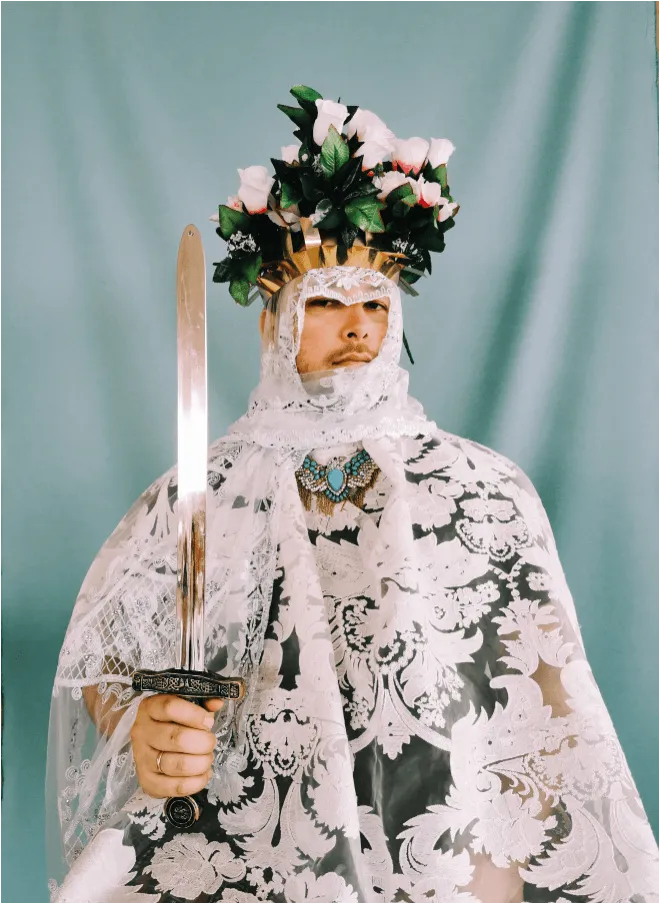
    The artist finds inspiration in the portraits of royals and important people found in big museums. He invites his models to emulate their poses, at the same time dressing them up with gadgets and replica items that reference regalia, luxury and the upper classes, combined with tools used by the historiantes of El Salvador in their daily jobs, such as machetes and other agricultural implements. This visual strategy is an intersectional commentary on the extractivist policies of colonial settlers in the Central American country at the same time as on the social status of the original peoples. By appropriating the European canon to portray a tradition that has barely been documented, the artist symbolically elevates folkloric dances to the standards of high European art and inserts the stories they tell as part of a universal history.

    El Historiante Blanco, 2019

    The images are crowded with cultural references other than Salvadoran, owing to the artist’s lack of access to traditional objects from his country of birth, or their total absence in the global market. To construct his photographs, he has to borrow commodities from cultures that share a common history of colonisation, using wax prints from West African traditions, for example, or the Palestinian keffiyeh; but he also uses English nationalist symbols. Studio Lenca recognises this laborious and disappointing process of searching and not finding authentic cultural signifiers from El Salvador in his work by dubbing the images ‘photographic performances’.

    The absence of a Salvadoran identity from the global collective imagination not only underscores the invisibility of a community that is heir to the trauma of colonisation and acculturation experienced by their ancestors, but it also facilitates the uprootedness enforced on so many Salvadorans as the legacy of a recent grinding civil war, destabilising the individuals’ sense of belonging and connection with their homeland. 

    In this series, Studio Lenca reconstructs the figure of the historiante in a Heideggerian sense; that is, by inhabiting it.[1] By doing so, the artist observes the tradition not only to problematise it, but to decolonise a visual language by participating in it from within, as in Silvia Rivera Cusicanqui’s Sociology of the Image.[2] This allows the artist to be in a position of learning from and embodying an ever-expanding archive of Salvadoran stories.

    For more information on Studio Lenca’s work, please visit https://www.studiolenca.com/
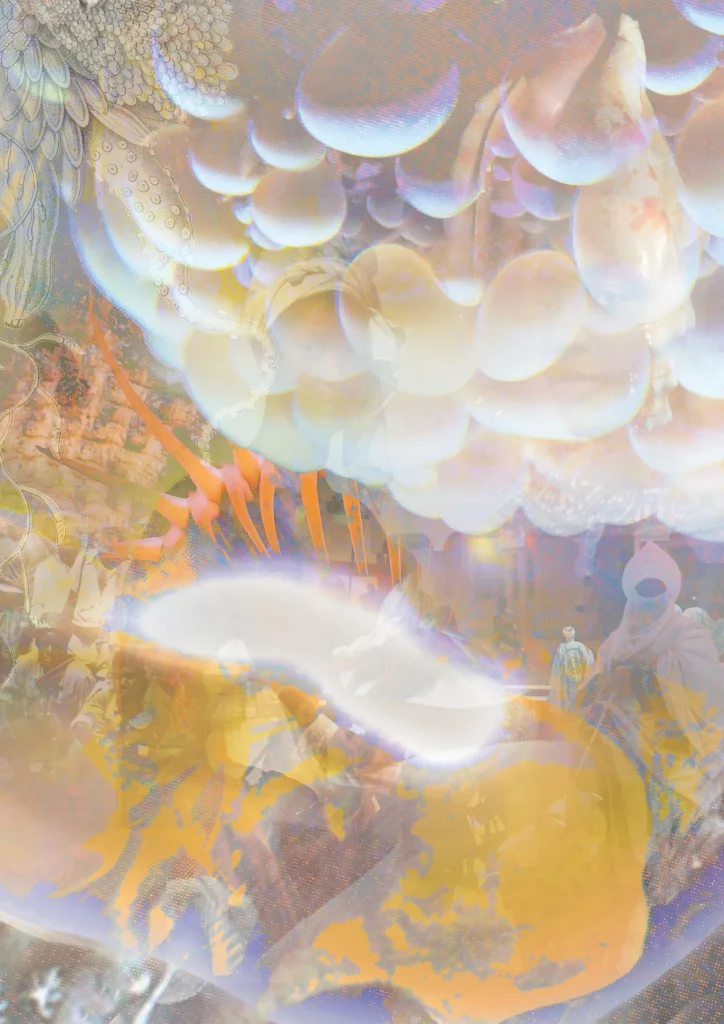
    El Historiante del Mar, 2021

    Footnotes:


    [1]
     Heidegger, M. (1971d). ‘Building, Dwelling, Thinking.’ Available online: http://frontdeskapparatus.com/wp/wp-content/uploads/2012/10/Building-Dwelling-Thinking.pdf

    [2] Rivera Cusicanqui, S., 2015, Sociología de la Imagen: Miradas ch’ixi desde la historia andina. Ciudad Autónoma de Buenos Aires: Tinta Limón.

  • Considerations on  ‘Tropical Identity’

    Considerations on  ‘Tropical Identity’

     (Originally published in C& América Latina on 7 November 2021)

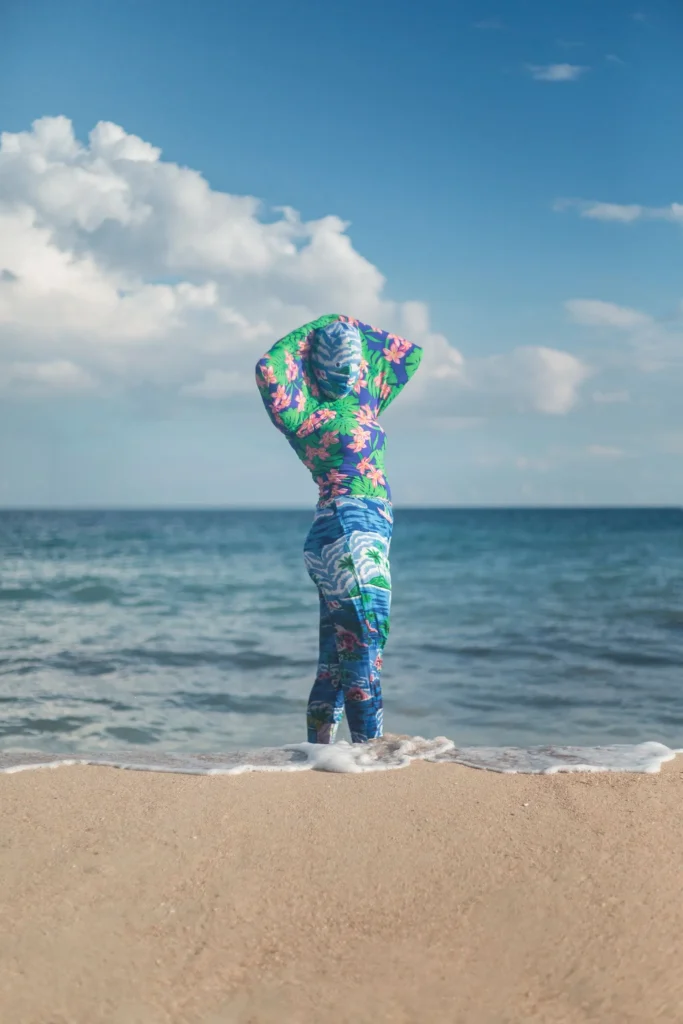
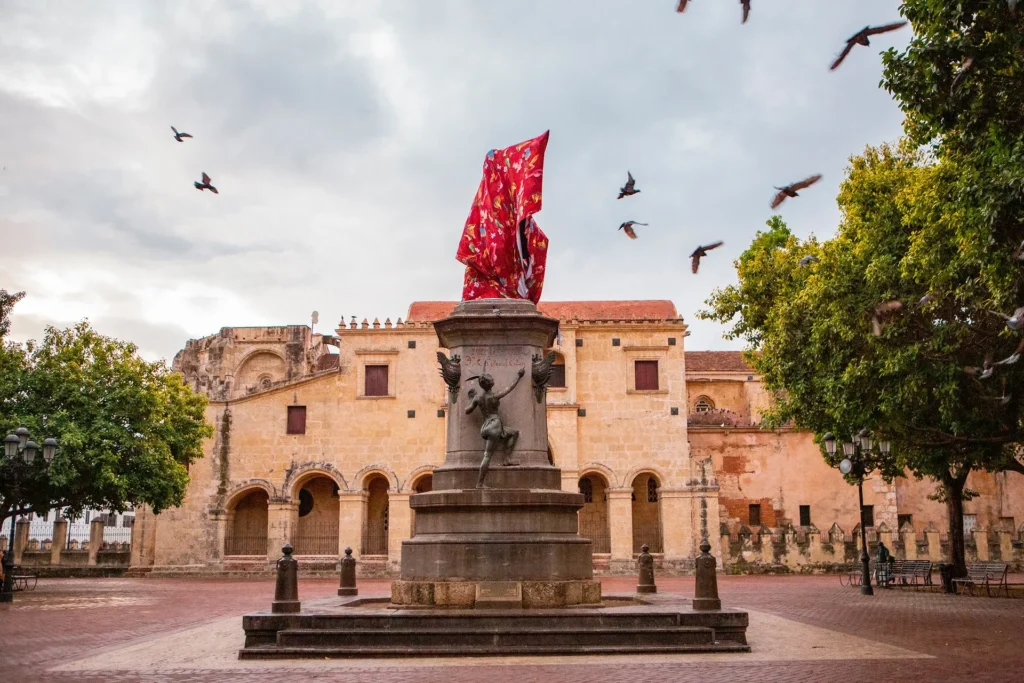
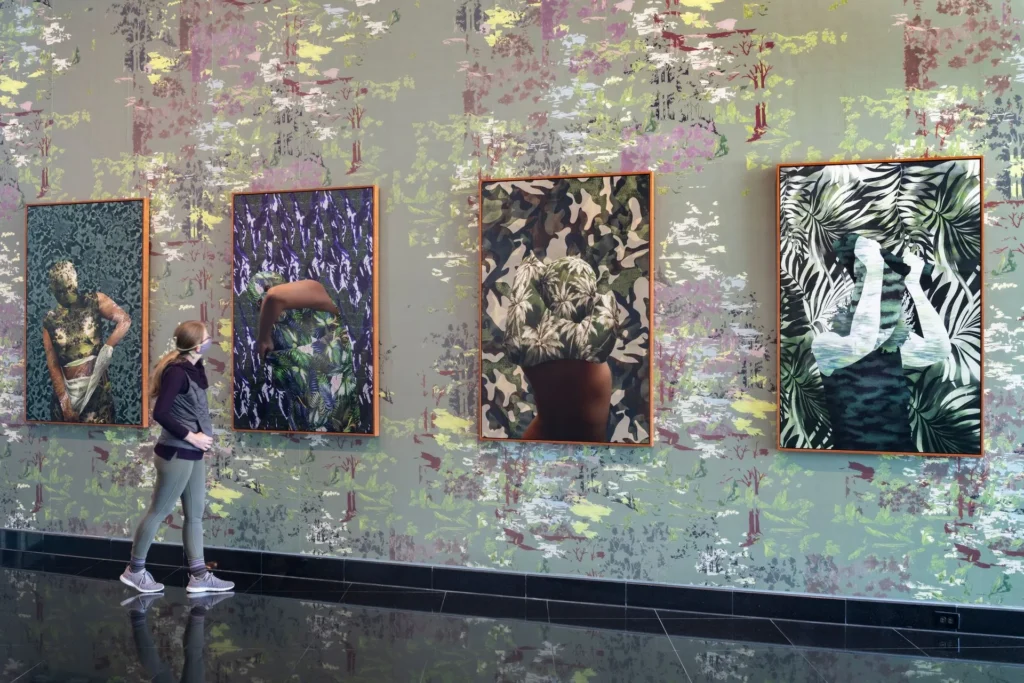
    The multidisciplinary artist from Santo Domingo, who lives and works in New York, appropriates visual codes formed in colonial times to point to a ‘tropical identity’ to create colourful pieces that invert the relation of power between the observer and the observed.

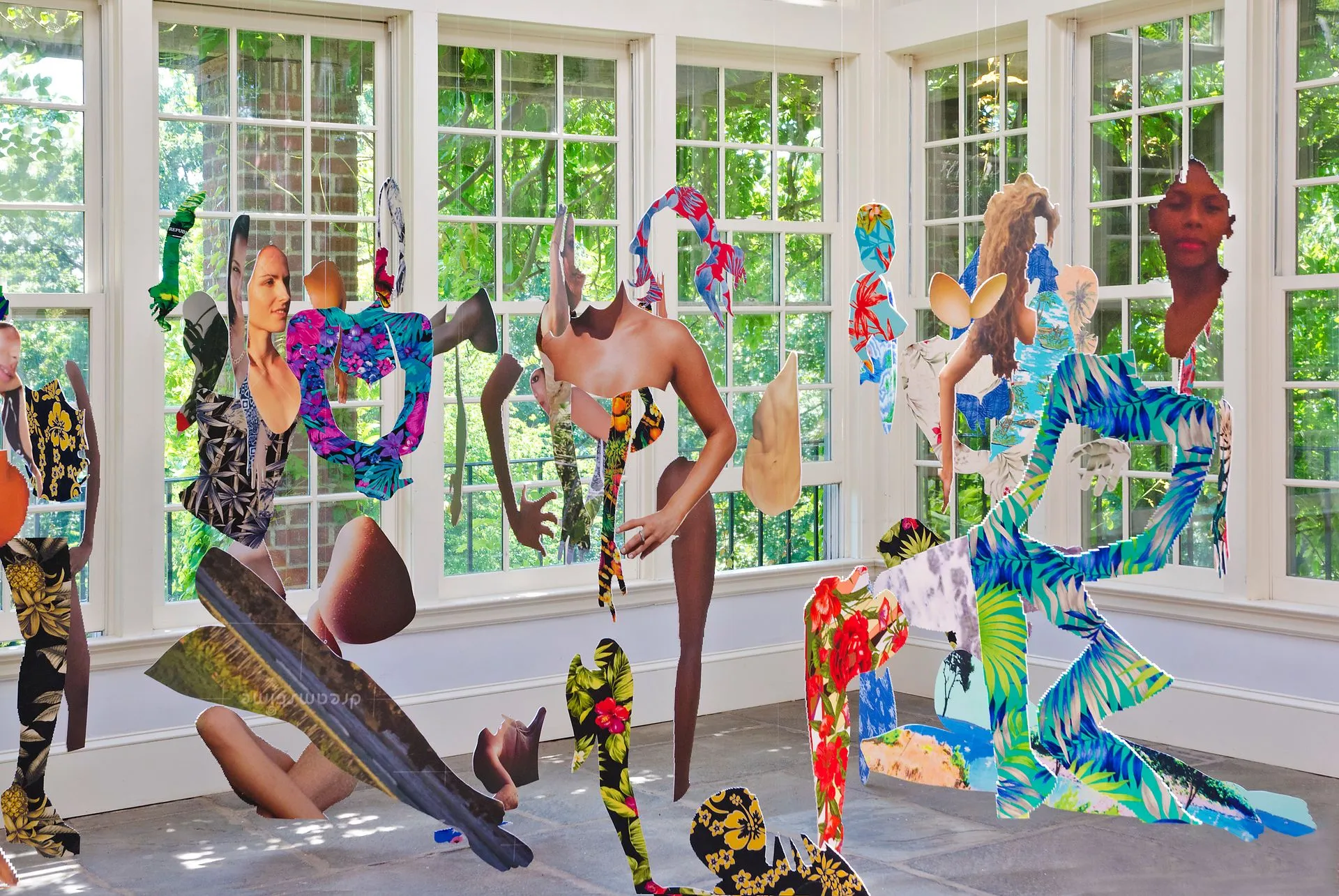
    #dominicanwomengooglesearch, 2016, installation view at the Sunroom Project Space at Wave Hill, Bronx, NY.
    Photo by Stefan Hagen. Courtesy Joiri Minaya.

    Raquel Villar-Pérez: Tell me more about yourself and how you became an artist?

    Joiri Minaya: I liked doing art when I was little, so my mom put me in the afterschool classes for painting. When I was 14, I enrolled in the National School of Fine Arts in Santo Domingo; it is a program called preparatoria. It was a twice a week after-school class mostly for drawing. Then sometime after, you have to undertake a test to go into the proper curriculum of the National School of Visual Arts. I failed the test the first time, so I had to do everything again, and I feel this was the decisive moment when I knew I wanted to pursue a career as an artist. I attempted a second time and I got in. I remember those times to be intense because I was a sophomore in high school, so I had classes Monday to Friday, like any other high school student, and the program at the National School of Visual Arts was also Monday to Friday, for around five hours in the afternoon each day. I spent the last three years of my high school doing two schools, basically.

    Container #4, 2020. Courtesy Joiri Minaya.

    RVP: The presence of women’s bodies permeates your multidisciplinary practice. I am curious to know more about the representation of the female form in your work, and how you got interested in representing or making it so prominent in your practices.

    JM: The first thing that comes to mind is just the experience of being a woman in the world; it makes you realize there isn’t a lot of representation or a fair representation anyway. In fact, the woman’s body is usually objectified or understood as a decorative object. A big part of including it in my work has to do with taking agency of my own representation.

    Something that I also wanted to draw attention on was the convention of portraiture. When I started studying art, there was a lot of portraiture, and representations of the human figure. It is a permanent subject within image making. The art of portraying women had to do with my experience as a woman in the world and especially my experience as a migrant in the US, and the experience of hyper visibility that immigrants deal with. I feel like since my beginnings in the arts, I have always gravitated to this analysis of the representation of women’s bodies as well as landscape.

    Container #3, 2017. Courtesy Joiri Minaya.

    RVP: Let’s talk about the references to landscapes. There’s a lot of symbols in your work that recall nature. Why do you feel like the urge of addressing nature in your work?

    JM: I’ve always been interested in nature. When I was a child, I dreamt of becoming a biologist or marine biologist when I grew up. I think that the experience of living in a big metropolis in the US has made these ideas resurface in my work. Also, living outside of Dominican Republic and realising that many times our identity is interpreted through the prism of what has been dubbed as ‘tropical’ nature, makes me want to reflect upon what this means. I investigate the history of the representation of tropical nature through the lens of colonialism and how some of these ideas have survived and how they spilled onto the bodies. This relationship between the body and nature is very present in my work because both are exercised and consumed and exploited in ways that are related to each other. Although more recently, I’m starting to approach these topics from a different angle to that of the postcolonial discourses, thinking about how we can relate to these issues in a more enjoyable way, and not only through all the trauma of colonialism.

    RVP: Can you expand on the idea of ‘tropical identity’, and how the Caribbean appears in the imagination of the outside world, but also of the Caribbean people?

    JM: In the last couple of years, I focused on how this notion of ‘tropical’ is representative for outsiders as well as for the Caribbean people. Having grown up there, I find there are parallels in how spaces are pictured.

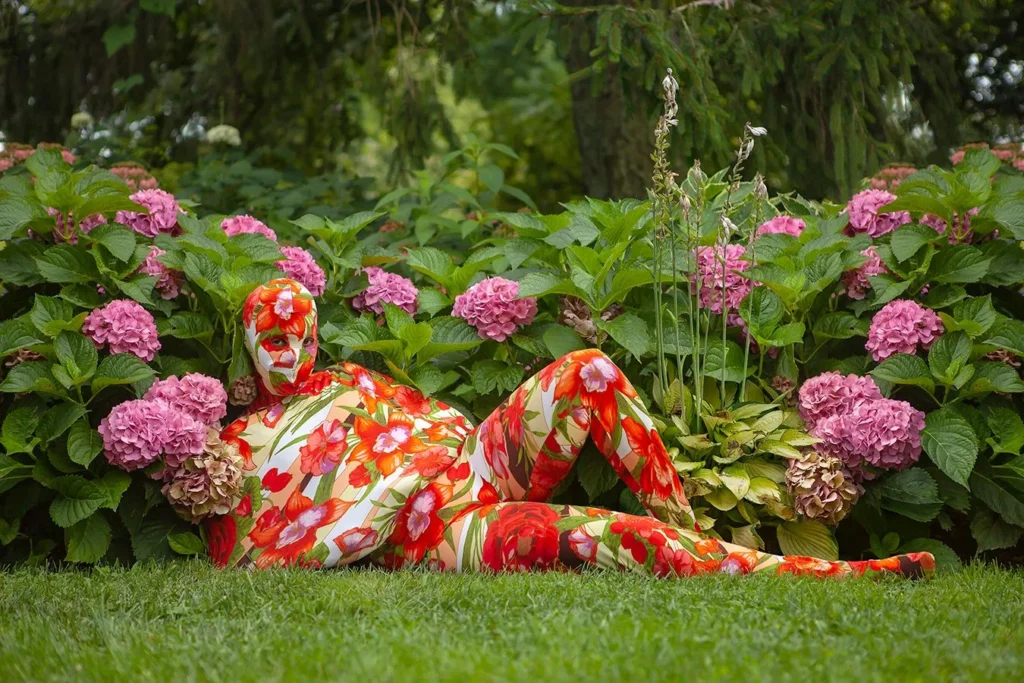
    I have noticed that in recent years the Hawaiian shirt for example, this type of shirt with ‘tropical’ prints, has become very popular in Western countries. Then I go to the Dominican Republic, and there are middle-class, young, hip people wearing them. I find this very interesting, because when I was younger, these visual codes were restricted to the construction of tropical spaces through resorts; it was more of the uniform of a resort or some sort of service that had to do with tourism. Now it has become this cool, trendy thing. This seems a worldwide phenomenon, and I am interested in the parallels and how both directions communicate or overlap.

    In terms of constructions of tropical space, I think how this space was visualized during colonialism has had a lot of impact into the imagery that still prevails today. There is literature that have helped me understand this, one is Krista Thompson’s An Eye for the Tropics and Picturing Tropical Nature by Nancy Stepan. Although the two authors draw their analysis in the English-speaking Caribbean, I see a lot of parallels with what is understood of Dominican Republic.

    Documentation of the action Encubrimiento, 18th of February, 2021. Photo: Sofía Marcos. Courtesy Joiri Minaya.

    RVP: How do you perceive the Caribbean art scene (Caribbean is simplified), and particularly in the Dominican Republic? Do you think there is a Caribbean art scene outside?

    JM: To answer the first part of the question, for me the Caribbean art scene is super-rich. It’s very diverse. I feel what lacks is platforms for visualisation and structures of sustainability in the sense of having a collectors base, museums that actually have an impact in the local scene, etc. But there are so many artists doing incredible work.

    With the Internet there are conversations that are happening at the same time about the same topics, in different locations, and it is interesting to see what is being said in other places, and what that does to the art scene. You can no longer be isolated from conversations about the colonial legacies, or racism, or classism.

    Divergences, 2020, (installation view). Kemper Museum’s Atrium Project, Kansas City. Courtesy Joiri Minaya.

    RVP: Last question: how do you think the pandemic has affected the artists in the Caribbean, and what are the strategies to overcome it?

    JM: The pandemic has definitely impacted the artists in the Caribbean, mostly in terms of opportunities to produce work. It seems that a lot of artists don’t have a sustainable system for making art or staying engaged in artistic conversations, by putting together a group show or solo shows on their own, but rather, these opportunities are driven by museums or institutions. Otherwise, there are a few commercial galleries, and artists affiliated to these are making it through. There is also commissioned works, particularly there are being a lot of commissioned murals recently, although you can interpret that as a will from authorities to whitewashing spaces.

    For more information on Joiri’s work, please visit https://joiriminaya.com/
  • Poetics of Resistance From the Archive in Two Acts

    Poetics of Resistance From the Archive in Two Acts

    Poetics of Resistance From The Archive in Two Acts was the winning exhibition proposal of the Peckham 24 Open Call 2021. It was exhibited as part of Peckham 24 during the Photo London week.

    Poetics of resistance from the archive in two acts proposes a re-reading of the archive as a catalyst that imagines and makes visible plural manifestations of queer masculinity through the works of the Spanish artists Pablo Lerma and Javier Hirschfeld.

    Credit: Leah Band and Peckham 24

    Poetics of resistance from the archive in two acts proposes a re-reading of the archive as a catalyst that imagines and makes visible plural manifestations of queer masculinity thought the works of the Spanish artists Pablo Lerma and Javier Hirschfeld.

    Archives function as keepers of history, often of a specific time, locality, or community. However, they are by their very nature incomplete. Archives are representative of the personal tastes or public agendas of those in charge of their making, therefore they are shaped not only by what is included but more importantly by what is left out. Both Lerma and Hirschfeld’s work is rooted in their personal experience of being unable to self-identify with the stereotype of a gay man created and perpetuated by heteronormative expectations. As a result, their work sheds light onto different performativities of being queer. 

    The ‘two acts’ in the title of the exhibition refers to the two different approaches to the archive. Both artists share the purpose of interpreting it in a gesture of subtle solidarity to imagine more nuanced and inclusive spaces within and for the queer community. It also refers to the two different temporalities on each of the works; whereas Lerma narrows down his research to images distributed in the 70s-90s, crucial decades for the formation and dissemination of the contemporary queer culture and – most importantly for Lerma – of queer solidarity movements, principally present in safe spaces known as queer villages. Hirschfeld establishes an aesthetic connection between images from the early 19th century with contemporary images of dating apps, to refer to the decline of these safe spaces.

    Credit: Pablo Lerma, On Community and Affection (detail), from It Doesn’t Stop at Images, 2020-21

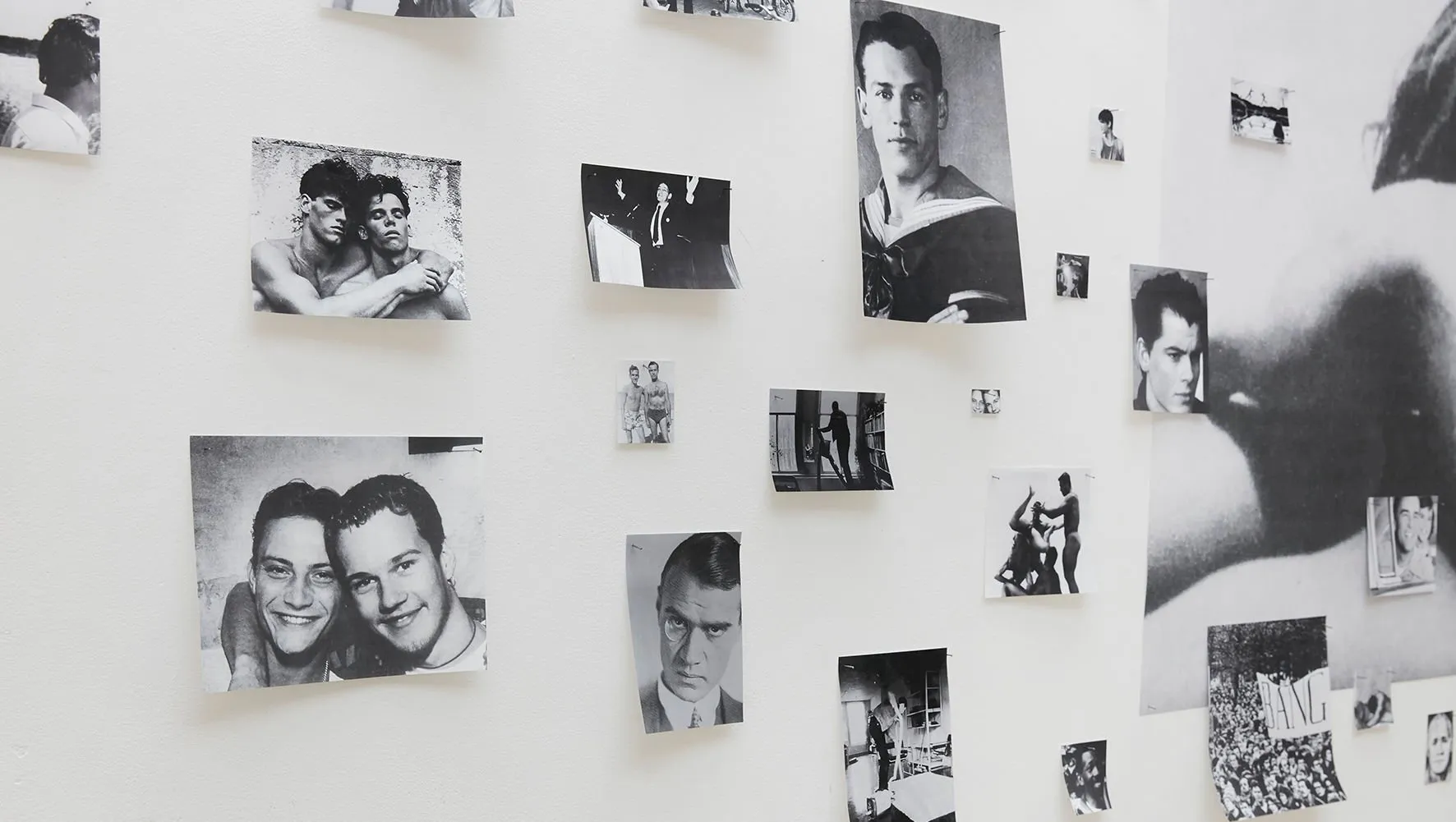
    Pablo Lerma’s work It Doesn’t Stop at Images is an on-going project in three chapters, two of which were present in this exhibition. Exploring the IHLIA archive, the largest collection of images and information on the LGBTQIA+ community in Europe, Lerma dissects three major queer magazines: HomologieSan Francisco Sentinel, and Lambda. Lerma is interested in unearthing the unfamiliar images of queer day-to-day lives that move beyond the stereotypical representation of gay men, masculinity, and queerness. 

    His installation combined a selection of images and text from the chapters 1 and 2, which explore the archival imagery in the magazines Homologie and San Francisco Sentinel. From the later, Lerma extracts the texts that were used to describe gay, the gay community and its struggle throughout this period and designs 40 posters, 18 of which will be available for the audience to take. From the former, the artist selects images of love, intimacy, and affection between men. Whereas San Francisco Sentinel situates and enunciates the historical LGBTQ battle for visibility and rights, Homologie is an atemporal manifestation of gay love, care, and warmth. The paradox of this composition prompts to reconsider queer representation in the media and history. Lerma is committed ‘to showing images of daily life, mundane pictures, those that show intimacy in a way that is not sexual; those that show the quotidian in a way that is not shocking; those that show tenderness and affection in a way that is familiar and not promiscuous; those that show struggle in a way that is not socially stigmatizing’.

    Credit: Leah Band and Peckham 24

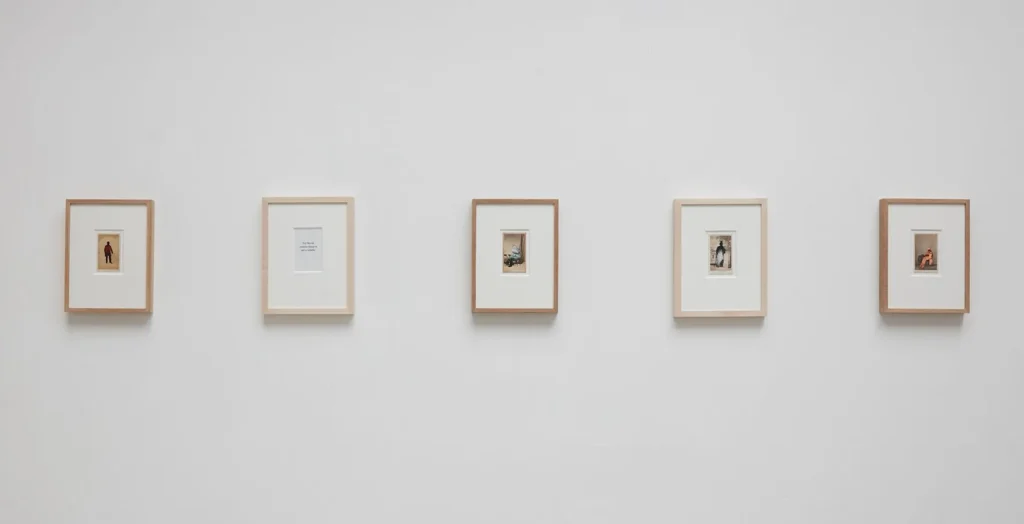
    Javier Hirschfeld’s Profile also considers expected images of gay masculinity, but in this case, the artist is concerned with the politics of self-representation in contemporary dating apps such as Grindr and Tinder. Hirschfeld examines the visual imagery of these ever-growing contemporary archives, identifying and interpreting trends such as the extended use of images of natural settings as profile pictures. If on one hand, the artist observes that the use of this visuals offers a fresh alternative to the predictable stereotypes within the gay community in line with what is known as emotional capitalism, whereby individuals are forced to self-commodify their bodies and follow stereotyping aesthetics of self-representation to create the necessary appeal to navigate and succeed in these platforms, on the other, Hirschfeld also reflects on the dimensions of contemporary queer visibility and representation, or lack thereof; to not respond to expectations, the individual becomes invisible.

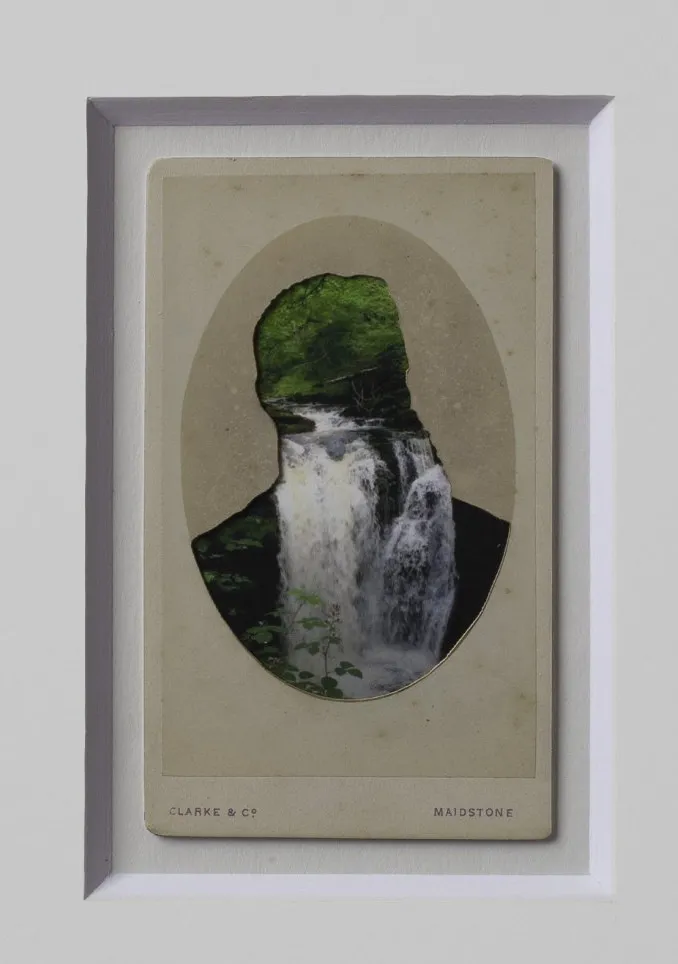
    Credit: Javier Hirschfeld, Profile 4, Clarke, Maidstone, 2020
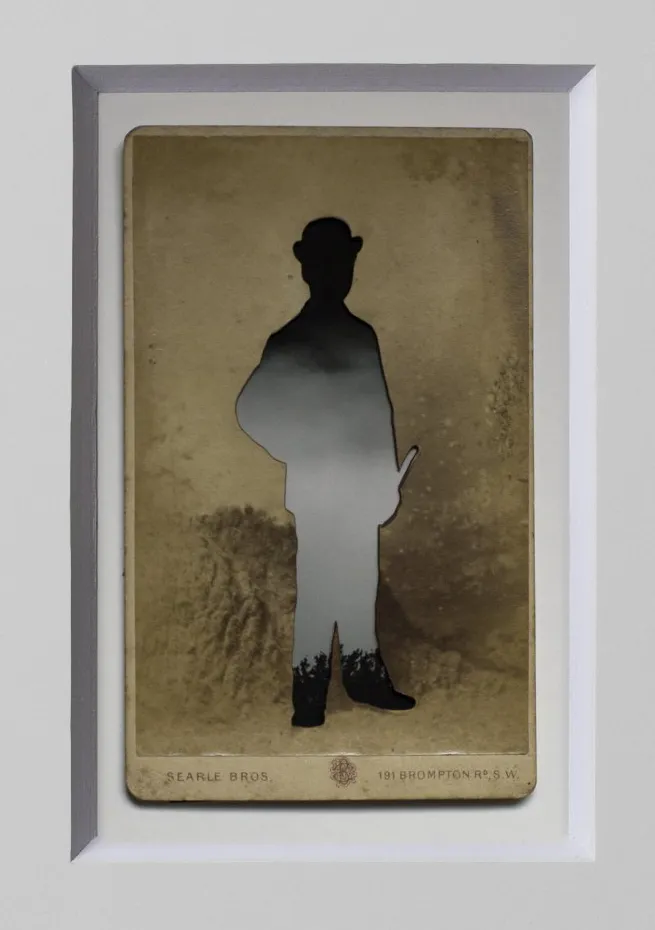
     Credit: Javier Hirschfeld, Profile 17, Searle Bros, Brompton, 2020

    Profile establishes a parallel with carte-de-visite, the first give-away studio portraits of oneself that became immensely popular in the mid-19th century in France and Britain. Cartes-de-visite were the catalyst of an ego culture that set the parameters for the visual representation of individuals, becoming one of the first devices for self-promotion and in many cases flirtation. The artist invites the viewer to consider the consequences that dating apps have on spaces for cruising observing that the transition from analogue-to-digital brings certain loss of queer presence in urban areas. In his view, these apps are displacing gay bars and other queered spaces, contributing to the slow death of the gay village that had afforded political visibility to the LGBTQIA+ community. 

    Credit: Leah Band and Peckham 24

    Whereas It Doesn’t Stop at Images pays homage to those who came before by bringing to the fore and normalising historical images of daily manifestations of the LGBTQIA+ community that were rendered invisible in favour of stereotyped images that would entertain the heteronormative gaze, Profile puts its focus on contemporary digital archives identifying alternative modes of self-representation and their contradictions, and sheds a melancholic light over the loss of physical political spaces for gay communities. 

    At a time when homophobic attacks are on the rise (please note this curatorial statement was written on September 2021) – in the last two years in the UK, hate crime against queer people have doubled and just a month ago, Spain saw a 24-year-old being beaten up by five people at the chant of ‘faggot’, dying shortly after due to the injuries – creating spaces that reflect and celebrate alternatives to heteronormative ways of being in the world is paramount. 

    Both Lerma and Hirschfeld offer novel approaches to LGBTQIA+ visibility opening a dialogue for more nuanced, plural, and multi-layered representations of queerness. Their research-led practices are responses to the archive and the different strategies of silencing and emotional absence. Their works offer new visual articulations of spaces of plurality, diversity, and solidarity with and amongst the LGBTQIA+ community.

    10-12 September 2021 | Copeland Gallery | London

    This exhibition was kindly supported by:

  • On Heroes, Authenticity, and the Power of Infiltration

    On Heroes, Authenticity, and the Power of Infiltration

    (Originally published in British Journal of Photography on 17 June 2021)

    Josèfa Ntjam’s images require care and attention. A consideration that directly opposes the fast-paced nature of the mediums she works with: modern technologies and the digital space. Ntjam interweaves the disciplines of photography, video, sculpture, performance and writing. Her works are infused with references to water and nature, which lead us through non-linear, multilayered conversations that address issues of family histories, colonialism, mythology and Black futurity.

    Family Reunion, from the series Unknown Aquazone, 2021.
    Courtesy Josèfa Ntjam and Nicoletti Contemporary.

    Born in 1992 in Metz, France, Ntjam became interested in the exploration and reimagination of the past because of the fragmented recollection of her family history. ‘My paternal grandfather was killed by the French colonial army during the independence revolts in Cameroon [in 1955]. Someone told me he died near a church,’ she explains. ‘But that’s all I know about him, so I started constructing a lot of mental landscapes and created lots of different stories in my mind.’ 

    She began to make digital photomontages where her imagined compositions materialised and came alive. This process enabled her to examine and fill the voids of her family memories by creating her own narrative and adding a fresh perspective. It afforded Ntjam the opportunity to nurture the stories of her ancestors. ‘I want to create my own trace of my family,’ she says.

    Émeutes Globuleuses, from the series Unknown Aquazone, 2021. Courtesy Josèfa Ntjam and Nicoletti Contemporary.
    Marthe Moumié, from the series Unknown Aquazone, 2021. Courtesy Josèfa Ntjam and Nicoletti Contemporary.

    Ntjam is supported by Nicoletti, a contemporary art gallery in London, where her first solo show, running until 31 July 2021, opens tomorrow. Among the works displayed are her most recent digital photomontages. A further nine photomontages, inspired by the visuals she created for the exhibition Anticorps at the Palais de Tokyo, Paris, will be exhibited at the Art-o-rama fair in Marseille in August. 

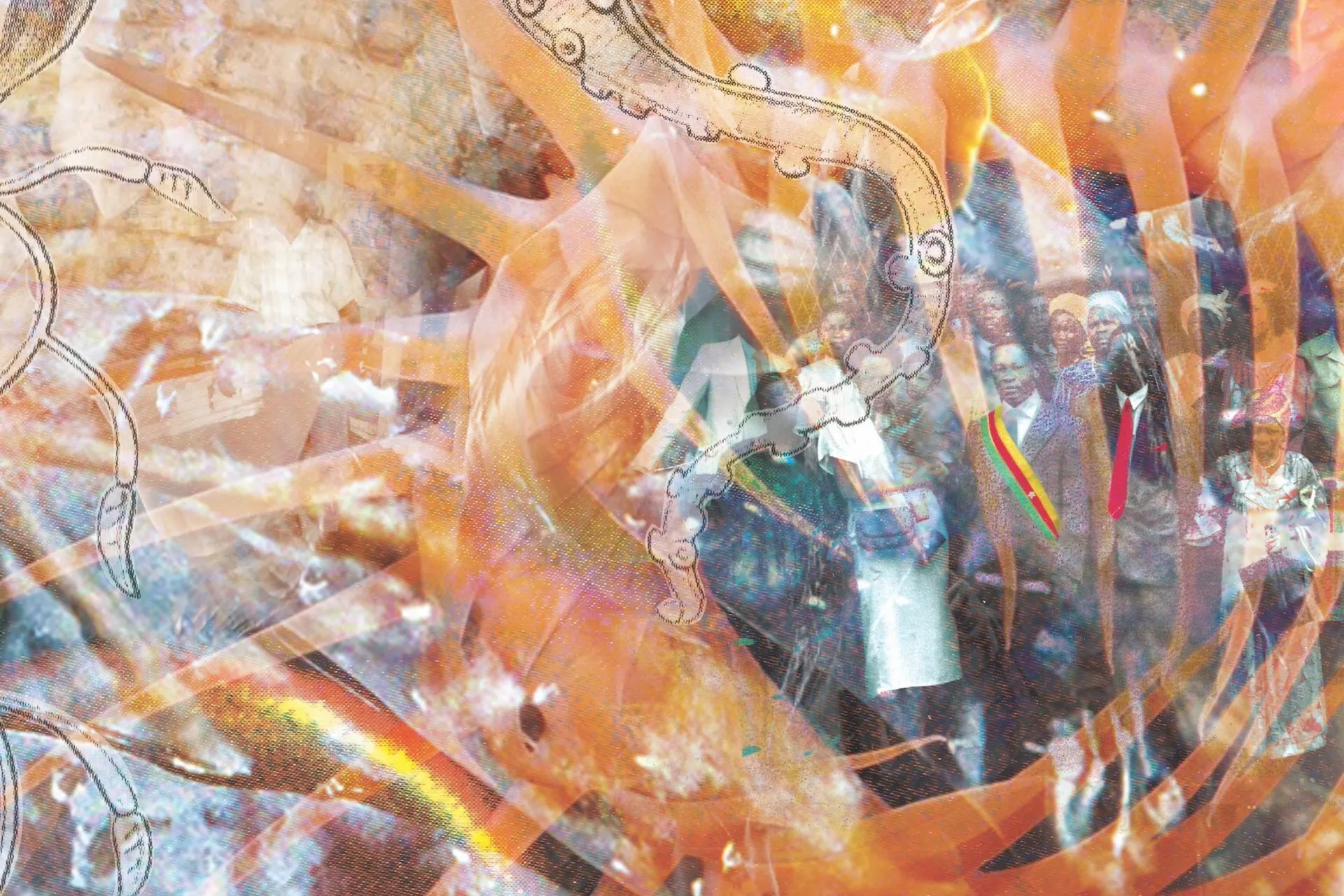
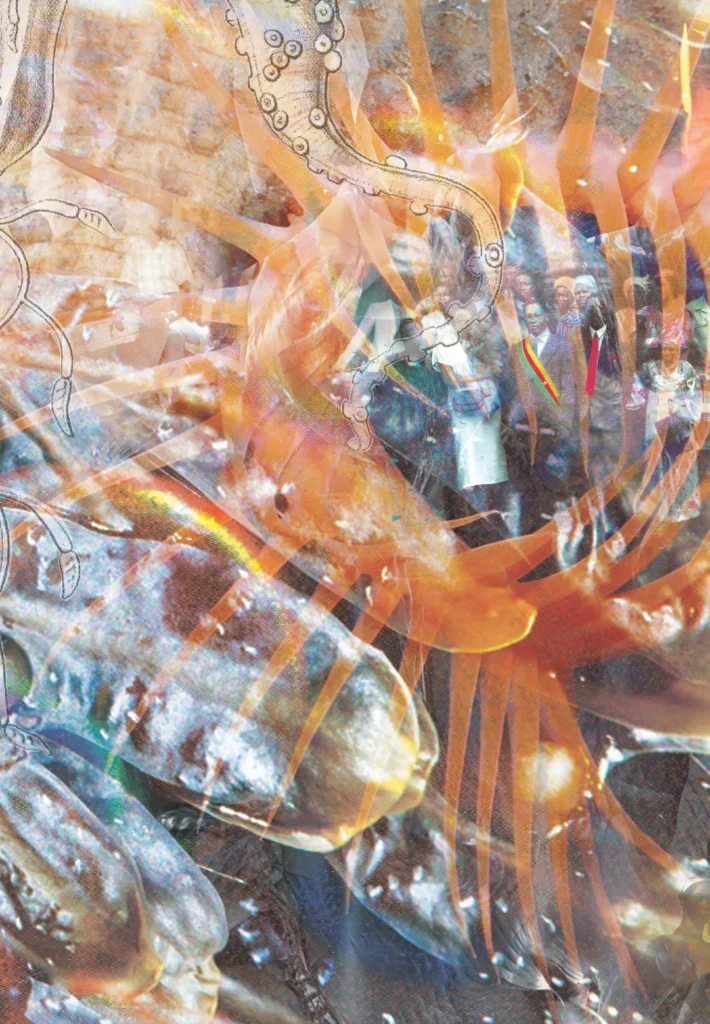
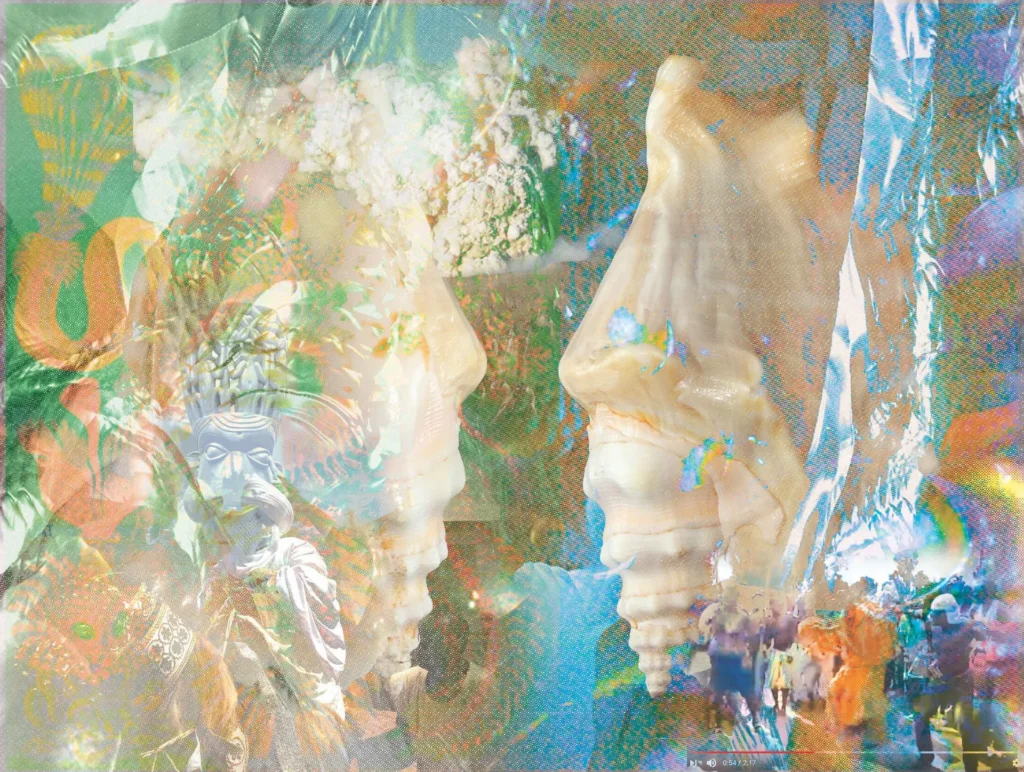
    This series, titled Unknown Aquazone, blends nature and history in a somewhat utopian narrative. In one montage, Family Reunion, a bright orange creature and light-blue mollusc attract our gaze. On closer inspection, figures emerge from beneath the semi-transparent shapes. In one corner, you can make out a solemn family photograph. In the centre stands the late Cameroonian leader Ruben Um Nyobé, who wears a sash with the Cameroonian flag. His wife, Martha, stands to his side, and other family members surround them. Like Ntjam’s grandfather, Um Nyobé fought for the independence of Cameroon and the anti-colonial struggle and, in 1958, he too was assassinated by the French army. On the opposite corner, the lone figure of a relaxed, seated man dressed in casual western clothing subtly emerges. The fact that the artist positions him, her elder, slightly higher than Um Nyobé in the collage, is not accidental.

    Ntjam finds the idea of heroes, specifically national heroes, problematic. Though many of these idolised figures are celebrated for doing good, they are imposed upon the collective memory of nation states at the expense of rendering countless others absent. These imported protocols establish a classification system. Featuring these figures in her photomontages allows her to question their value. For the artist, family members are her heroes. She unapologetically creates ‘a fictional story of my own life, where I can really place my family and celebrate them,’ she says. By doing so, she interrogates the politics of historical documentation.

    Informed by the academic work of the Senegalese historian Cheikh Anta Diop, and the pan-Africanist philosophy of Sun Ra, an American jazz musician and an influential pioneer of Afrofuturism, Ntjam believes in the importance of alternative methods of display in museums. Particularly ones that move beyond established narratives based on chronological and geopolitical arrangements – as per imperialist ideas of time and space. She suggests a new museography, based on aesthetic affinities and hybridity. ‘I like challenging what we are made to believe,’ she says. Ntjam’s work aligns with the Black Speculative Arts Movement, also known as the second wave of Afrofuturism. It brings together artists and creative practitioners of the Black diaspora whose work ‘integrates African diasporic worldviews with science or technology and seeks to interpret, engage, design or alter reality for the reimagination of the past, the contested present, and to act as a catalyst for the future,’ states the BSAM website. 

    Father Riding Seashell, from the series Unknown Aquazone, 2021.

    Tradition and modernity

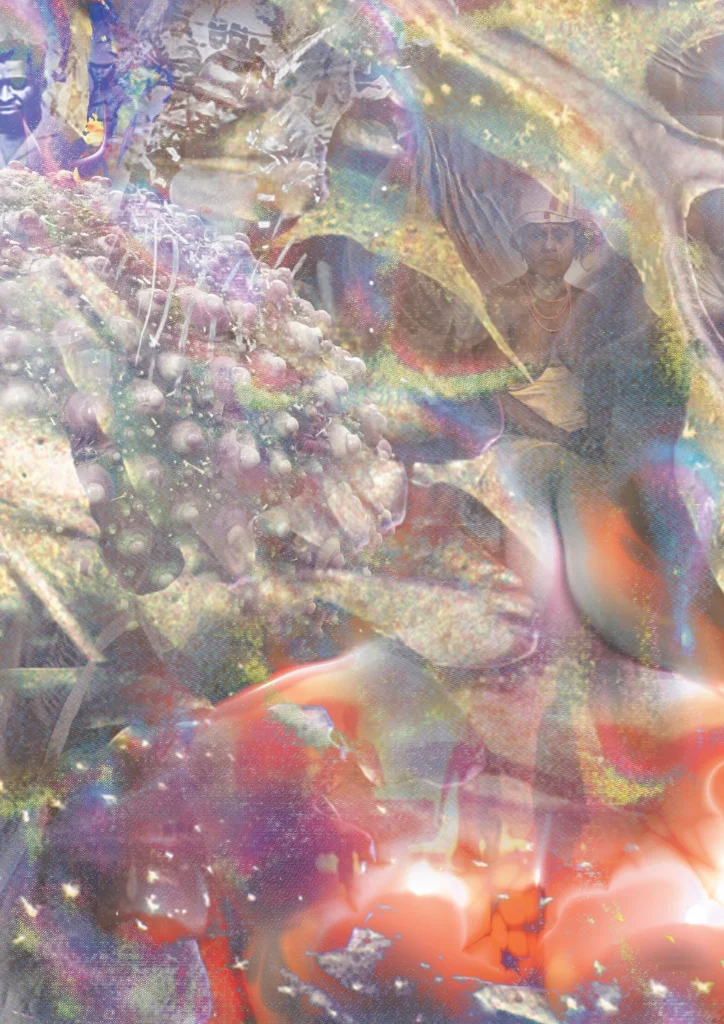
    Water and the ocean are omnipresent in Ntjam’s photomontages. These too connect to her cultural past. From images of marine life, such as molluscs, octopuses, turtles, shells, and the representation of water spirits, to her choice of printing materials. Plexiglas, resin and more recently latex are chosen for their transparency. ‘What I like about these printing materials is the depth they give to the photographs,’ she explains. ‘You can see some parts of the picture pop up, like when you have 3D glasses on.’ She adds: ‘Transparency is important for me; I like that the light can go across the works creating additional shapes and figures in the image.’ 

    Beneath the watery surfaces, the artist embeds images of African wooden sculptures, entangling tradition and modernity. They symbolise the lives of Africans who died in the Atlantic Ocean during the slave trade. ‘There are many boats which broke amidst the ocean, so there are a lot of archives and sculptures lost to the sea. Today they have their own life,’ she says. The artist also prints her digital photomontages on fabric. The light textile moves freely in the gallery space, replicating the ebb and flow of the sea’s waves.

    In his thesis Flux and Reflux: African Diaspora (1968), the late Pierre Verger reminds us of the similarities and cultural semblances between peoples on each side of the Atlantic. ‘Since the beginning of the world, everything has blended together,’ says Ntjam. ‘You can’t say that you specifically come from one place geographically because everyone and every population has been travelling since the beginning of humanity.’ 

    Ntjam finds these connections particularly visible in what she calls ‘twin mythologies.’ She refers to the figure of Mami Wata – a water deity, half-human half-mermaid, who is revered in many parts of Africa and its diasporas in the Latin American continent. Mythology, she believes, is the natural space that allows for the devising of collective futures. ‘Mythology is important for futurism,’ she says. ‘You can imagine the world in many different ways with mythology. I love the fact that you can find connections between different myths from different parts of the world.’ For Ntjam, water and its fluidity is an analogy for the dissolution of established sociopolitical categories. These properties also represent the porosity of history and the inescapable continuous renewal we are bound to.

    Kankurang, from the series Unknown Aquazone, 2021. Courtesy Josèfa Ntjam and Nicoletti Contemporary.

    Ntjam’s main source of imagery comes from the internet. ‘I grew up with the internet and it was a revolution,’ she recalls. ‘If you are looking for something you can just type it in, and you find a lot of information.’ She finds a connection to the ocean here too. From its origin, the sea has been a metaphor for the worldwide web, a place we surf or navigate, filled with data flows. Though crucial to her work, Ntjam also warns about its dangers: ‘I think the internet is a big paradox,’ she says. ‘It’s beautiful, but also a great danger for humanity. It holds a lot of information, but the algorithms decide what to make you look at.’ It is ironic that its expansive nature is filtered by the choices and biases of those who control it, quietly moulding our worldviews at the expense of the freedom it came to provide.

    Ntjam’s practice would not be complete without her poetry. In her cross-disciplinary performances, the artist combines art forms to create a holistic experience for the viewer. She establishes non-hierarchical dialogues between things that are seemingly exclusive of one another, facilitating an encounter where new possibilities can emerge. The symbols of water, mythology, and African imagery continue to be the references that allow her to create spaces for emancipation and further critical reflection on the ideas of constructed memories, hybrid identities, and plural possible futures. 


    For more information on Josèfa’s work, please visit https://ntjamjosefa.com/
  • Visual Parables of Times

    Visual Parables of Times

    (Originally published in Photography+ on 27 May 2021)

    How can someone start to make sense of a socio-political and cultural context in which their body is read, but the context itself is so alien to them because, in fact, they never belonged? What is it to be given an identity that is at the same time being overwritten by your actual environment? El Jardin de Senderos que se Bifurcan (The Garden of Forking Paths), borrows the title and the parable strategy – a literary resource to tell stories – from the Argentinian writer Jorge Luis Borges. It is the exploration of imagined stories and the multiplicity of possible parallel narratives of oneself. 

    Dead Ringer/Self Portrait as Found Photograph (1979 Lima, Peru), 2018.
    Courtesy Tarrah Krajnak.

    Tarrah Krajnak was born in Lima, Perú, in 1979, in the lead up to the bloodiest armed conflict the country ever witnessed since colonisation and that started in 1980 by the group known as Sendero Luminoso. Two consecutive military dictatorships, an uneven industrialisation that forced major migratory movements from the Andean and Amazonian region to the coastal cities, and a severe economic crisis facilitated a fragile political system. But Krajnak only read about this history. She was born an orphan, as the result of a sexual violation and was then given up for adoption to a North American transracial couple. She only returned to Perú for the first time thirty years later. For the past 11 years, the artist has relied on photography and text as the mediums that bring her closer not only to her native Perú but also to her given indigenous identity

    Time Twin, Self Portrait as Claudia, Lima, Peru, 1979 / Claremont, CA 2017, 2017. Courtesy Tarrah Krajnak.
    Time Twin (Diptych), Self Portrait as Angie, Lima, Peru, 1979 / Claremont, CA 2018, 2018. Courtesy Tarrah Krajnak.

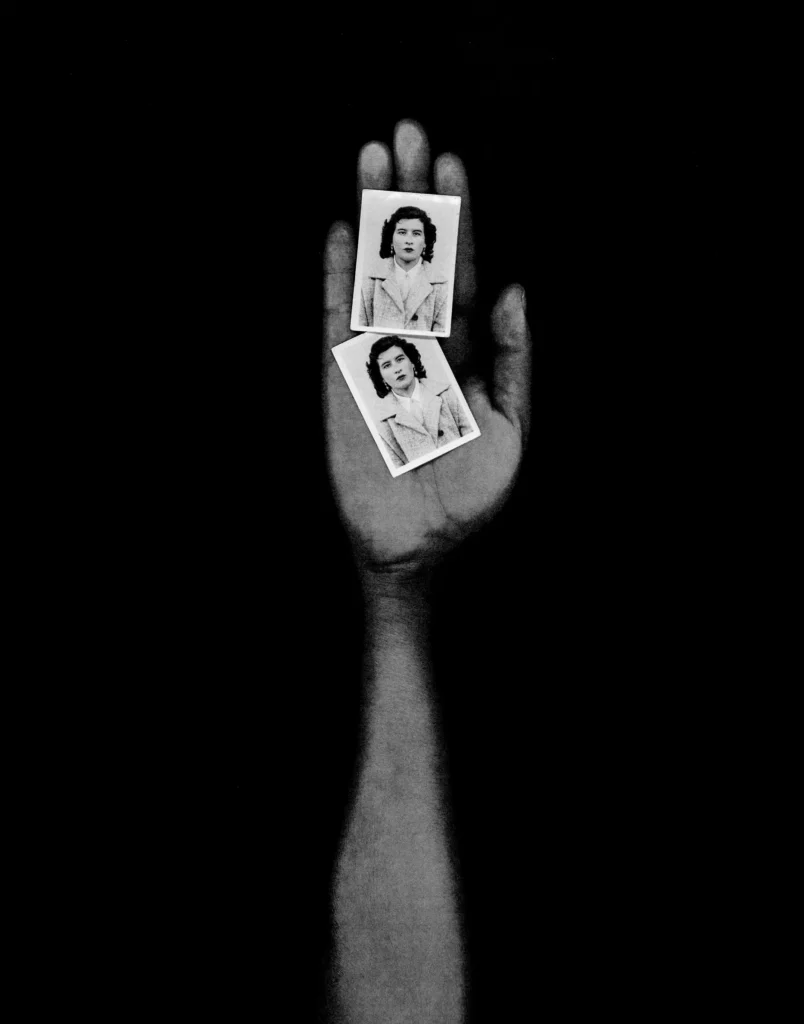
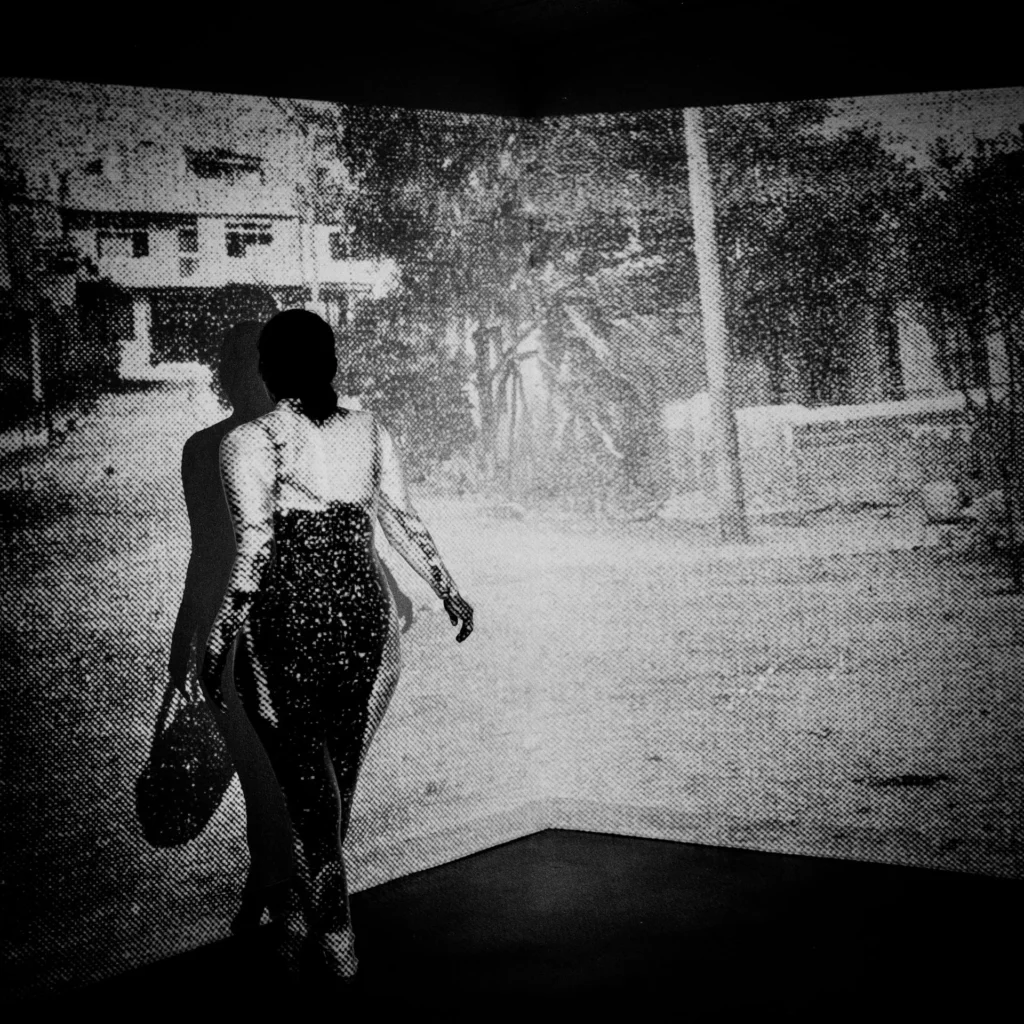
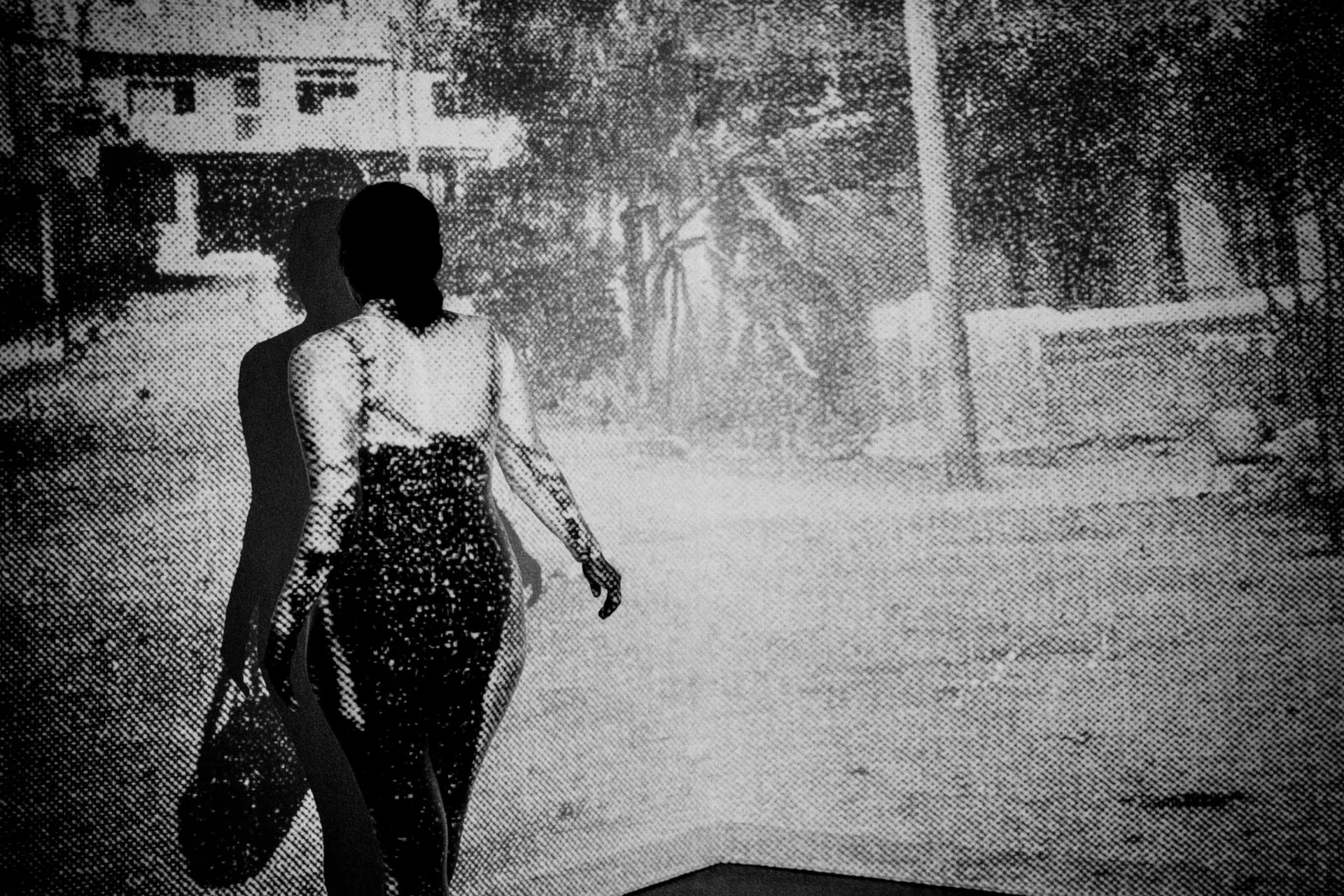
    Krajnak restricts the colour palette to a warm timeless cream and black, putting the spectator in a comfortable mental space of sorts; yet the images and texts that follow soon alter the climate to one of tension and unease. The project is composed by seemingly disjointed sections displaying re-photographed ID photographs of unfamiliar women, images of an envelope with a name and a date on it, the photograph of a baby goat conjoined faces, a dog lying on the ground, the missing photograph of a pyramid, the disturbing sequence of a woman walking away from the audience, and more. Functioning as visual and textual parables, as in Borges, these strategies permeate the project with confusion and uncertainty, referencing the non-linear and difficulty to articulate the story of the artist based on a recollection of inconsistencies and disagreements

    Holding Hands, 2018. Courtesy Tarrah Krajnak.

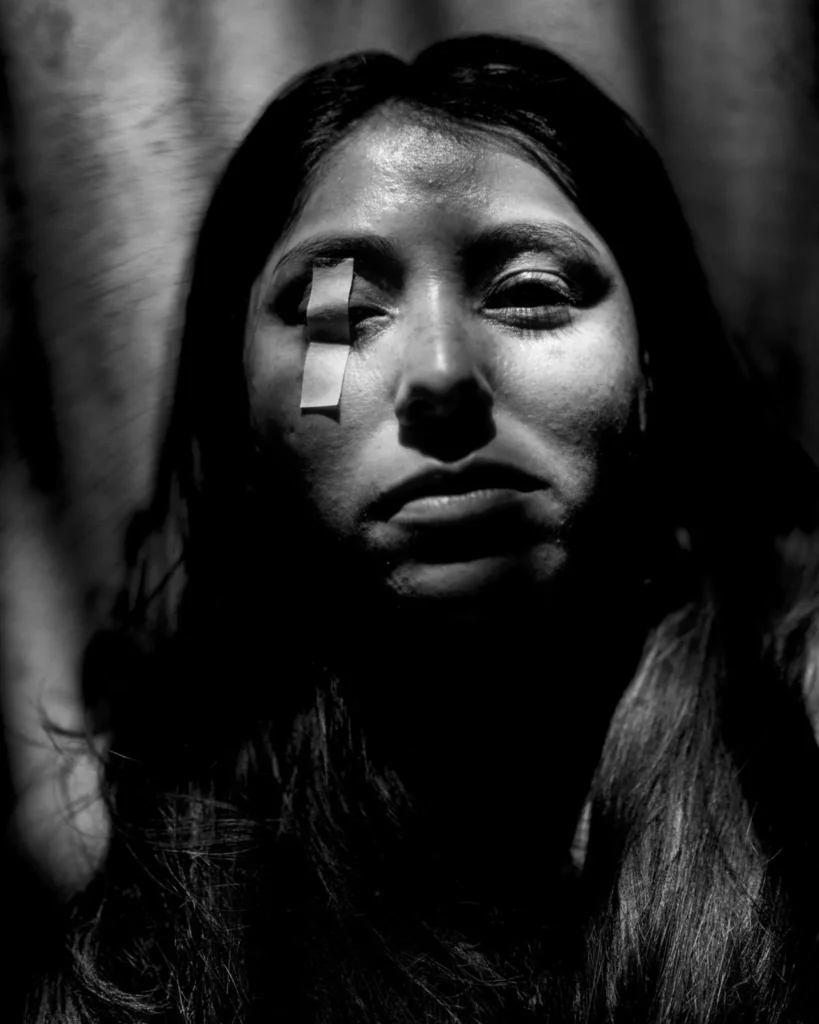
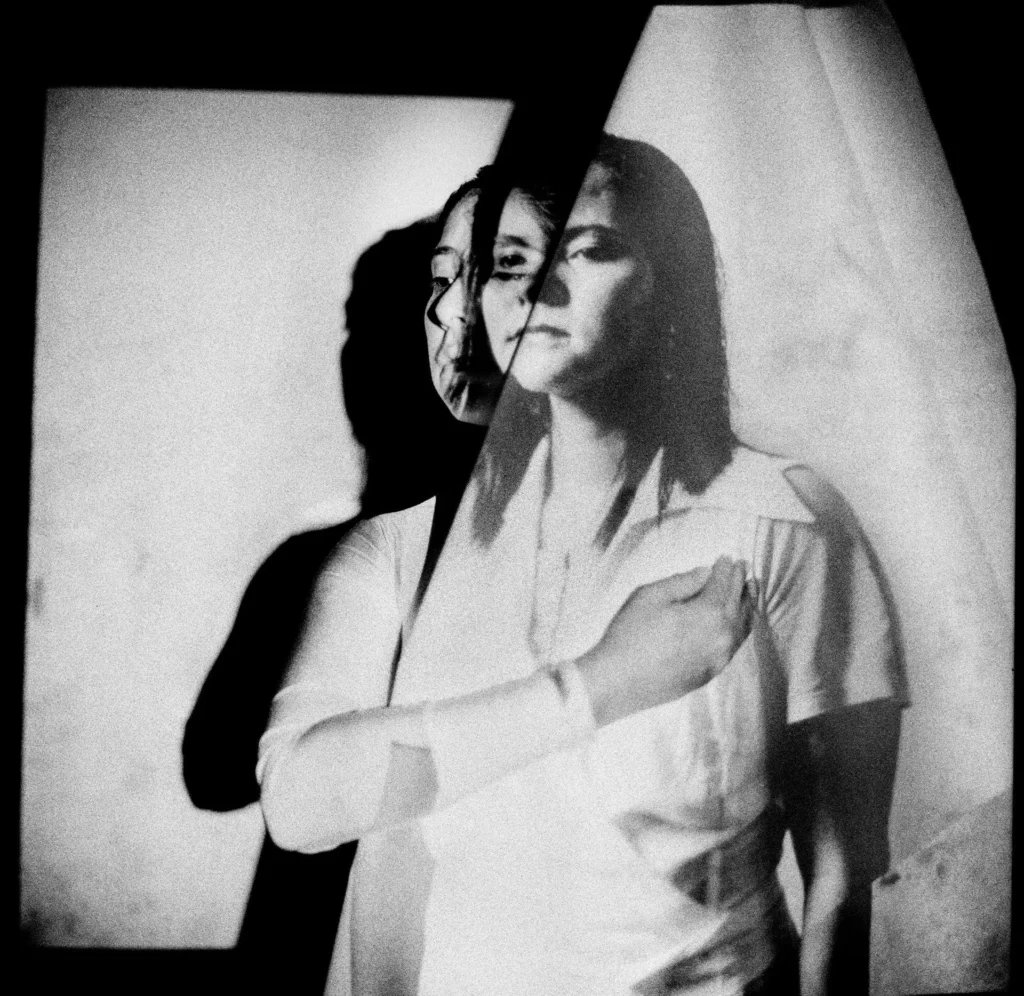
    To begin to imagine her potential history, Krajnak gathers and photographs the stories and memories of other women born in 1979 in the same circumstances than her, and also the stories and photographs she found in the orphanage where she was born. Performativity is a crucial element to her practice; the artist embeds herself in the black and white projected photographs of the women her age re-enacting their stories, and also in the archival images, in a gesture to own these histories and memories. The resulting grainy-analogic-quality photographs, purpose-made or refashioned from old found material, add to the set of disorienting games at stake in this project. These images emphasise the punctum or ability to defeat the time(ness) in them, as per Barthes, and also does the ritualistic process of re-photographing the found photographs and juxtaposing them in the present. Serving as real or fictitious time capsules, they enable the artist to reflect on the traumas of violence and war in Perú that are unaddressed and in particular, that of rape. 

    The final Report of Truth and Reconciliation made in Perú as an evaluation of the armed conflict and published in August 2003, confirmed that uncountable acts of sexual violence against women were committed by the State and also various guerrilla groups for over 20 years. However, sexual violence was considered collateral damage to the many violations of human rights infringed during the conflict. Because of the associations with the victims’ sense of humiliation and shame, these perpetrations generally go undocumented. In her seminal book The Civil Contract of Photography, the scholar Ariella Aïsha Azoulay wonders if anyone has ever seen a photograph of a rape? and in her analysis of World War II, she reveals that in spite of being highly attracted to areas of conflict and violence, photographers clearly choose not to photograph rape, making them accomplice of silencing the trauma. 

    Self Portrait as Woman Walking with Bag (Turned),
    December 1979, Lima, Peru/ Claremont, CA, 2018, 2018. Courtesy Tarrah Krajnak.

    Personal dreams also inform Krajnak’s El Jardin de Senderos que se Bifurca. Ultimately, it is an abstract visual meditation on time and temporalities, the arbitrariness of representation, the versatility of truth in the absence of memories, and the fragility of the existing ones.

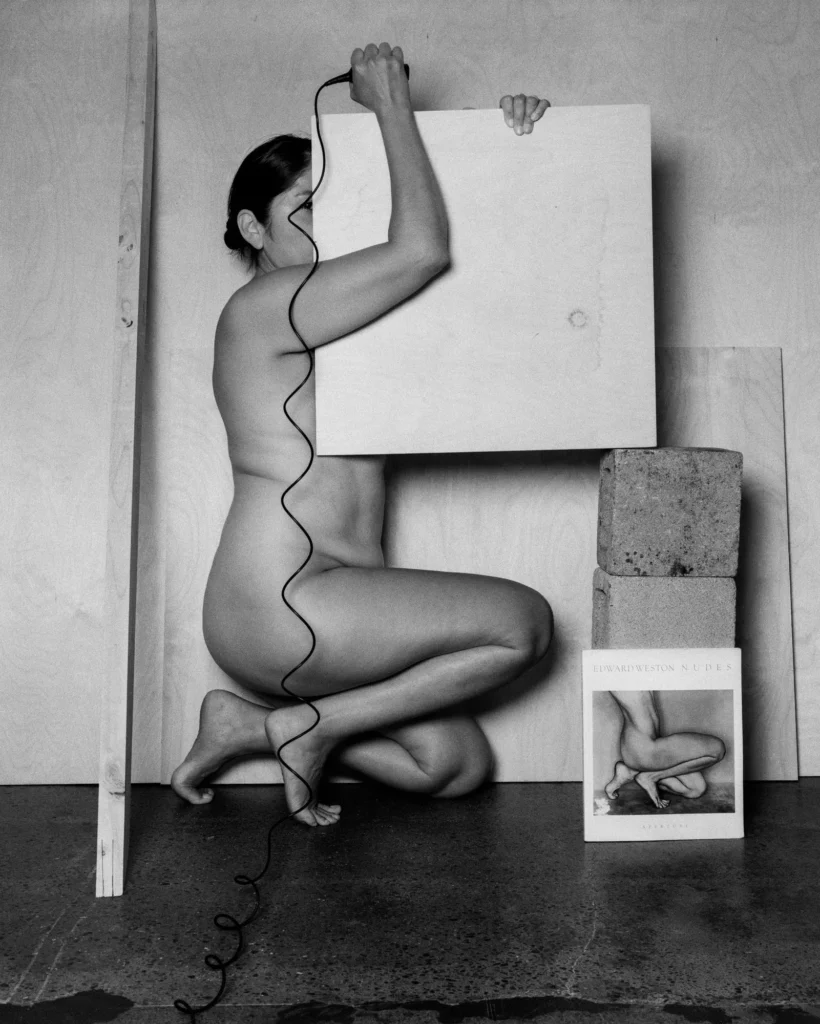
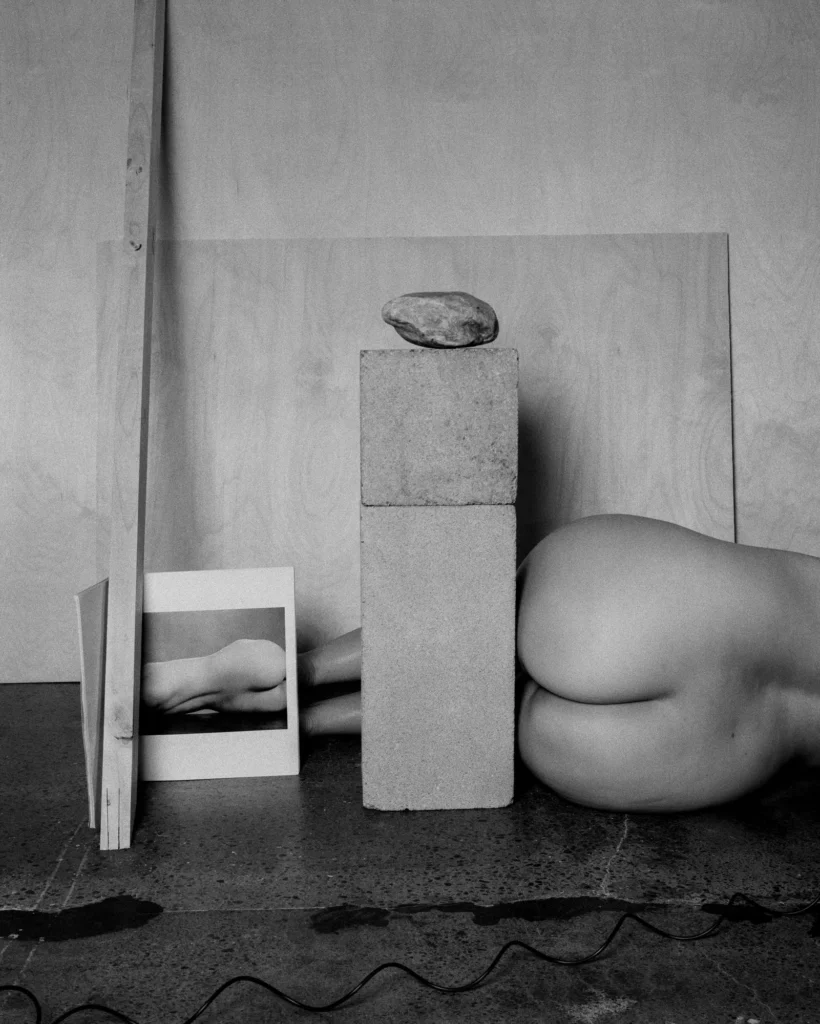
    Tarrah Krajnak works on several projects at the same time and not all of them have such depth and investigative diligence. In her project Master Rituals II: Weston’s Nudes the artists re-enacts Edward Weston’s iconic nude studies. As a brown woman, she makes a playful, yet critical commentary on the canonical white male gaze in photography. Master Rituals II: Weston’s Nudes won the Louis Roederer Discovery Awards at the Rencontre d’Arles 2021. 

    For more information on Tarrah’s work, please visit https://tarrahkrajnak.com/
    Self-Portrait as Weston/as Bertha Wardell, 1927/2020, 2020.
    Courtesy Tarrah Krajnak.
    Self-Portrait as Weston/as Charis Wilson, 1927/2020, 2020.
    Courtesy Tarrah Krajnak.
  • Letting the Archive Speak of the Present

    Letting the Archive Speak of the Present

    (Originally published in Photography+ on 12 April 2021)

    Xaviera Simmons is an interdisciplinary artist who lives and works in New York. Her series Sundown (2018–) and Index (2008–) were exhibited alongside three new video works at Liverpool Cotton Exchange Building as part of the Liverpool Biennial entitled The Stomach and The Port, 20 March until 6 June 2021.

    Index Three, Composition Three from the series Index, 2008–. Courtesy Xaviera Simmons.

    Simmons was exposed to art from an early age and had access to New York’s major museums and art institutions as she grew up. Her work is rooted within the art historical canon, which she combines with socio-political commentary. She has developed a multi-layered visual language that investigates the past to engage with present and future histories – particularly matters related to the legacies of slavery, racial justice, and the inequalities of the system – while simultaneously pushing forward conversations around artmaking in general. She considers art to be a powerful language and urges people ‘to get more courageous in our language if we actually want to change things’. 

    Sundown (Number Eighteen) from the series Sundown, 2018–.Courtesy Xaviera Simmons.
    Index One, Composition Two from the series Index, 2008–.
    Courtesy Xaviera Simmons.

    Simmons has been working on both Sundown and Index for a long time. Although distinct, the series share some common ground. ‘They’re looking at contemporary colour photography and also historical photography, they look at ways that photography can change through sculptural practices,’ she explains. ‘They prompt conversations about archival research, and about building and owning an archival research practice, and about constructing anew from those things in the archive.’ Archival images present, as John Berger argues, ‘a direct testimony about the world which surrounded other people at other times’, but when such images are placed in conversation with contemporary photographs, a multiplicity of discourses come into play. 

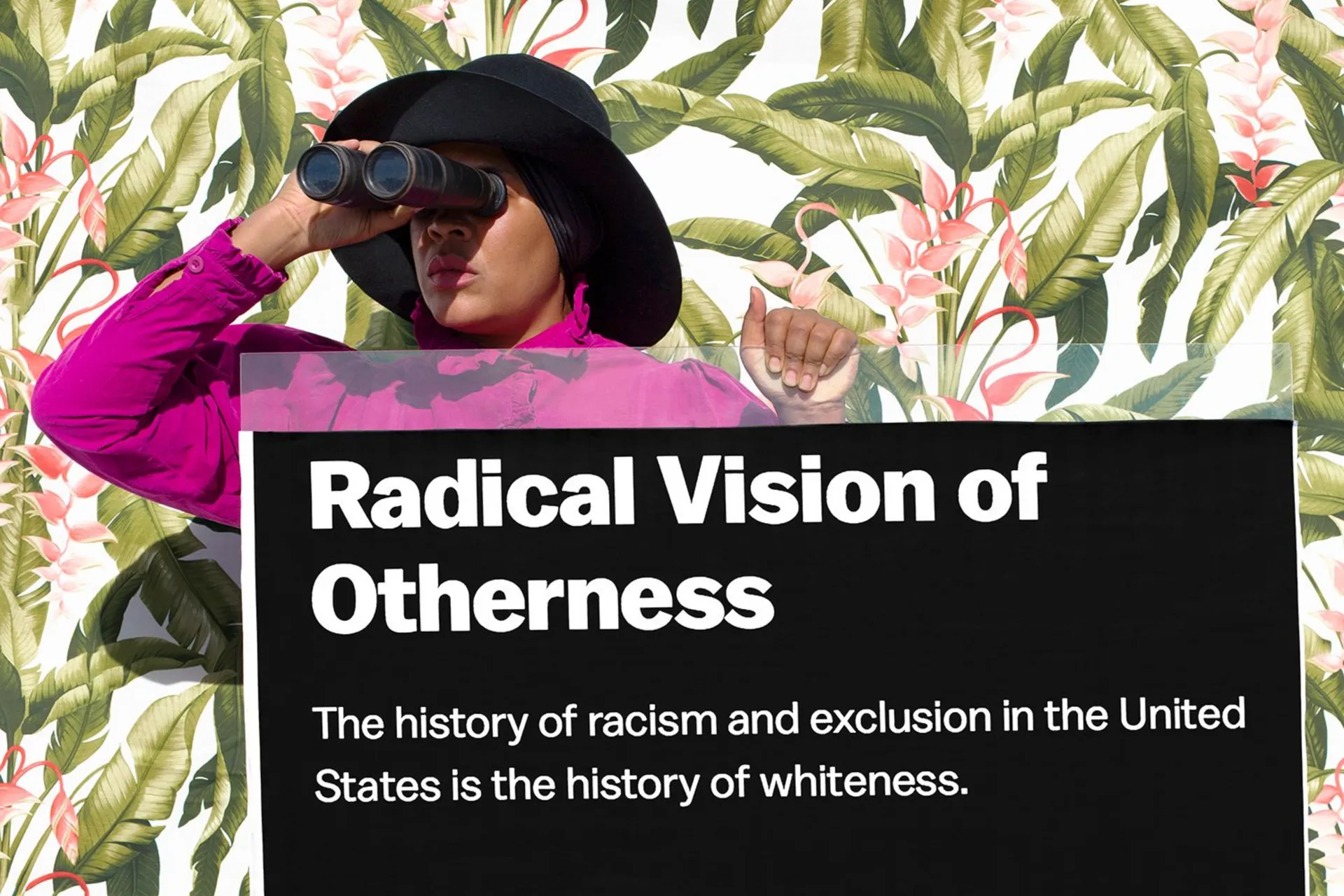
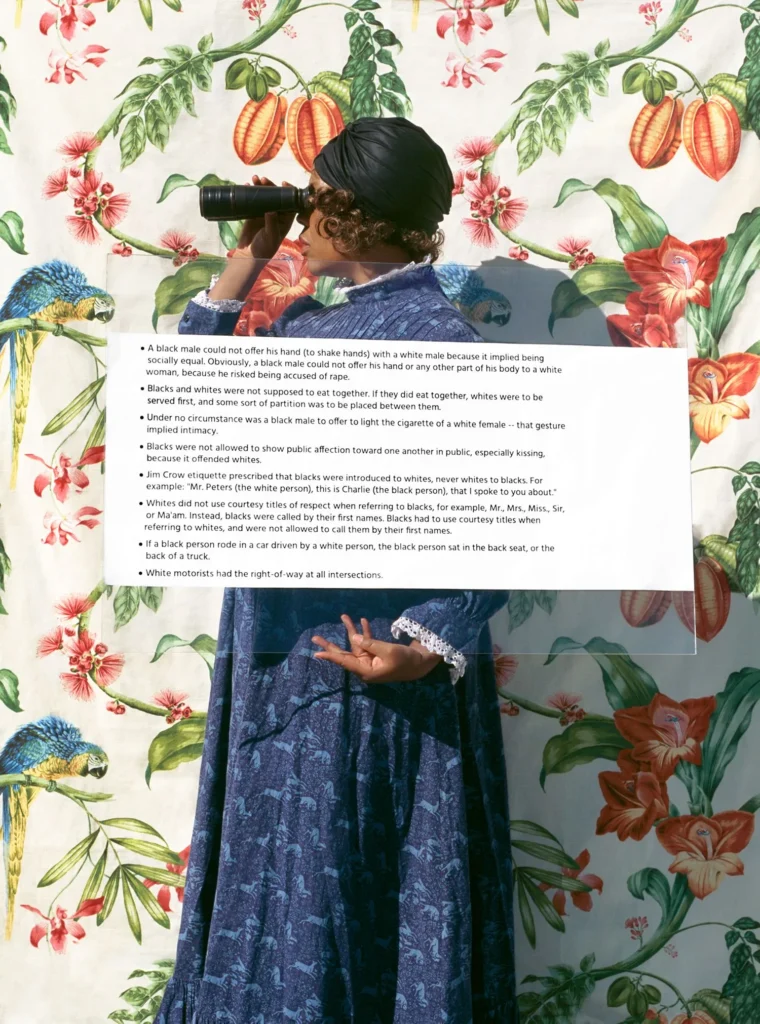
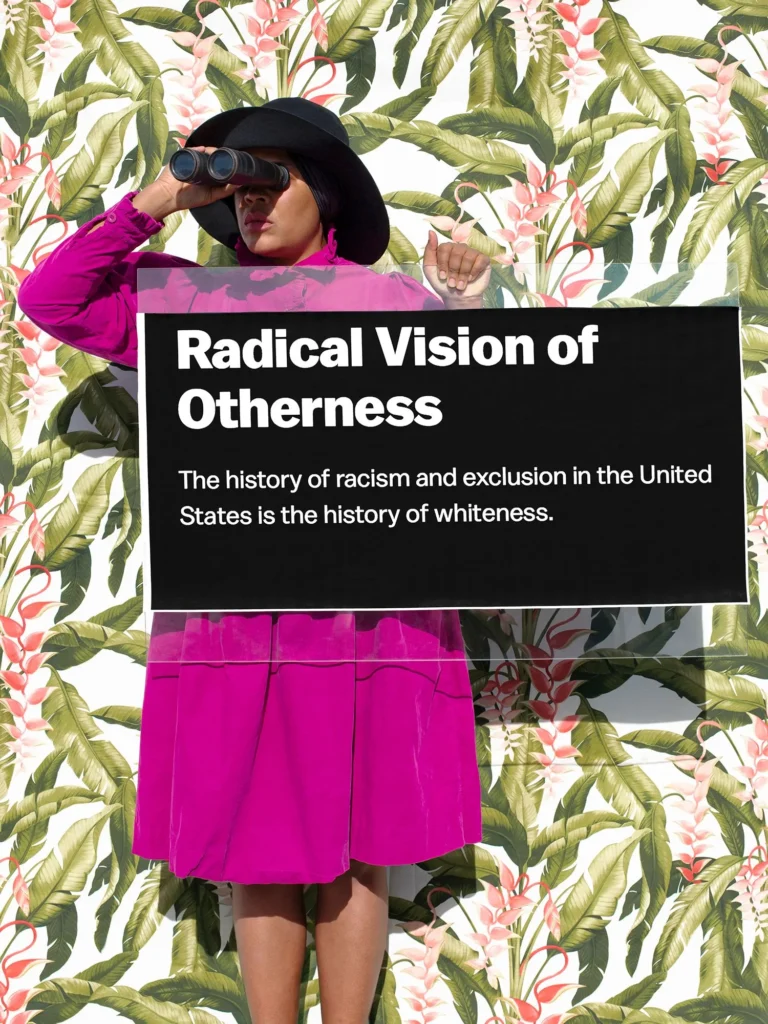
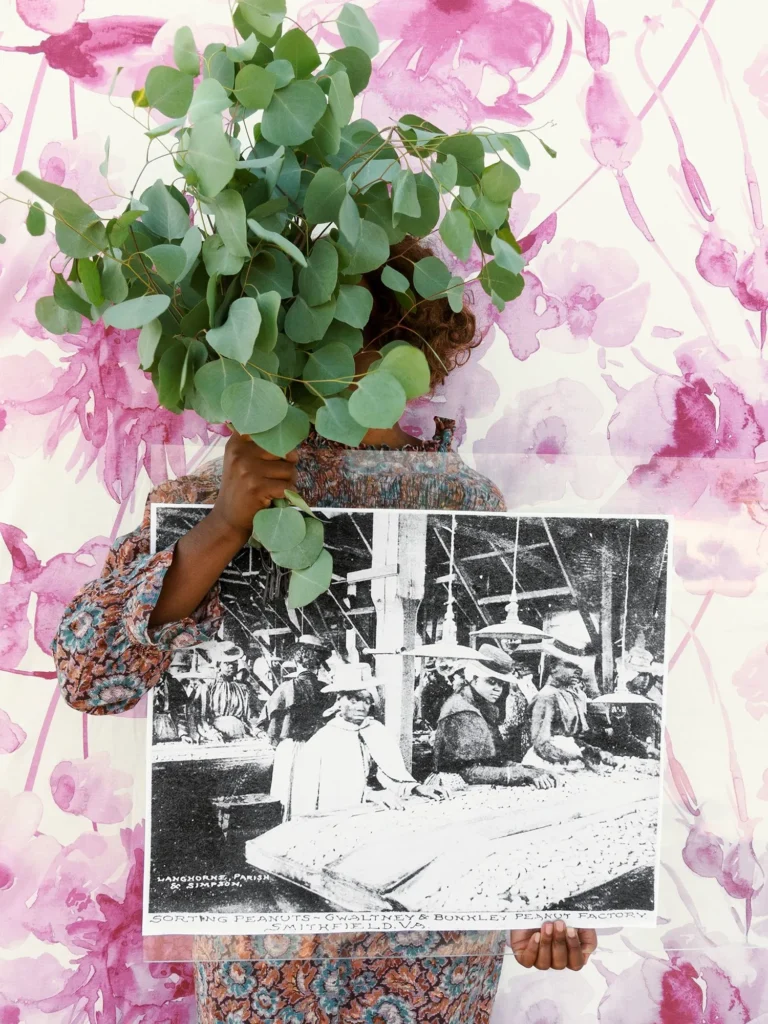
    In the Sundown series, Simmons appears at the centre of each photograph, standing in front of lush botanical backgrounds, some real, some painted. The artist holds archival images showing daily scenes in the lives of Black people in the early twentieth century. Using visual strategies of blending and blurring in Sundown (Number Eleven) and Sundown (Number Fifteen), the artist drives the viewer’s gaze upon the archival images. In the former a queue of migrant workers waits to collect supplies of surplus commodities in Florida, whereas in the latter, Simmons presents a dignified W.E.B. Du Bois seated with his classmates from Fisk University – a juxtaposition that reflects the differing life experiences of Black people in that era. Intriguingly, the dress in Sundown (Number Fifteen) is blurred, leaving one wondering if what is perceived is actually true, indicating the fact that racism was and is suffered despite class. 

    Sundown (Number Sixteen) from the series Sundown, 2018–. Courtesy Xaviera Simmons.

    Simmons avoids eye contact with the audience by turning her back on the spectator or covering her face with African masks or large raffia hats. In a number of images, the artist looks through binoculars. The expansiveness of vision evoked by the instrument is flattened by the two-dimensionality of photography, a contrast that draws attention to the myopic condition of contemporary (white, American) society, which, despite promising boundless opportunities, remains incapable of perceiving a sharp version of the realities of Black people’s lives. With her work, Simmons is ‘trying to understand the levers or the pulleys that need to happen to really activate, particularly white Americans, but also white Europeans, to shift. What will it take for that group to see the requests from the people that they oppress, and what would it take to shift the conditions in which Black people live?’ 

    Index Two, Composition One from the series Index, 2008–. Courtesy Xaviera Simmons.

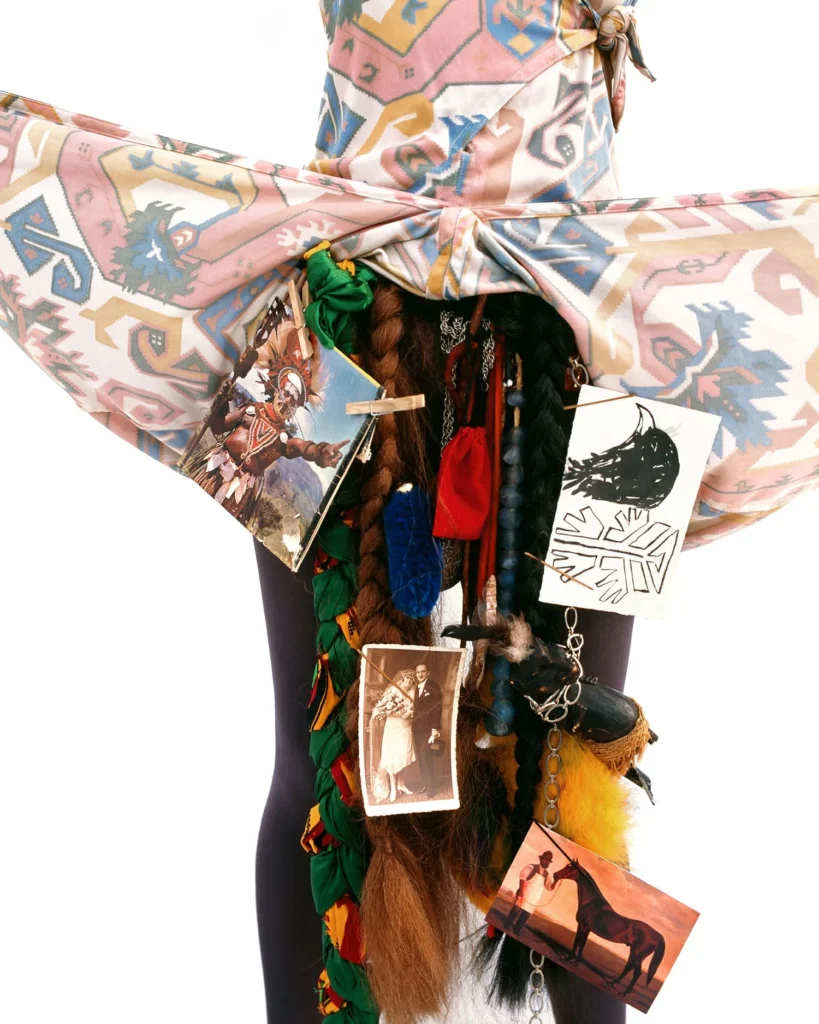
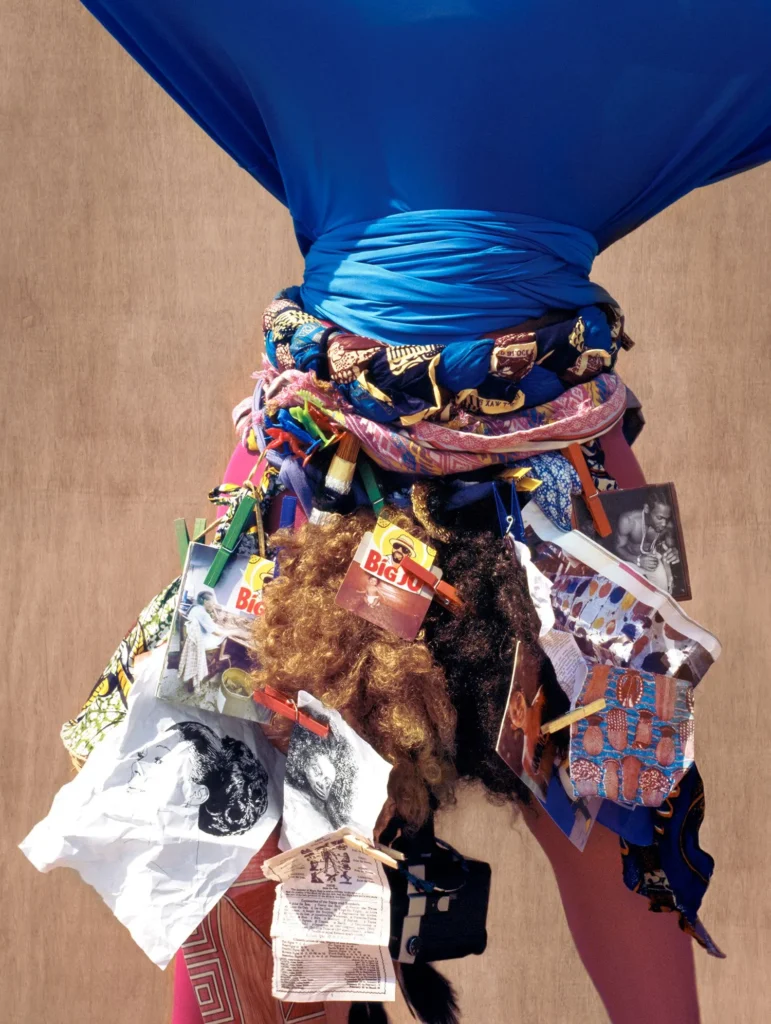
    Singular figures also appear in each of the works in Simmons’s Index series, but instead of holding individual archival images, they hold a ‘whole archival shape’. The figures are constructed by way of assemblage, indicating the artist’s preoccupation with sculpture. Each one presents a collection of artefacts and images hanging from the waist down, whereas the top part of the body is covered by fabrics, thereby concealing the individual’s face, arguably, the utmost signifier of identity. Index presents different subjects as defined by their cultural baggage, reflecting on the multi-faced nature of identity and questioning how identity can be defined – or if it is even possible to do so. 

    Sundown (Number Five) from the series Sundown, 2018–. Courtesy Xaviera Simmons.

    In Index Two, Composition One, the figure carries a variety of disparate objects hanging from a thick braid made up of what looks like African wax fabrics around the subject’s waist: a couple of wigs and hairdo drawings, a page of a book explaining the horoscope, a photograph of a young Black man captured possibly dancing, what looks like an African wax design referencing different hair styles, a photograph of an old Black woman seemingly at work, a picture of a Black baby and cutouts of Big Jo packaging (a Jamaican juice producer), among other items. By revealing the different elements that constitute the self, the artist disputes the essentialising process by which some selves are othered. 

    For Liverpool Biennial, Simmons  continued expanding on these ideas of race, whiteness, archival research practice, and identity in three new video works; one animation, one live-action clip, and one text-based video work. 

  • Queering Boxing, Undoing the ‘Macho’

    Queering Boxing, Undoing the ‘Macho’

    (Originally published in C& América Latina on 16 November 2020)

    Clotilde Jiménez is an Afro-Latino artist born in Honolulu that lives and works in Mexico D.F.

    Through collage, painting and sculpture, he uses his artistic practice to raise questions around race, class, sexuality and gender.

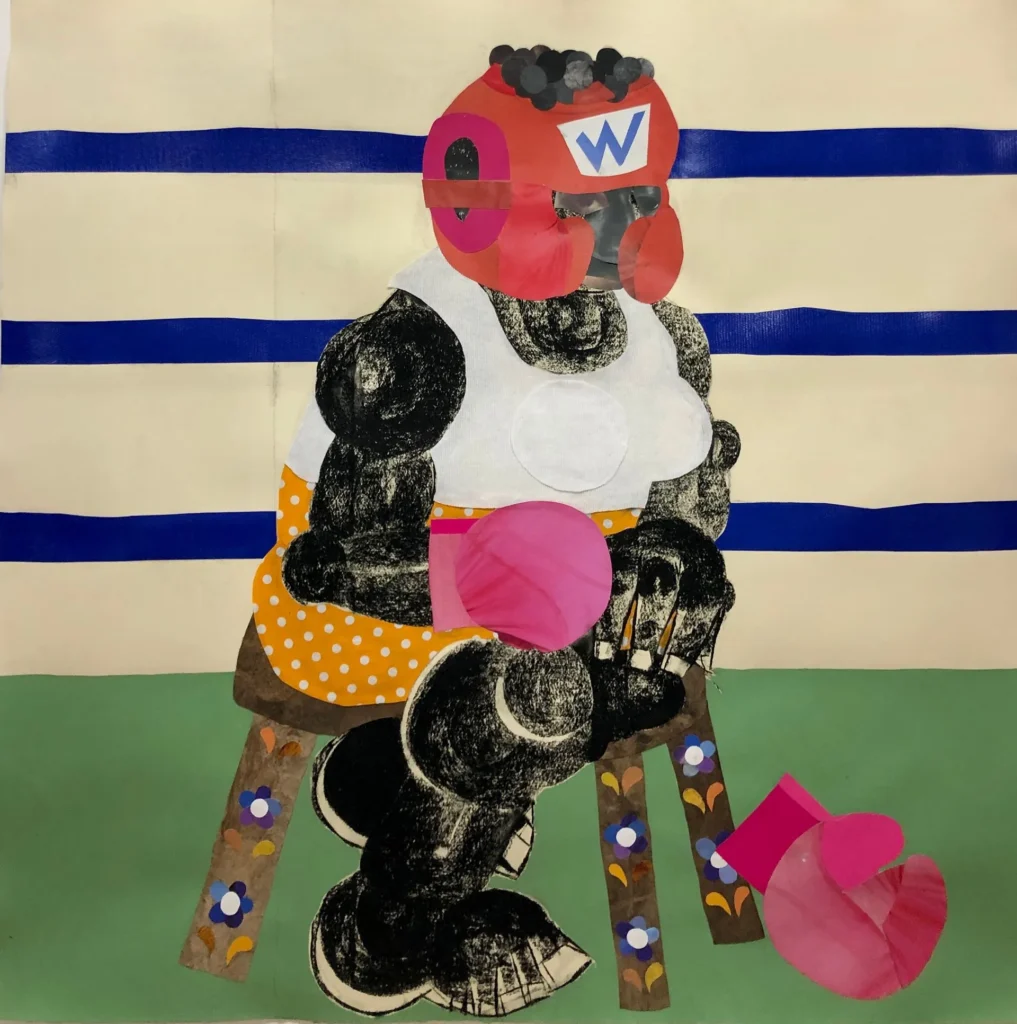
    The Contest, 2019. Courtesy Clotilde Jiménez and Mariane Ibrahim Gallery.

    Clotilde Jiménez was raised by his Puerto Rican mother in an impoverished neighbourhood in the North of Philadelphia, where he was the middle child of three, an older sister and a younger brother. His father, an African American boxer who competed at an amateur level, left the family home when Clotilde was five.

    His upbringing was characterised by the continuous enquiring of his surroundings and, particularly, aspects that defined his day-to-day, such as socio-economical background, skin color, and hair type, but were not reflected on the mainstream media he consumed at the time. Determined to challenge what was expected of him as an African American young boy, Jiménez attended art school where he moulded his art practice for the purpose of continuing his enquiry. ‘My artwork is just a way of asking questions’, Jiménez explains. ‘I’m trying to get closer and closer to some sort of understanding of the world that surrounds me, but I don’t feel I’m getting a lot of answers and I don’t know if I’ll ever get them. It may be more of a collective search, a community effort, where, if enough people are talking about these subjects, then collectively we arrive to that point that I would like to.’

    Eat the Booty Like Groceries, 2018. Courtesy Clotilde Jiménez and Mariane Ibrahim Gallery.

    Informed by his family background, Jiménez’s work attempts to unpick multi-layered and complex issues that have been engrained into humanity’s psyche for centuries, such as the established ideas around race and class that stand as immovable truths to date. Despite the association of the artist’s practice with the current #BlackLivesMatter movement, the artist admits that his work talks to the issues raised by the movement, but not because of it: ‘I’ve been having these conversations and trying to move forward within these issues ever since I started producing art,’ he says, and he hopes for broad audiences and diverse communities to engage with his work because these topics are ‘everyone’s lived experience in some way.’

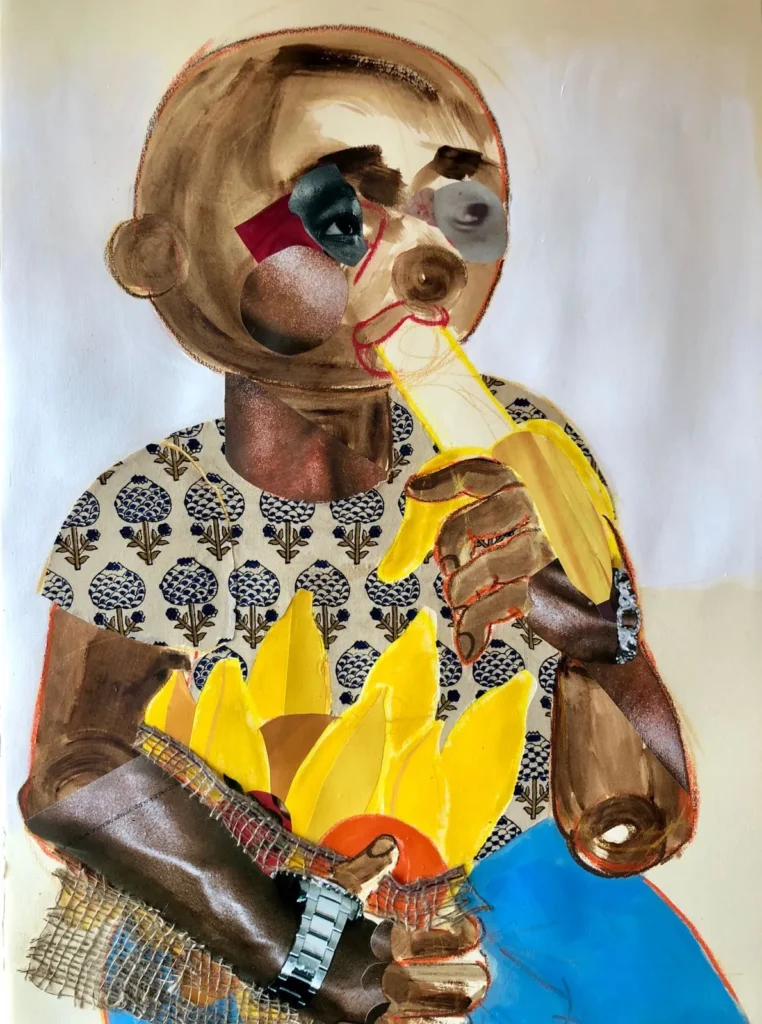
    Image above: How to Eat a Banana, 2018.
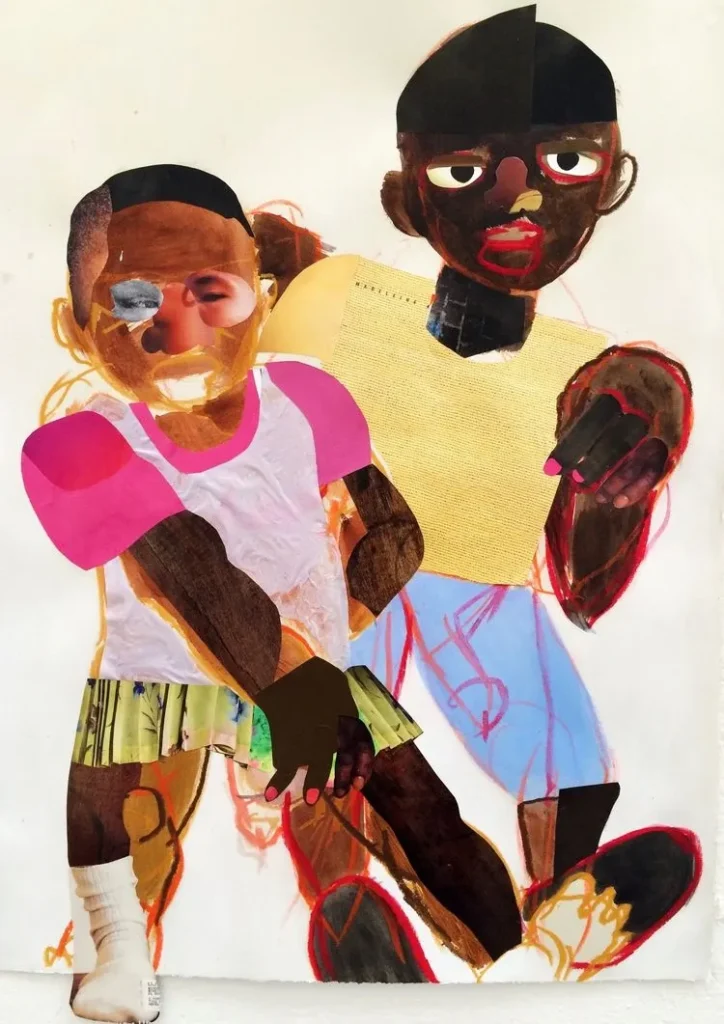
    Right image: N.W.A. (Niggaz Wit Attitude), 2016. Courtesy Clotilde Jiménez and Mariane Ibrahim Gallery.

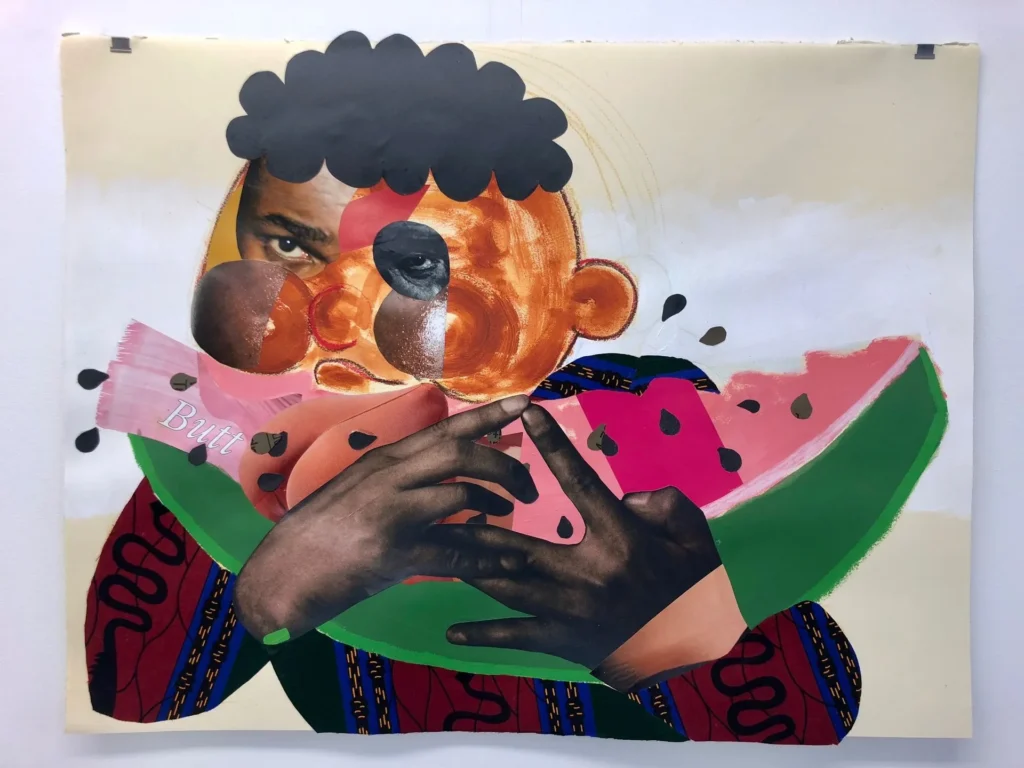
    The colourful cartoon-like aesthetics in Jiménez’s compositions are a reference to the artist’s childhood, particularly his experience attending a Southern Baptist church. The artist admired the way the pastor would simplify the parables to the point that he was able to understand the message. Simplification and making accessible the complex stories and questions that he is asking, so everyone can enter the work and the space with a lot of understanding, have driven the artist’s practice from the beginning. To that end too, the artist incorporates to his work a sensible dose of humor, since, as he maintains, ‘it is easier to talk about certain things if you approach them with a little comical sense but respecting the weight of the subject. It’s about finding the balance.’

    Jiménez is inspired by the artist of the Harlem Renaissance William H. Johnson, who portrayed Black subjects in a relatable way and away from the realistic academic style. In that same spirit of accessibility and reaching broader audiences from outside the art world, Jiménez strives to create a visual language that defies the Western tradition.

    I Had a Dream I Took an L, 2020. Courtesy Clotilde Jiménez and Mariane Ibrahim Gallery.

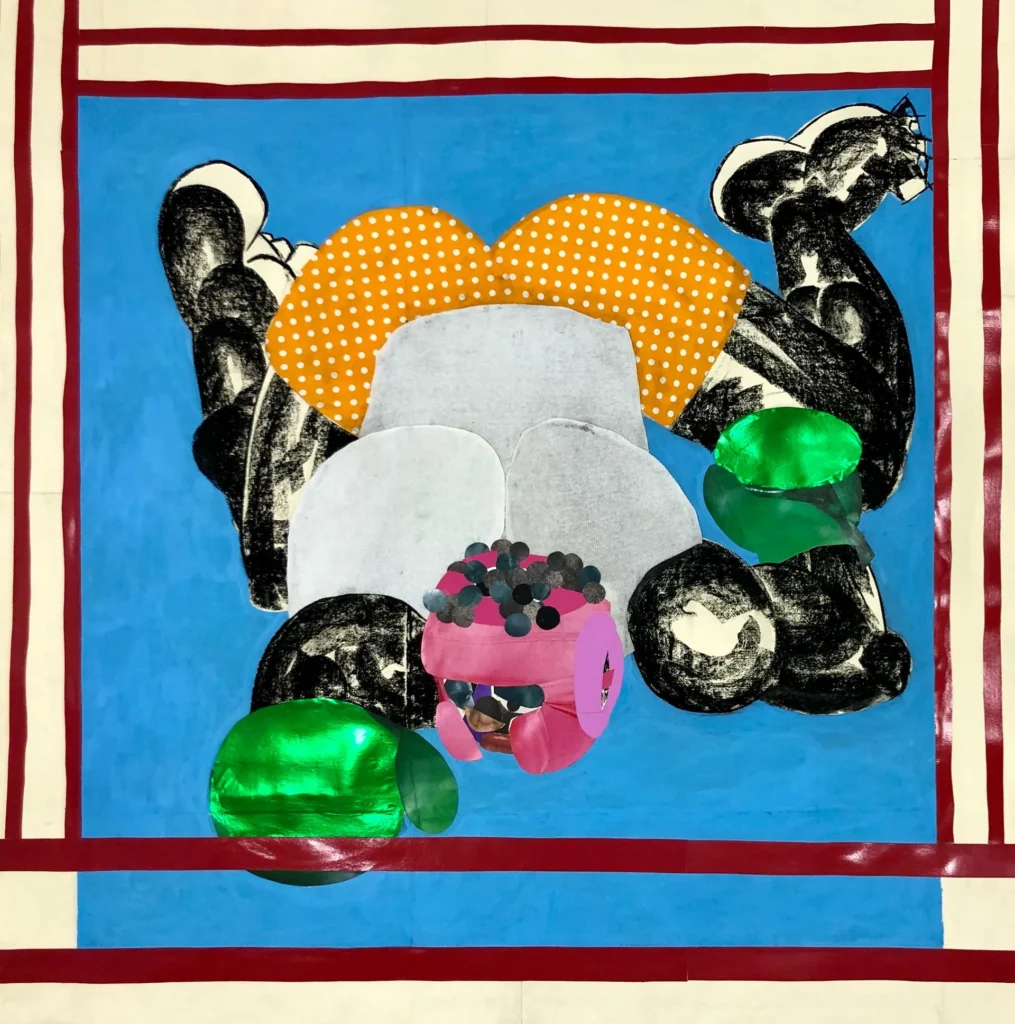
    Even more, the artist is developing a visual language that depicts individuals that look like him in a meaningful way and tells the common shared story of his ancestors and Black life from his own lived experience. The big feet and hands in Jiménez’s work become a symbol, suggesting how little society has changed in terms of understanding race and class. ‘My grandma said that sometimes black people’s hands and feet are larger than life because of the labour and hardship that people have gone through’ – a situation that has morphed but endured to date. Charcoal has increasingly become more prominent in Jiménez’s work as a medium to depict Black bodies, whilst living in a country that has a troubled history in relation to race and that lives with the consequences of it.

    In the past few years, Jiménez has incorporated to his practice the exploration of the notions of gender and sexuality in an attempt to amplify the limiting understanding of these, particularly that of masculinity, and coinciding with the grounding and open acknowledgment of the artist’s own bisexuality. His most recent series, Pose and The Contest – exhibited at Mariane Ibrahim Gallery in Chicago in 2020 – are precisely about the artist’s own intersection between the two, his masculinity and his sexuality. Drawing from his own boxing practice – encouraged by his father at age 13 and within the family for generations – Jiménez describes these two bodies of work as ‘an open letter to my father’, whereby he confesses his truth to his senior in a gesture towards ‘understanding and unpacking my own queer relationship, new relationship, to the physicality of this kind of athleticism.’

    Toy Puncher, 2020. Courtesy Clotilde Jiménez and Mariane Ibrahim Gallery.

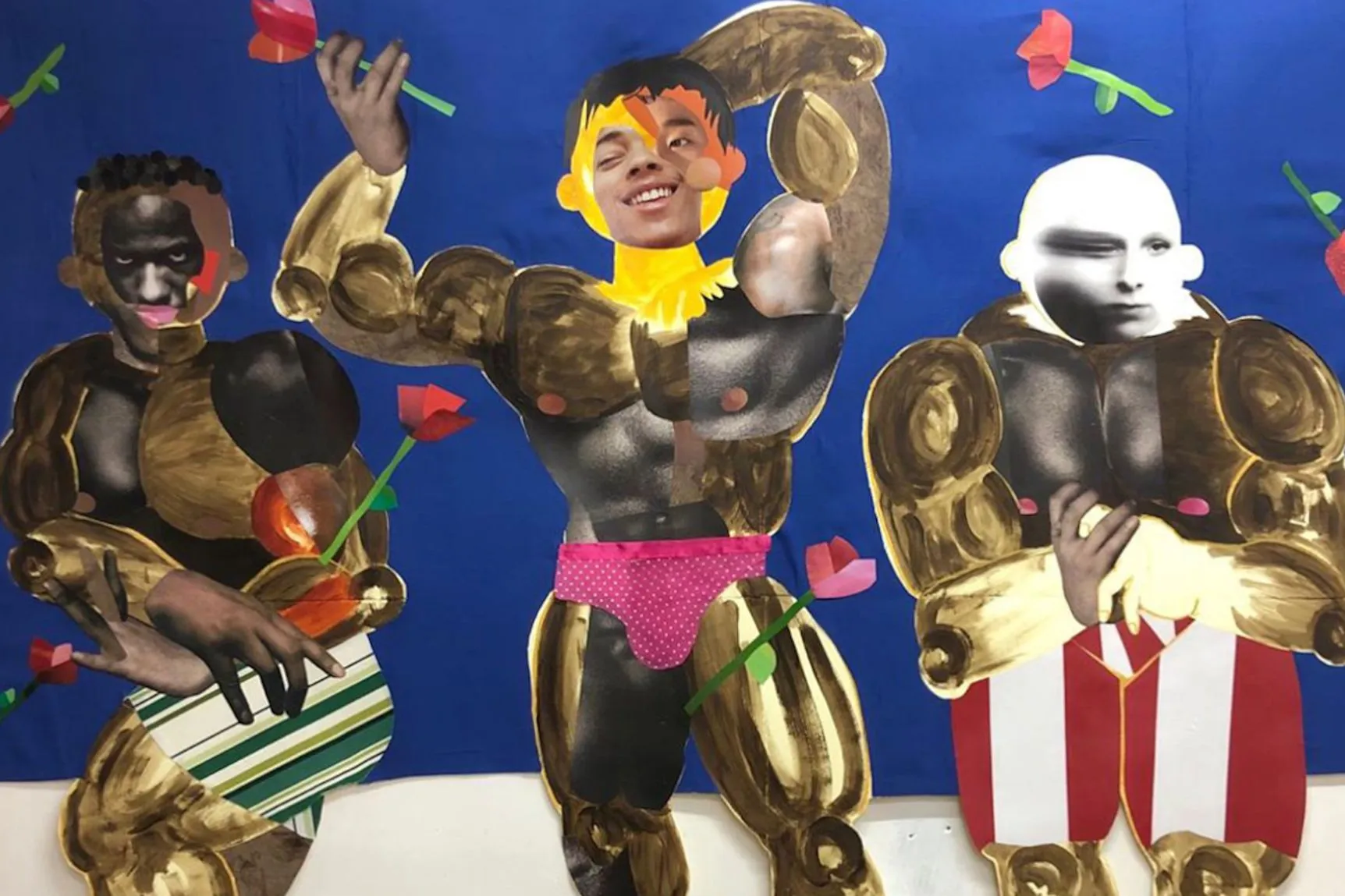
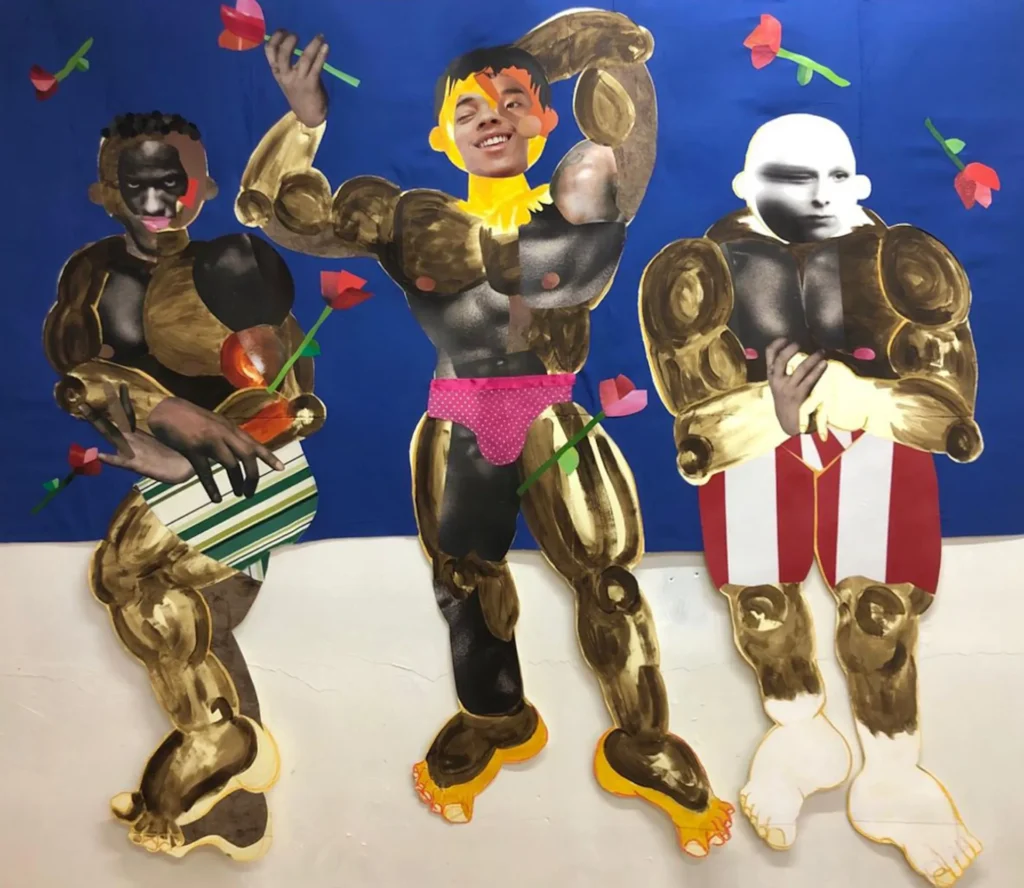
    Super-muscular women and men referencing the figure of Greco-Roman gladiators are portrayed in these series celebrating the athletic nudity and the aesthetic allure of these sporting bodies. Jiménez sensualises the embodied perception of masculinity in body-builders, which remains very much dominated by traditional toxic configurations around the idea of powerful ‘macho’, in favor of an appreciation of the raw beauty of corporeality, independently of gender. ‘There’s something queer about people, and most particularly men, building their bodies, grunting in the gym, rubbing oil on each other, they put the little neon pink thong to get on stage to be stared at by other men,’ says Jiménez. He thus dismantles the limiting principles of what’s expected, opening up the imagination to larger possibilities of performing gender and embodied presence.

    The gym stands as the bear witness of this new array of possibilities for gender performativity and understanding. Jiménez converts it in a sensual and safe temple where performing bodies become objects, subjected to the gaze, desire, and erotic encounter. ‘A place,’ he expains, ‘where one can meditate.’

    For more information on Clotilde’s work, please visit https://www.clotildejimenez.art/
  • ‘We were always here’ and the use of artistic activism as a tool for raising awareness

    ‘We were always here’ and the use of artistic activism as a tool for raising awareness

     (Originally published in C& América Latina on 27 March 2020)

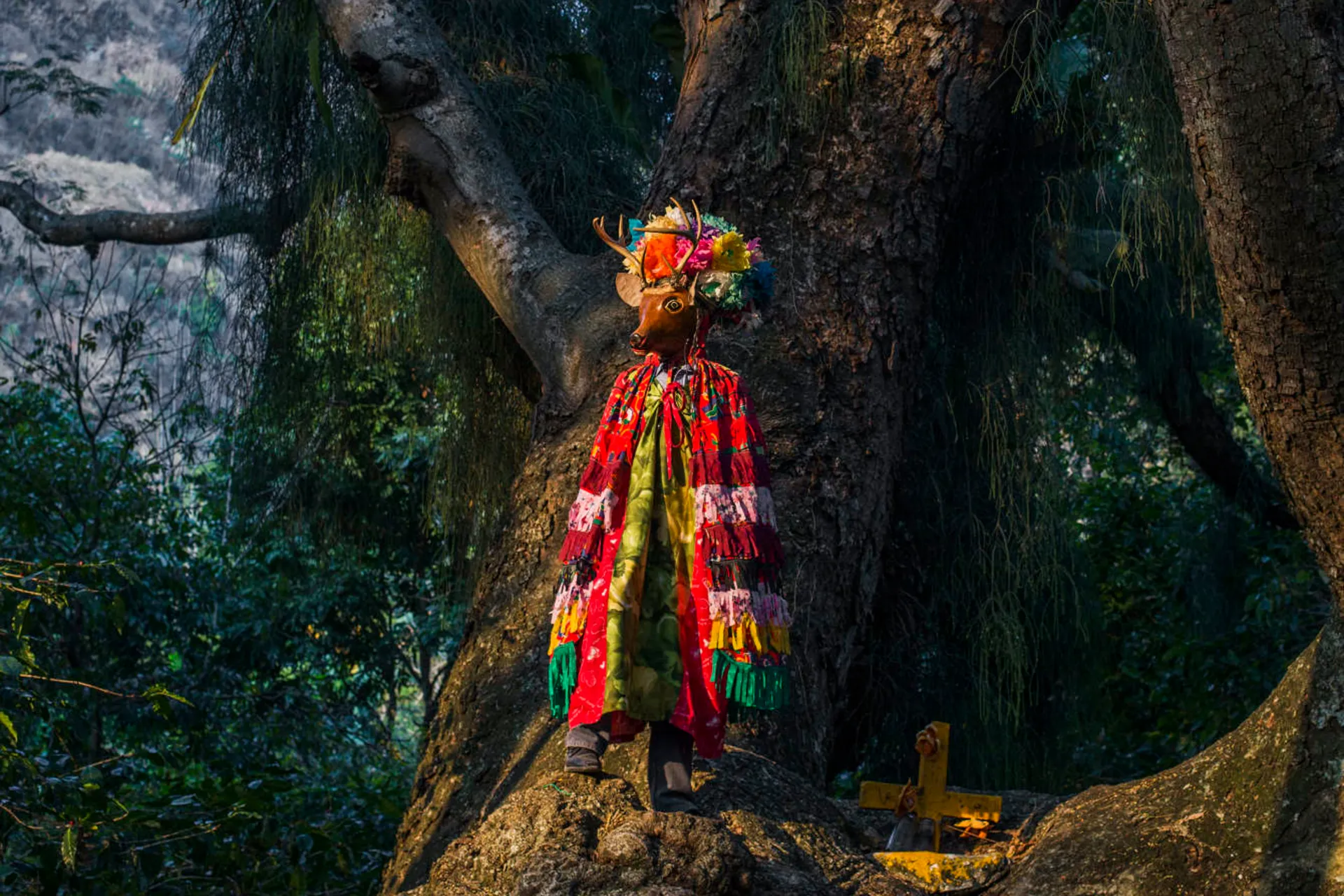
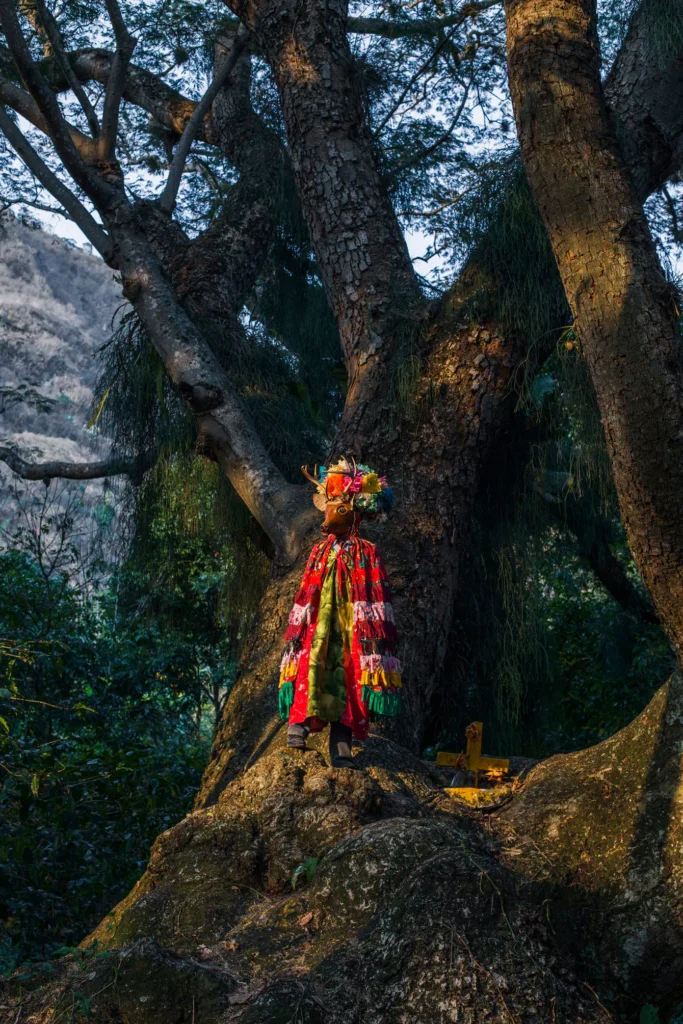
    In her photographs, Mexican artist Koral Carballo, born in Veracruz in 1987, not only explores visual narratives as they relate to identity, violence and territory; she also expands the frontiers of photography towards journalism, visual arts and documentary. Her project We Were Always Here (ongoing since 2017) is dedicated to Afro-descendants in Mexico and aspires to depict everyday life and what persists of Afro-Mexican traditions and identity. To this end, she uses documentary photography, family photos and visual interventions. We spoke with Carballo about her project.

    From We Were Always Here – Prologue ‘ The Mystery of Disguised’. Courtesy Koral Carballo.

    Raquel Villar-Pérez [C&AL]: When and how did We Were Always Here emerge?

    Koral Carballo: Initially, the project developed in a very unconscious way. In 2014 I was working as a photojournalist and one day I decided on impulse to visit Coyolillo, a town in the north of the state of Veracruz, in Mexico. Once I arrived and began to talk to the people in the town, I also began asking questions about myself, getting to know and understand myself and my identity. Five years later, I am starting to realize that the impulse that led me to Coyolillo came from an urge to search for myself. For me, this has meant uncovering Afro-descendancy, something that had always been with me and my family, but was never talked about.

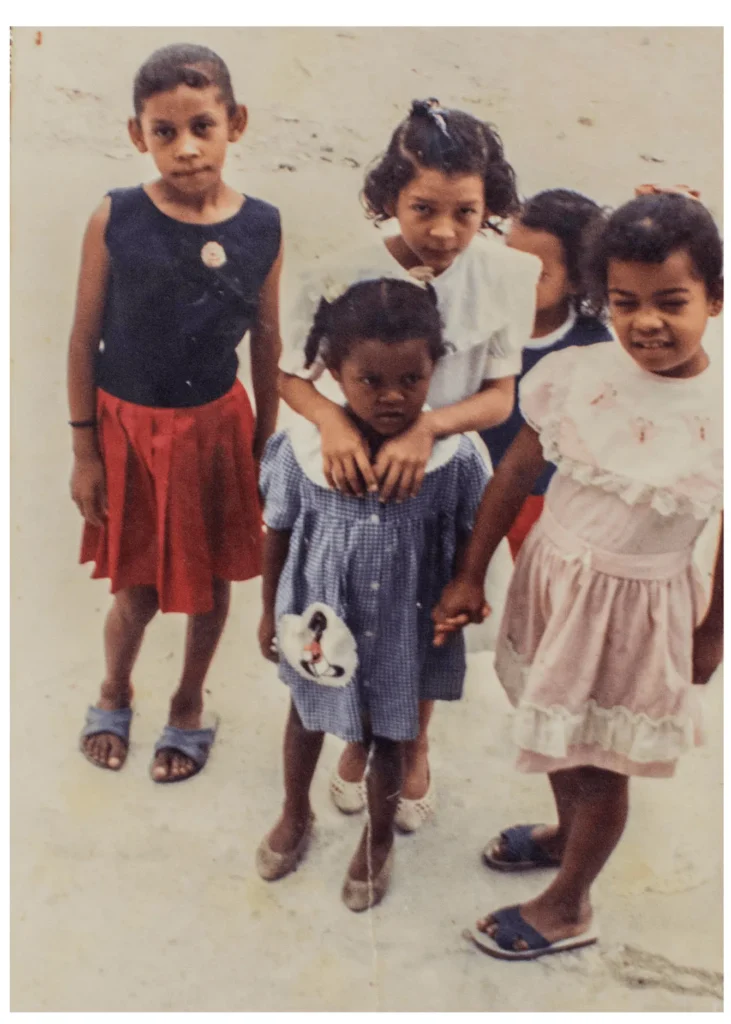
    In Coyolillo I find very familiar references, and, in a sense, myself. I come from a humble family where we didn’t have access to photography and in fact, we don’t even have a family album. So when I take pictures of the people of Coyolillo I feel like I’m photographing all the things I was never able to see. My symbolic family.

    From We Were Always Here – Chapter I ‘Hidden’. Courtesy Koral Carballo.

    RVP: Do you think there is an awareness of the Afro-Mexican past in today’s Mexico?

    KC: I think we are going through an awakening of the Afro-Mexican consciousness, but there is still much to be done before the historical debt of the Mexican State to the Afro population can be repaid. At the moment, the main drivers of this awareness are Afro-Mexican activists, and we are grateful that they are mobilizing this kind of epistemology among ordinary citizens. While academia generated a lot of research on the Afro-descendant population, the knowledge kind of just stayed there. In a way, I want to apply my project within artistic activism, because at the end of the day, it talks about black history and people of African descent should have access to their own history.

    From the series We Were Always Here – Chapter I ‘Hidden’. Courtesy Koral Carballo.

    RVP: The title for the first chapter of your project is Hidden, and it refers to the denial of African roots in Mexican society. How prevalent is that denial today?

    KC: In Mexico we have people who openly identify as Afro-descendants, but there are also those who don’t. There are people with dark skin who will insist, that “No, there are no blacks here!” In the popular vocabulary, the expression “You are black” basically means “you are ugly”. The good thing is that, at least in Coyolillo, young people are promoting an acceptance of Afro-descendants and questioning the traditional canons of beauty.

    This year is going to be historic because a population census will take place, and so, for the first time in over 500 years, people of African descent are going to be registered. On 31 July 2019 there was constitutional recognition, but the census will be crucial for public policies to move forward. That being said, there is still a long way to go before people begin to self-identify and stop denying our African roots.

    RVP: How has your work received by the Mexican art world and is there an interest or concrete plans to create inclusive spaces for Afro and indigenous artists?

    KC: Actually, last year was the first time my work was exhibited in my country.

    For the presentation I chose the Zócalo [main square] of Puebla, a town with a large population of Afro-descendants. Because it was presented in a public space, the work challenged a lot of people; it was a very interesting experience.

    From We Were Always Here – Chapter III ‘The Afromexican Path’. Courtesy Koral Carballo.

    RVP: What are your plans for the future?

    KC: First of all, to finish the project We Were Always Here; two chapters are still unfinished. The third chapter, where I want to analyze the Afro-descendant route from a historical reinterpretation, and the fourth chapter, which deals with the Afro-Mexican struggle and activism. A while back, I met Sergio Peñalosa, one of the pioneers of the Afro-descendant struggle in Costa Chica, in the state of Guerrero. He told me that we are witnessing a generational shift, and I realized that in Coyolillo I have young friends who are now taking the reins of the Afro struggle. I find their courage incredible and very inspiring and that’s why I want to include them in the project.

    At the same time, I am preparing a street intervention in Coyolillo. I take portraits of Afro-Mexicans, but I also engage with them and we talk about what they are interested in, how they would like to see themselves, and so forth. For the creation of the exhibition proposal, I am working closely with them, because I want them to feel represented and loved. During the exhibition I want to create a happening which will become the fifth chapter of We Were Always Here. It is an open and dynamic project. It has become a standing joke when I say that “I arrived in Coyolillo in 2014 and I haven’t been able to leave.”

    For more information on Koral’s work, please visit www.koralcarballo.com